
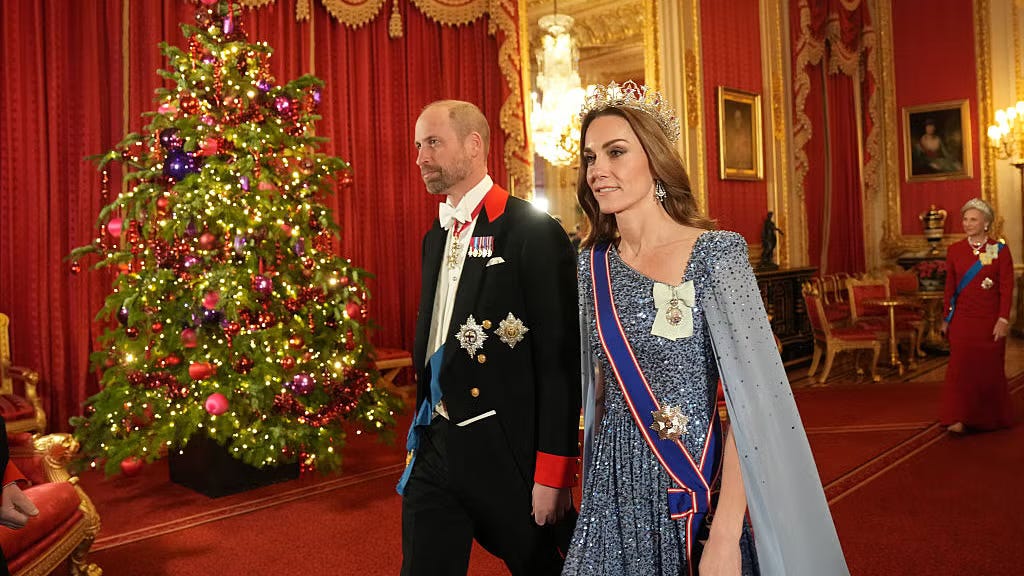
You’ll never be able to see Christmas the same after this.
Not in a bad way—more in the way that knowing how a magic trick works makes it more interesting.
You see, our modern Christmas - the tree, the gifts, Santa, the whole production - none of it is ancient.
In fact, it’s barely 170 years old.
And most of it traces back to one family running what might be the most successful PR campaign in human history.
The Windsors and their Victorian circle took scattered customs—German trees, English feasts, American gift-bringers—and through royal endorsement, media innovation, and commercial genius, created the global Christmas we know today.
This is the story of how that happened.
The Photo That Changed Everything
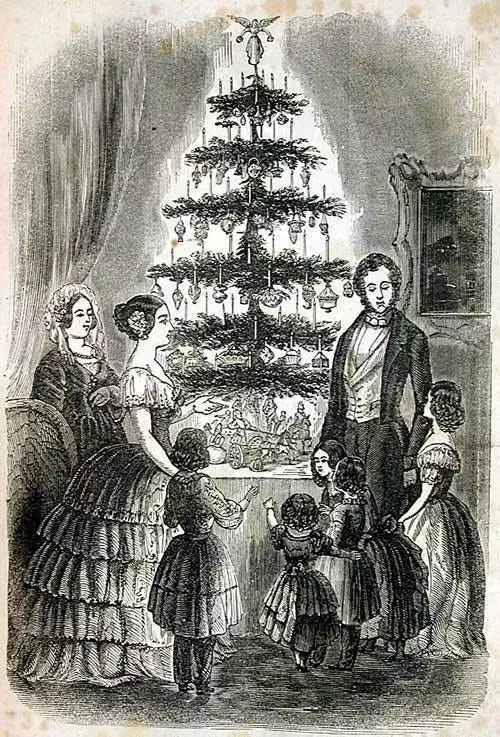
In December 1848, The Illustrated London News ran a full-page engraving of Queen Victoria and Prince Albert gathered around their Christmas tree at Windsor Castle.
Victoria in an elaborate gown, Albert with his distinctive mustache, their children gazing upward at the candlelit branches… and the whole scene calculated to project warmth, prosperity, and family devotion.
The magazine had 57,000 weekly subscribers—massive reach for the era. And the response was immediate.
IWithin a decade, Christmas trees went from exclusive palace tradition to standard feature in middle-class British homes.
But here’s the part that gets overlooked.
Two years later, Godey’s Lady’s Book—America’s premier women’s magazine with 150,000 subscribers—republished the same image with crucial modifications.
The editors removed Victoria’s crown, shaved off Albert’s Germanic mustache, and subtly altered their features to appear less foreign, less royal, more... American.
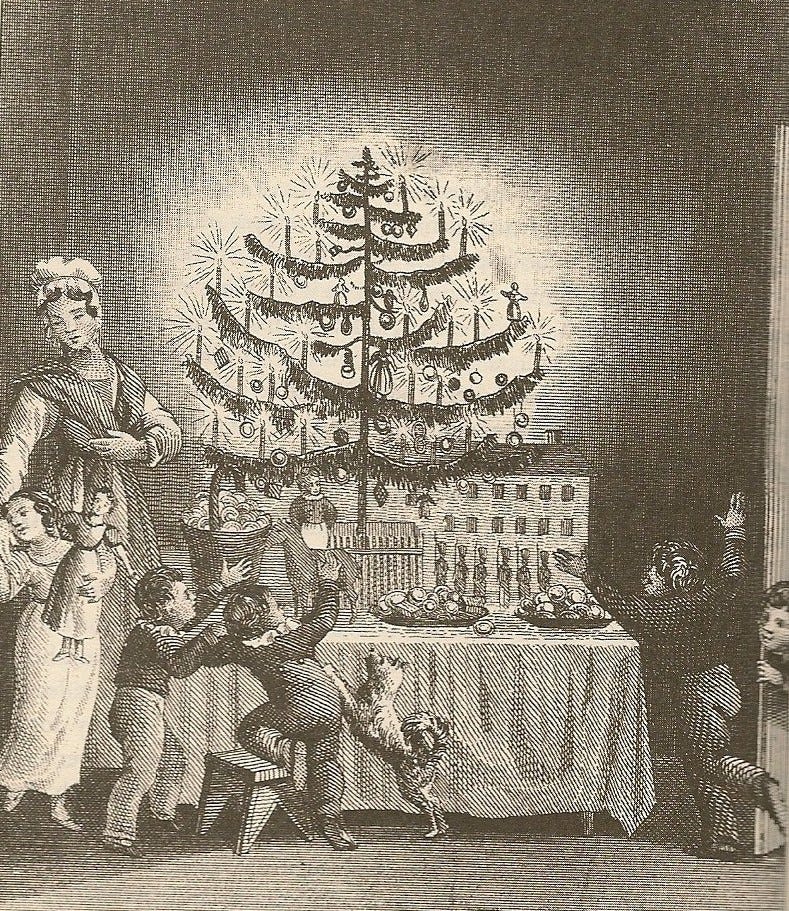
By presenting the Christmas tree as aspirational American tradition rather than foreign royal custom, they transformed cultural adoption into something closer to patriotic duty.
German immigrants had actually brought Christmas trees to America decades earlier. But those remained ethnic curiosities—markers of German difference rather than American identity. The Godey’s republication changed the framing overnight.
The Writer Who Made Christmas Mandatory
Now, while the royals were decorating their trees, a London writer was creating something equally transformative: the emotional blueprint for how Christmas should feel.
Charles Dickens began 1843 furious about child labor. He’d read Parliament’s February report exposing factory horrors—children mangled by machinery, suffocating in mines, worked to exhaustion.
His plan was to write a thundering political pamphlet titled “An Appeal to the People of England, on behalf of the Poor Man’s Child.”
But after speaking at a Manchester fundraiser in October, Dickens realized pamphlets only reached educated elites. A Christmas story could touch every heart in Britain.
He wrote A Christmas Carol in six weeks, pouring all that political rage into the transformation of Ebenezer Scrooge.
Scrooge embodied everything Dickens despised about industrial Britain: supporting workhouses where the poor suffered, dismissing charity as weakness, viewing employees as expenses rather than humans.
The genius was making poverty personal through the Cratchit family, particularly Tiny Tim—whose survival depended on Scrooge’s willingness to change.
When reformed Scrooge purchases “the prize turkey” for the Cratchits, he doesn’t simply feed them - he acknowledges their dignity.
Turkey had graced English Christmas tables since Henry VIII’s time, but remained expensive, beyond working-class reach. Thus, the gift carries moral weight.
Consequently, the story did something unprecedented: it made Christmas a moral obligation rather than just a religious observance or social custom.
Within months, theatrical adaptations toured Britain and America.
The 1844 child labor reforms passed shortly after publication, with reformers citing the story’s influence.
Dickens wrote a weapon. He disguised it as a heartwarming tale. And it worked.
Santa Claus Started as Civil War Propaganda
The figure sliding down chimneys worldwide each December emerged from an unlikely merger of two completely different mythologies.
Britain’s Father Christmas had existed since the fifteenth century—green-robed, holly-crowned, presiding over feasts and theatrical entertainments. But this Father Christmas brought no gifts to children. He embodied the season’s adult pleasures: drinking, eating, midwinter revelry.
Across the Atlantic, Dutch settlers in New Amsterdam had maintained their Sinterklaas traditions, but these remained confined to New York’s Dutch communities through the eighteenth century.
The visual Santa we recognize today came from Thomas Nast, a Bavarian immigrant and Harper’s Weekly cartoonist.
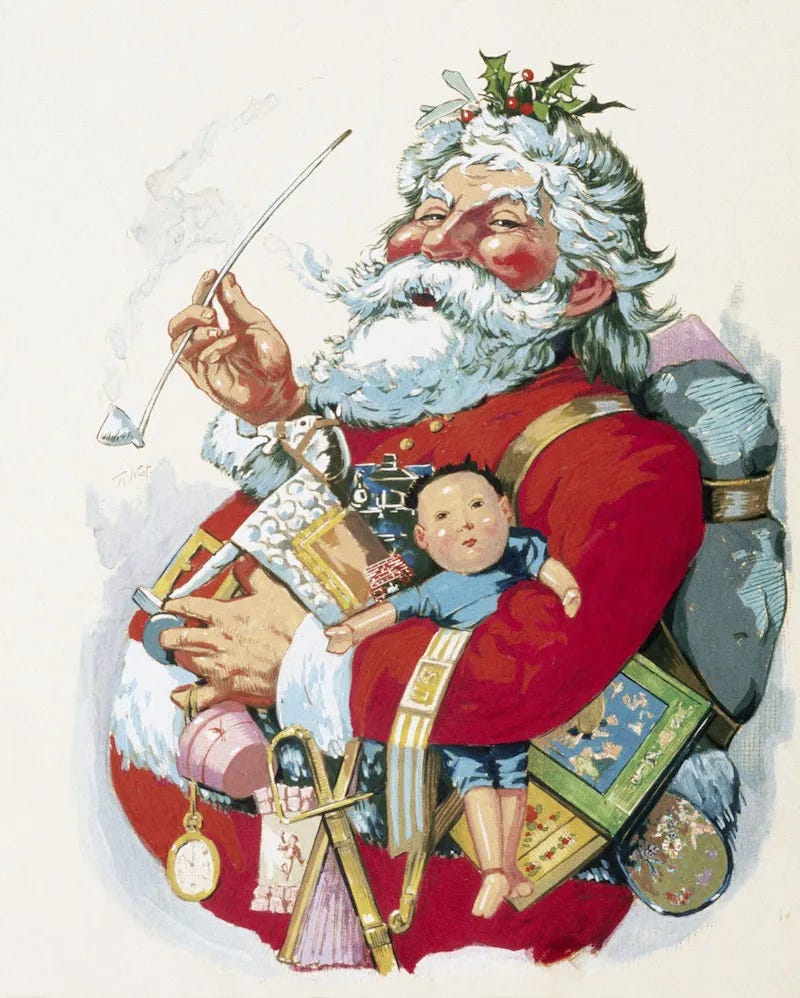
Nast’s first Santa illustration appeared in January 1863—showing Santa visiting Union soldiers, dressed in stars and stripes, holding a puppet of Jefferson Davis with a noose around its neck.
This was propaganda genius: Santa himself supported the Union cause, transforming gift-giving into patriotic act.
Over the next twenty-three years, Nast drew thirty-three more Santa illustrations. He added the North Pole workshop, the toy-making elves, Mrs. Claus, the red suit trimmed with white fur. The whole mythology emerged from one cartoonist’s imagination, refined across two decades.
Meanwhile, Britain’s traditional Father Christmas was becoming problematic for Victorian sensibilities—too associated with adult drinking and revelry.
The solution arrived through transatlantic cultural exchange as British publications began featuring American Santa imagery.
Gradually, Father Christmas absorbed Santa’s attributes: the sleigh, the reindeer, the chimney descent, the toy delivery. By 1920, when J.R.R. Tolkien wrote his children about Father Christmas living at the North Pole with elves, the merger was complete.
Santa Claus is literally Union propaganda that became so beloved everyone forgot the politics entirely.
The Commercial Machine
The final piece of the Victorian Christmas revolution came through commercial innovations that made traditions portable and profitable.
Christmas crackers: Tom Smith, a London confectioner, discovered French bonbons on an 1840s trip to Paris—sugared almonds wrapped in tissue with love mottos. He imported them to London, noticed massive sales spikes at Christmas, and wanted something uniquely spectacular for the British market.
Legend credits his inspiration to watching his fireplace: what if the bonbon could “crack” like logs in the fire when opened? After years of experiments with silver fulminate, he patented his “popping cracker” in 1847.
By the 1890s, his company employed two thousand workers. Royal endorsement arrived in 1906 with a warrant from the Prince of Wales. Christmas crackers spread throughout the British Empire—Canada, Australia, South Africa—becoming synonymous with Commonwealth Christmas dinners.
Advent calendars: German Lutheran families had marked December days privately for decades. Gerhard Lang, a Munich printer, created the first commercial version in 1903. In 1920, he added little doors opening to reveal pictures, making the calendar interactive. When Cadbury launched the first chocolate Advent calendar in 1971, the commercialization was complete—from Lutheran devotion to global consumer product in under seventy years.
Department store Santas: The first retail Christmas Grotto opened at JR Roberts store in Stratford, London, December 1888. Every mall Santa since follows this template.
Indeed, it’s still wild to see how fast this all moved: by 1880, Britain produced 11.5 million Christmas cards annually—from virtually none forty years earlier.
What This Actually Means
The point here isn’t that Christmas is fake or hollow… it’s fascinating is the mechanics of how it happened.
The Windsors wanted to appear relatable and domestic. Dickens wanted labor reform. Nast wanted Union victory. Department stores wanted foot traffic.
Different motives, converging on the same cultural moment—and producing rituals that shaped how billions of strangers would spend some of their most cherished moments with family.
That’s worth sitting with for a moment.
The Windsors pulled off one of the most successful cultural campaigns in history. And every December, the whole world still participates.
Wow! Very insightful, I previously had no idea of any of this. I was particularly struck by the connection to the US Civil War.
A fun but glossed over versions of history. Many more traditions co-opted, Druids burning solstice trees, Amanita mushroom trips with flying reindeer and suits of red/white matching the mushrooms. Krampusnacht, Hershey’s, coke a cola, and Disney’s role in commercialization. Not even to mention the churches role in all this. Correct me if I’m wrong but I believe if you dig into the gospels Jesus was born in the spring.🤷♂️😬🫣