
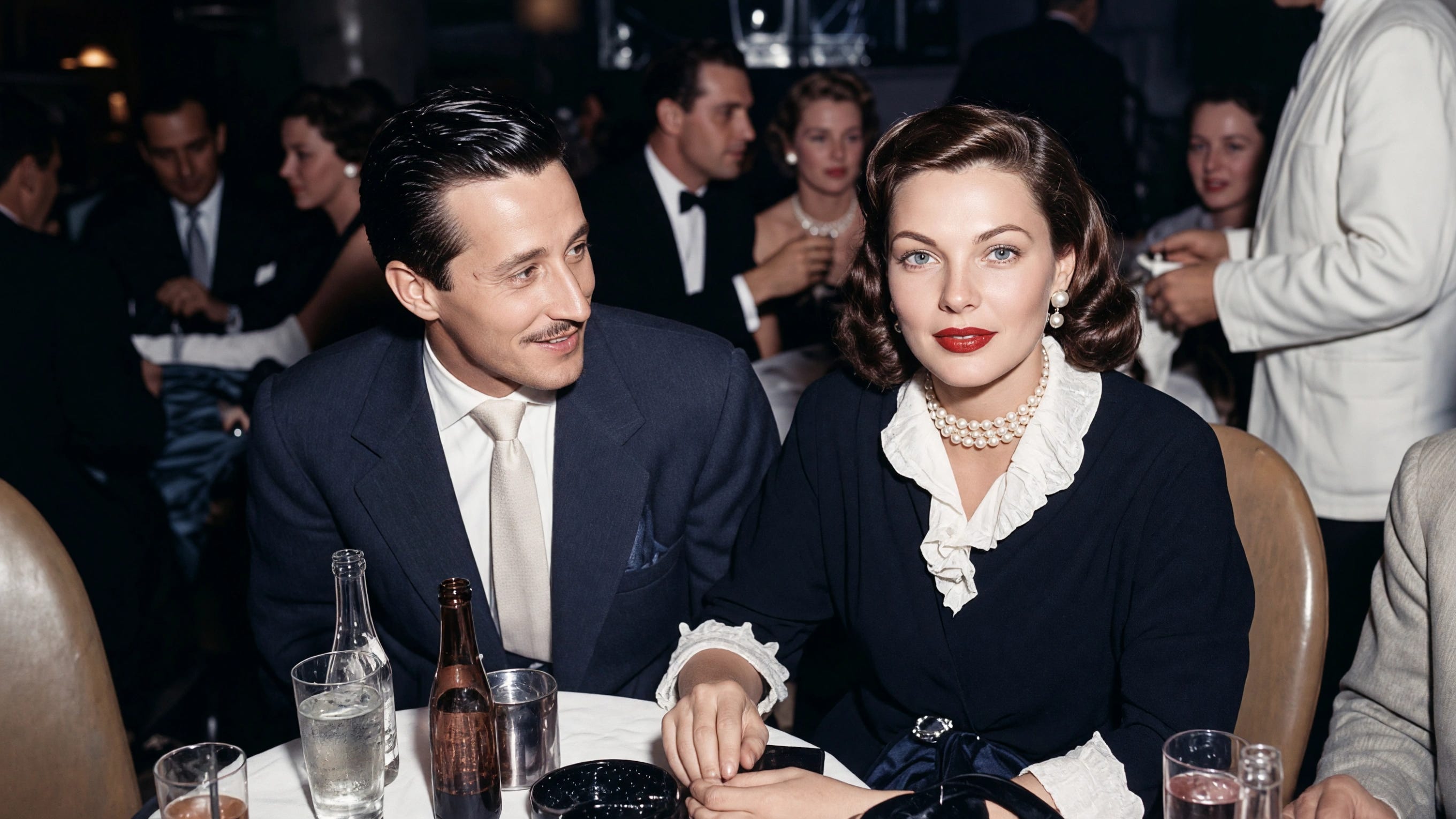
It’s October 1959, and you’re a resident of the quaint and quiet capital of Kansas, Topeka.
On your way to work, you pick up a copy of your local newspaper, the Topeka Daily Capital, and read a scoop: the newest salesclerk at your favorite clothing store in town once played opposite Henry Fonda.
To your surprise, you actually remember this woman. She’s Gene Tierney, the star of Laura and one of 20th Century Fox’s biggest names of the 1940s.
In that 1944 murder mystery, a New York detective falls in love with a murder victim’s portrait while he hunts her killer. The film won an Academy Award and made her a major star.
Later, the national press would pick up the story, yet the customers who recognized her simply asked for help choosing clothes.
Behind that familiar face lay a history of family betrayals, public scandals, and extraordinary personal suffering.
In one life, she was a Connecticut debutante turned face of 1940s Hollywood. In the other, her own parents took her to court, and her first daughter was born needing care for life.
Electric shocks erased whole years of her memory, and in December 1957 she stood on a ledge fourteen stories above Manhattan.
Yet in September 1958, she walked back onto her old studio lot, and executives, actors and carpenters greeted her with handshakes, hugs and kisses.
And her family opposed that world from the start.
Her father once mapped out a grander life for her, and it opened with a dance at the Fairfield Country Club.
“Refreshingly Modest”

The dance was her father’s idea, and so were most of the turns in Gene Eliza Tierney’s early life.
She was born in Brooklyn in November 1920, the middle child of Howard Sherwood Tierney, a prosperous Manhattan insurance broker, and Belle Lavinia Taylor, a former physical-education instructor.
Her father’s insurance business paid for everything the Tierneys owned, and Belle moved easily among the wealthy friends that money brought.
Gene shared that comfortable life with an older brother, Howard Jr., known as Butch, and a younger sister, Patricia.
In the 1930s, the broker moved the family to Greens Farms in Westport, Connecticut, where he bought land and built a substantial house. He ran his children’s futures the way he ran his business, with a plan for each one.
Gene Tierney’s father planned a society debut, and Warner Bros. nearly ruined it.
For Gene, the plan meant private schools in Connecticut, then a finishing school in Lausanne, Switzerland, the polish a wealthy girl needed to marry well.
A family trip to California in 1938 put that polish in front of a camera. The 17-year-old toured the Warner Bros. lot and took a screen test. The studio offered her a contract.
Her parents turned it down, reportedly because the salary was low and they wanted her home in time to be presented to society.
Gene went back to Connecticut, and on September 24, 1938, she made her debut at a dance at the Fairfield Country Club. The New York Times reported it the next morning.
A local museum history says her father insisted on the evening, while the debutante herself took no interest in the life it promised.

Still, Howard gave ground on one point. “If Gene is to be an actress,” he said, according to one biographical account, “it should be in the legitimate theatre.”
On Broadway, Gene Tierney started out carrying a bucket of water across the stage.
Her first job was a walk-on in the George Abbott comedy What a Life!, and one account says the bucket was her whole part.
A few months later, in February 1939, she played an Irish girl named Molly O’Day in Mrs. O’Brien Entertains at the Lyceum Theatre. This time a critic took notice.
“Gene Tierney in her first stage performance is very pretty and refreshingly modest,” wrote Brooks Atkinson, the Times drama critic.
Hollywood noticed too. Columbia Pictures signed her that year to a six-month contract at a reported $350 a week, roughly $8,000 today.
Then the studio found nothing for her to do.
Gene refused to sit out the six months, and she went back to Broadway for a part in The Male Animal.
The next studio was smarter. In 1940, 20th Century Fox put her opposite Henry Fonda in The Return of Frank James and signed her to a long-term contract.
Gene answered the idle months at Columbia the way she’d answer trouble for years to come, by taking the next job.
Eighteen years later, after a breakdown and eight months in a Kansas clinic, she told Time magazine where that habit led:
“I tried to work harder and harder, thinking that work would cure everything. All it did was make things worse.”
For now, the habit paid.
A long-term contract meant a steady salary, and her father was already arranging where the Fox paychecks would go.
