

Old money families don’t interview you. They observe you.
Indeed, there’ll be no vetting process you’ll notice, no questionnaire, no background check with visible results. Instead, something far more effective: quiet observation over time.
You see, generational wealth survives because these families learned centuries ago that the wrong person in their orbit can do more damage than a market crash.
A fortune can survive recessions, but it rarely survives a well-positioned betrayer.
So before you’re ever truly “in,” before the real conversations happen, before you’re trusted with anything that matters, you’ve already been assessed.
Here’s what they’re looking for.
1. Do they need to be seen?
This is the first filter, and it eliminates most people immediately.
Old money watches how you behave around attention:
Do you position yourself for photos? Mention where you’ve been, who you know, what you own? Is your social media a museum of your own accomplishments?
The need to be seen signals insecurity. And insecurity is unpredictable.
From an “old money” perspective, eople who crave visibility will eventually crave it at your expense.
They’ll name-drop your family at a dinner party, maybe post a photo from inside your home. They’ll let something slip to a journalist because the attention was too intoxicating to resist.
Discretion isn’t taught. It’s selected for.

Bunny Mellon and Jackie Kennedy exemplified this filter.
Despite immense wealth (Bunny from the Mellon banking fortune, Jackie from her position as First Lady), both maintained what biographers called “an almost pathological dislike for publicity.”
When Bunny redesigned the White House Rose Garden, she deliberately designed it “not to draw attention” to herself.
Their friendship survived decades because, as Jackie wrote:
“We talked for hours, on nothing, and never gossiped. She was loyal beyond anything, and we gave each other space.”
Neither needed visibility because their identities were built elsewhere.
The families that last learned to spot the difference between someone who has a life and someone who performs one.
But visibility is only the first screen. The second is subtler, and far more people fail it.
2. How do they react to our wealth?
There are two disqualifying responses to encountering significant wealth: fawning and performative indifference.
Fawning is obvious: the wide eyes… the comments about the house, the art, the car. The sudden deference in tone.
This signals that your wealth has destabilized their sense of self. People destabilized by money eventually behave strangely around it. They’ll ask for things, expect things, feel entitled to proximity they never earned.
Performative indifference is equally revealing.
The person who makes a point of not noticing. Who overcorrects with studied casualness. Who goes out of their way to seem unimpressed.
This is fawning in disguise. It reveals that the wealth is all they see.
Brooke Astor demonstrated the correct response through decades of philanthropic work.
After inheriting the Astor fortune, she distributed nearly $195 million to New York institutions, often funding unglamorous items like air conditioning units, fire escapes, and boilers that bore no Astor name.
She visited grantees personally, delighting in simple lunches on “paper plates and folding tables.”
When meeting community leaders, she asked genuine questions out of curiosity rather than strategy. She treated wealth as incidental to connection. The engagement itself was sufficient.
What old money looks for is simple acknowledgment without fixation. The way you’d react if a friend had a nice garden. You might notice, compliment it once, then move on.
Because the garden isn’t why you’re there.
Still, someone can pass both filters and fail the third. This one separates acquaintances from intimates.

3. Do they try to impress us... or simply be with us?
Striving is visible.
The person who steers conversations toward their accomplishments. Who subtly positions their credentials. Who always has a story that one-ups the last one.
Who brings gifts that are slightly too expensive. Who laughs slightly too hard at jokes that weren’t that funny.
Old money families are exhausted by this. They’ve been performed at their entire lives. Everyone wants something, and the performance is how most people try to get it.
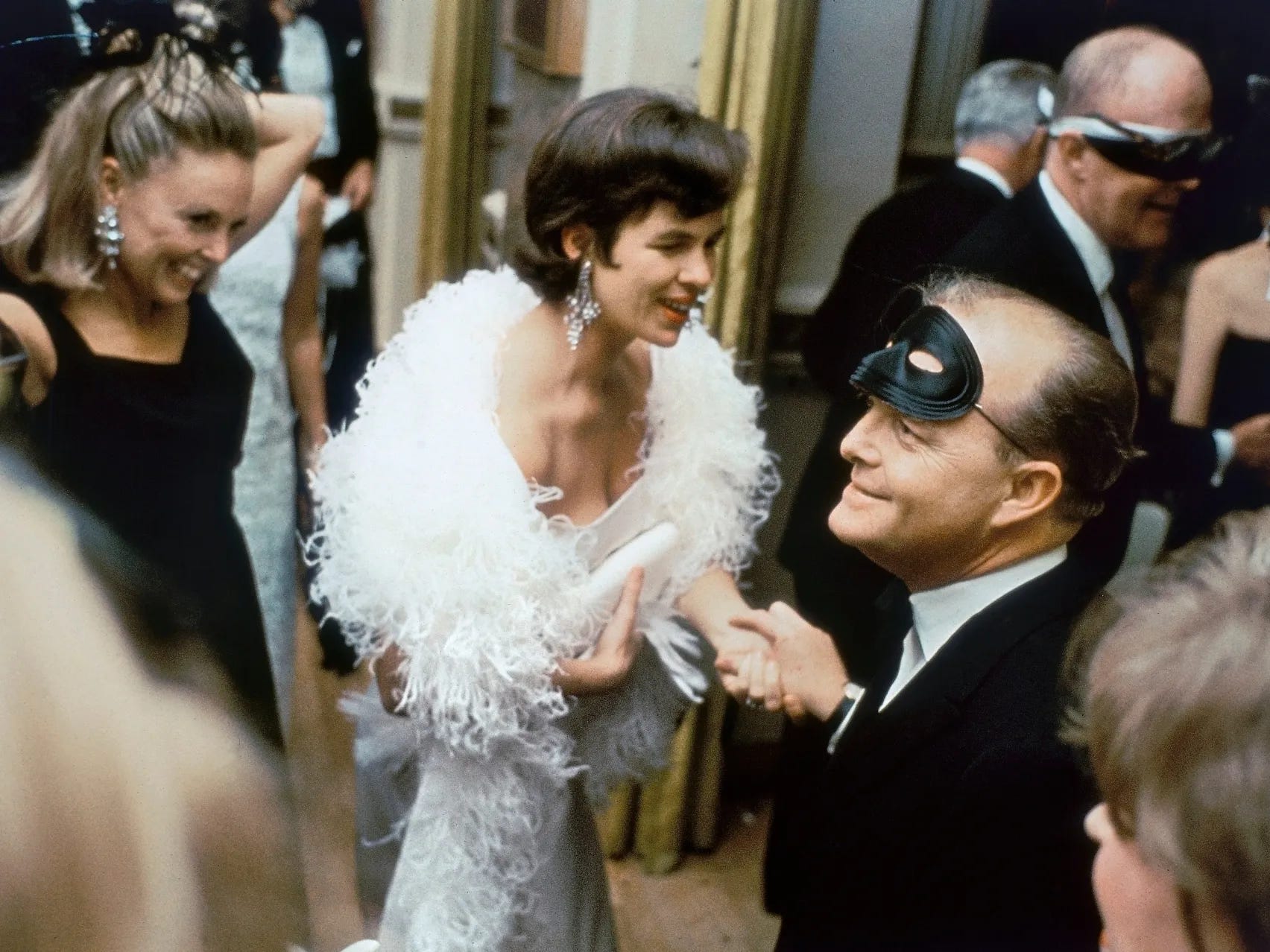
Truman Capote proved the consequences of failing this test.
For years, he cultivated relationships with society’s “Swans” (Babe Paley, Slim Keith, C.Z. Guest) who welcomed him because he seemed to genuinely enjoy their company.
But Capote was performing. He was collecting material.
When Esquire published his thinly-veiled exposé in 1975, revealing their intimate secrets, the reaction was immediate and permanent.
Babe Paley died without ever speaking to him again. Slim Keith cut him off completely. Capote died in 1984, ostracized from every circle that had once embraced him, his final novel unpublished.
What old money looks for instead is ease.
Someone who can sit in their presence without an agenda. Who can enjoy a meal without angling for anything. Who asks questions out of genuine curiosity. Who seems to want nothing more than the pleasure of the company itself.
This is rarer than it sounds.
The proximity to wealth and status creates a gravitational pull toward performance. Resisting it requires a level of self-possession most people simply lack.
When they find someone who can simply be with them, that person becomes valuable precisely because they want nothing.
The Paradox of Trust
In short, you can’t fake your way through these filters.
If you’re consciously trying not to seem impressed, you’ve already failed..
If you’re strategically suppressing your desire to impress, you’re still striving. Just with extra steps.
The people who pass these tests aren’t performing the absence of these behaviors. They simply don’t have them.
They genuinely aren’t impressed by wealth because their self-worth isn’t tied to it.
They genuinely don’t need to be seen because their identity isn’t built on external validation.
This is why, if you ever find yourself inside those circles, the real question isn’t whether they can trust you.
It’s whether you’ve built the kind of self that’s worthy of it.