

The press called her “The Double Heiress”.
She was indeed, on paper, entitled to inherit from two of the great fortunes of the industrial and shipping ages simultaneously.
In practice, she'd inherit from neither on her own terms.
Elena Anne Ford was born in May 1966 carrying two of the most storied families of the 20th-century. On her mother’s side, she is a great-great-granddaughter of Henry Ford. On her father’s side, she is the daughter of Stavros Niarchos, one of the two most famous Greek shipping tycoons of the century, a man whose fortune was estimated as high as $12 billion.
But her father had set a trap before she could walk.
He’d obtained a Greek annulment of her parents’ marriage, then written explicit language into his will ensuring that any child of that annulled union would receive nothing. Elena wouldn’t discover the full extent of the trap until December 1997, when an Athens court confirmed her paternity and denied her inheritance in the same ruling.
But none of it would have happened if Charlotte Ford's yacht had anchored one harbor further down the French Riviera in the summer of 1964.
Stavros and Charlotte

In the summer of 1964, Charlotte Ford was 23 years old and cruising the French Riviera aboard her family’s yacht, the Santa Maria.
She was the eldest daughter of Henry Ford II and Anne McDonnell, raised between Grosse Pointe and Manhattan, educated in the expectation that she’d marry well and carry the family name into whatever dynasty her parents considered suitable.
The harbors between Nice and Monaco that summer were thick with old money and new divorces. Charlotte’s yacht found both.
By coincidence, or by design depending on the account, Charlotte’s Santa Maria anchored near Villefranche-sur-Mer at the same time as the Creole, a magnificent three-masted schooner belonging to Stavros Niarchos, then 55 years old.
Niarchos was already a legend of Mediterranean high society.
He’d made his first fortune during World War II, buying surplus cargo vessels and converting them into oil tankers at a speed that outpaced every competitor except Onassis.
By the mid-1950s his fleet spanned hundreds of vessels, and he’d amassed one of the finest private art collections on the planet, including multiple Van Goghs, Renoirs, and Gauguins.
He bred champion racehorses at his stud farm in Normandy, acquired a private island in the Aegean, and developed a habit of making enormous decisions, marriages included, on instinct rather than deliberation.
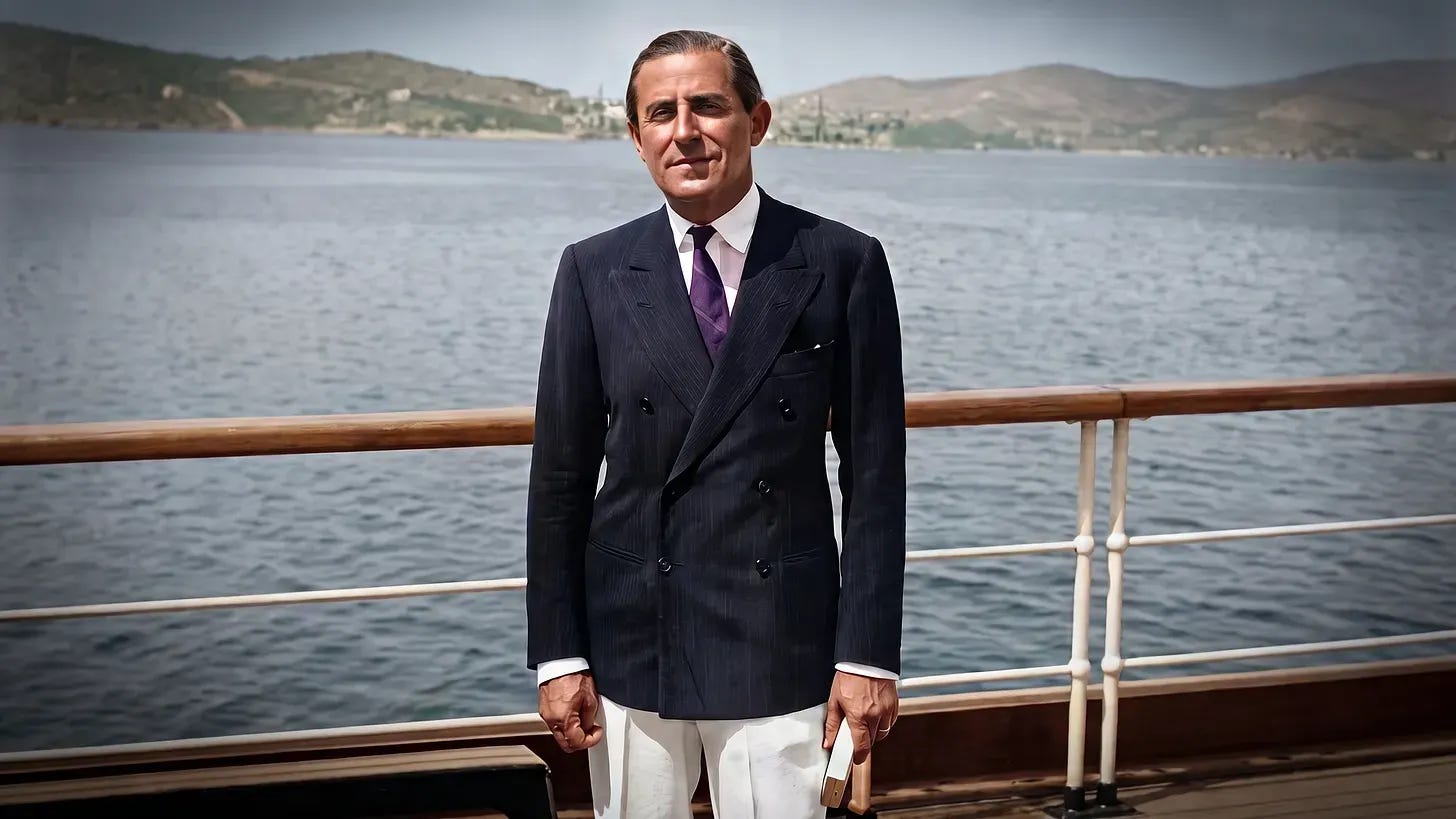
Consequently, he was on his third marriage by the summer Charlotte’s yacht pulled alongside his. He was still legally married to his then-wife, Eugenia Livanos, the daughter of the Greek shipping magnate Stavros Livanos.
And the Livanos connection mattered beyond the marriage itself: Eugenia’s sister Tina had married Onassis, making Niarchos and Onassis brothers-in-law as well as commercial rivals, two men who competed for routes, contracts, fleet size, and now, inevitably, for the attention of women half their age.
But the attraction between Niarchos and the much younger American heiress was immediate and, by several accounts, overwhelming.
Charlotte was glamorous, confident, and came from one of the most recognized industrial families on earth. Niarchos was older by more than three decades, but he moved through the world with a confidence that made the age gap feel like a credential rather than a warning.
He began dissolving his marriage to Eugenia so he could pursue Charlotte, and within roughly 18 months of that Riviera summer, they married.
The venue they chose would determine their daughter’s entire financial future, though neither of them knew it at the time.
Ciudad Juárez

On December 17, 1965, Stavros Niarchos and Charlotte Ford married in a civil ceremony in Ciudad Juárez, Mexico.
The jurisdiction was commonly used by wealthy Americans and Europeans for its speed and its relative lack of formal requirements compared to marriages performed in Greece, the United States, or Western Europe.
For a man who’d already been through three marriages and wanted a fourth without a prolonged legal process, Ciudad Juárez was efficient. The choice seemed practical at the time. It would prove legally decisive three decades later.
