
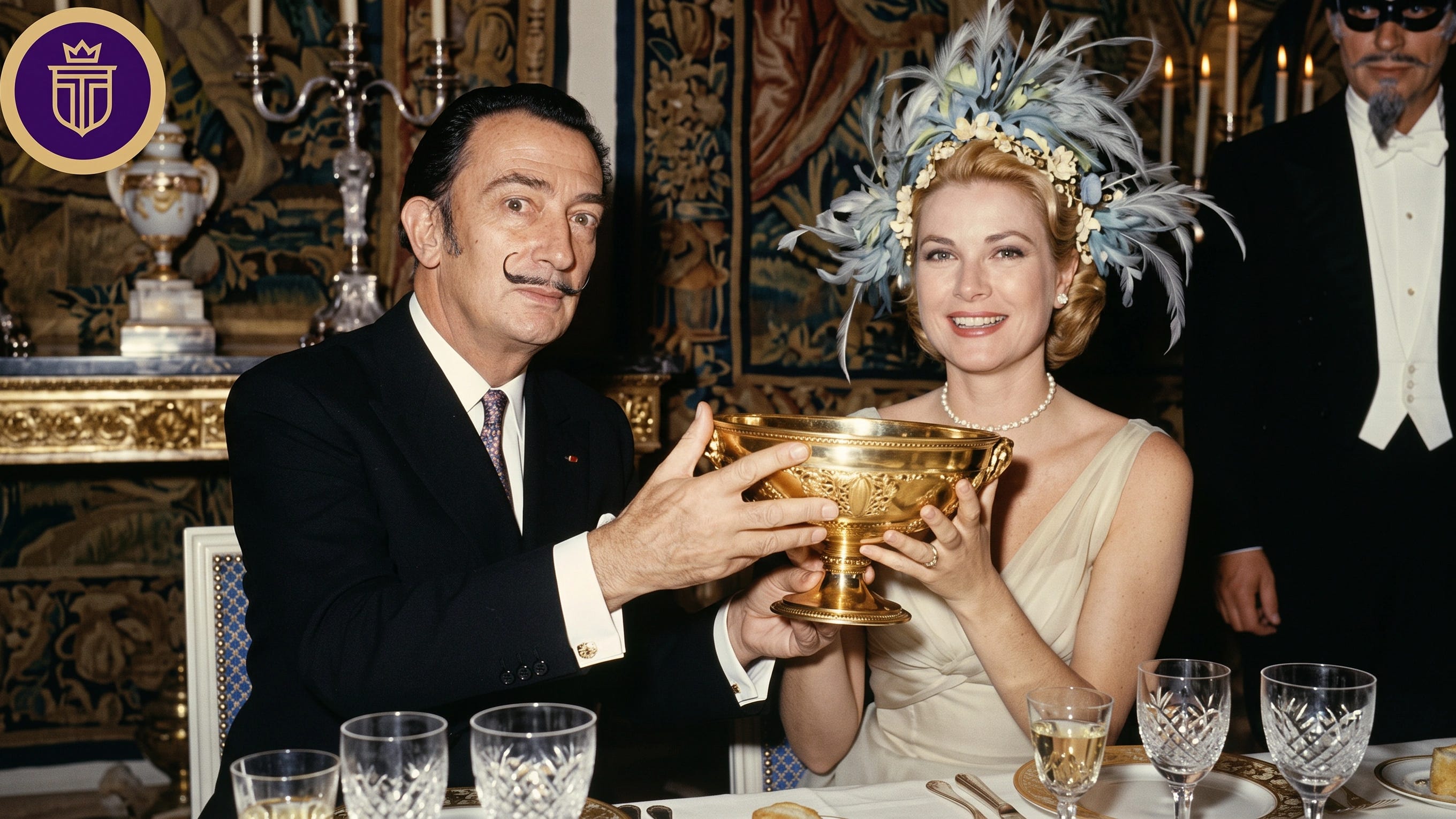
On December 12, 1972, guests drove through dark woodland east of Paris and emerged to find Château de Ferrières bathed in shifting orange and red-gold floodlights… creating the illusion that the palace was burning.
Baron Guy de Rothschild and Baroness Marie-Hélène de Rothschild were hosting what would become the most famous private party of the decade, with Salvador Dalí helping shape the evening’s artistic direction.
Weeks earlier, the first puzzle arrived in the mail: an invitation printed entirely in reverse.
Held before a mirror, the card revealed the date, the location, and the dress code: black tie, long dresses, and surrealist heads.
The guest’s bodies would remain governed by dinner jackets, couture, and inherited rules, while their head could become an animal, a machine, a cage, or something with no rational name.
That collision between discipline and fantasy was Marie-Hélène’s specialty. Each of her balls at Ferrières grew more ambitious, and after the success of her 1971 Proust Ball, another historical reconstruction would have felt like repetition.
For 1972, she chose to turn the family palace into a dream whose guests could enter but never fully understand.
She thought she was designing her masterpiece, unaware that Ferrières was preparing to host its own farewell.
The Palace That Was Built To Be Impossible
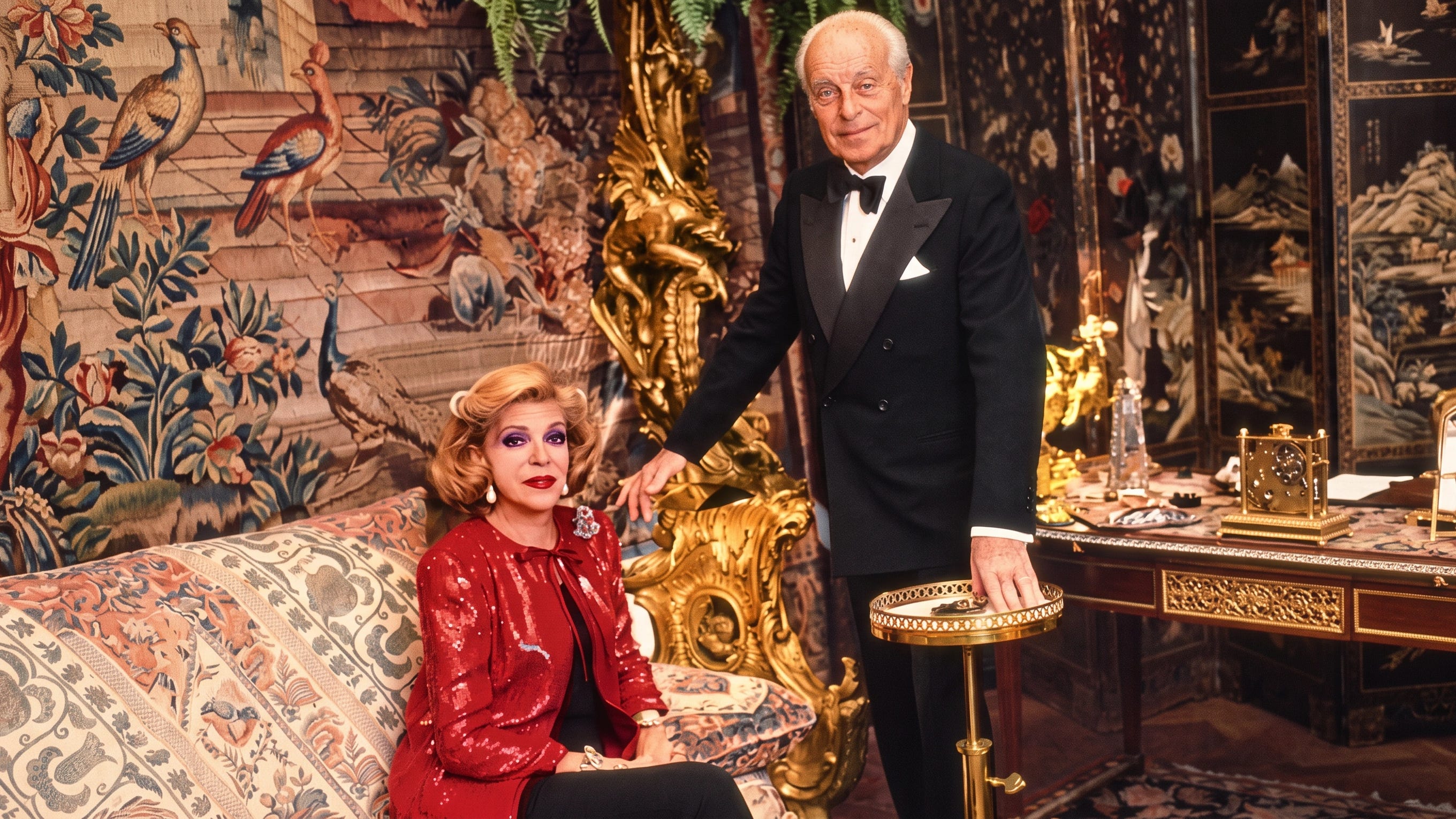
The ground that would house this eccentric extravaganza was born from an act of one-upmanship.
Baron James de Rothschild bought the land in 1829, then spent nearly thirty years waiting for the right moment to outdo his own family.
When he finally hired Joseph Paxton, the Englishman behind the Crystal Palace, the instructions were almost comically direct: James had seen Mentmore Towers, the estate belonging to his English nephew, and simply told Paxton to build it again, twice the size.
The result, finished in 1859, was closer to a small kingdom than a château. A skylit hall stretched 120 feet long and 60 feet high, ringed by more than eighty guest suites, an eight-thousand-volume library, quarters for a hundred servants, and stables for eighty horses.
The kitchen sat in its own separate building, far enough away that guests never caught a whiff of smoke or heard a pot clatter. Hot food traveled to the dining room via an underground railway, so supper arrived like a quiet feat of engineering.
None other than France’s emperor, Napoleon III, showed up to the inaugural gala in December 1862.
A French Rothschild had built on an imperial scale, then dared the actual emperor to come admire it. He did.
That reputation for splendor came back to bite the family. Otto von Bismarck had once stayed at Ferrières as Prussian ambassador and never forgot how comfortable it was.
So in 1870, with the Franco-Prussian War underway, he marched back in and made the château his headquarters for the siege of Paris, turning the Rothschilds’ pleasure palace into an enemy command post.
German forces occupied it again in World War II, and by the time Guy and Marie-Hélène reopened Ferrières in 1959, its walls had absorbed a century of parties, invasions, and quiet recoveries.
Marie-Hélène’s plan was to make those same walls look like they were on fire.
The Setting
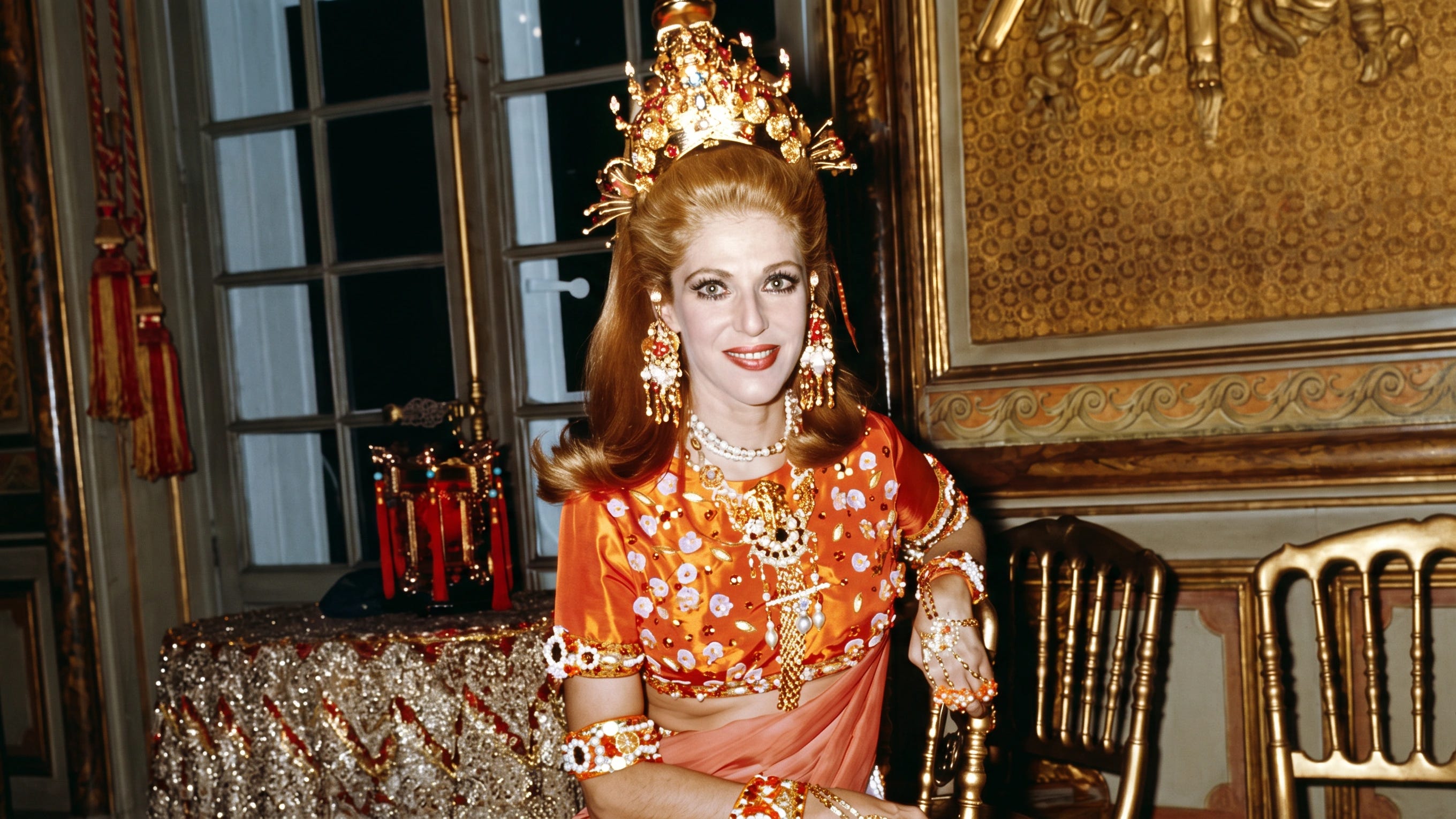
Guy de Rothschild, was born in Paris in 1909, brought his own share of family drama to the 1972 ball’s story.
A great-great-grandson of the Frankfurt founder of the banking dynasty, he fought with the French cavalry in 1940 and earned the Croix de Guerre at Dunkirk.
When Vichy stripped the family of citizenship, he fled through Spain and Portugal, joined the Free French, survived a torpedoed transport ship in the Atlantic, and made it back to Paris by 1944, a run of near-misses that reads like a thriller.
He took over the family business after his father’s death in 1949, rebuilt it as Banque Rothschild, and landed on the cover of Time in 1963. Along the way, he hired an obscure young teacher named Georges Pompidou in 1953, who climbed the ranks at the bank before climbing all the way to the French presidency.
By the late 1960s, Guy had restored the Rothschild name in finance and politics.
Ferrières demanded a different kind of power, one measured in seating charts, guest lists, and the exquisite terror of not being invited.
That was Marie-Hélène’s domain entirely, and it set the stage for what came next: the 1972 Surrealist Ball.
The Woman Who Was Not Born A Rothschild
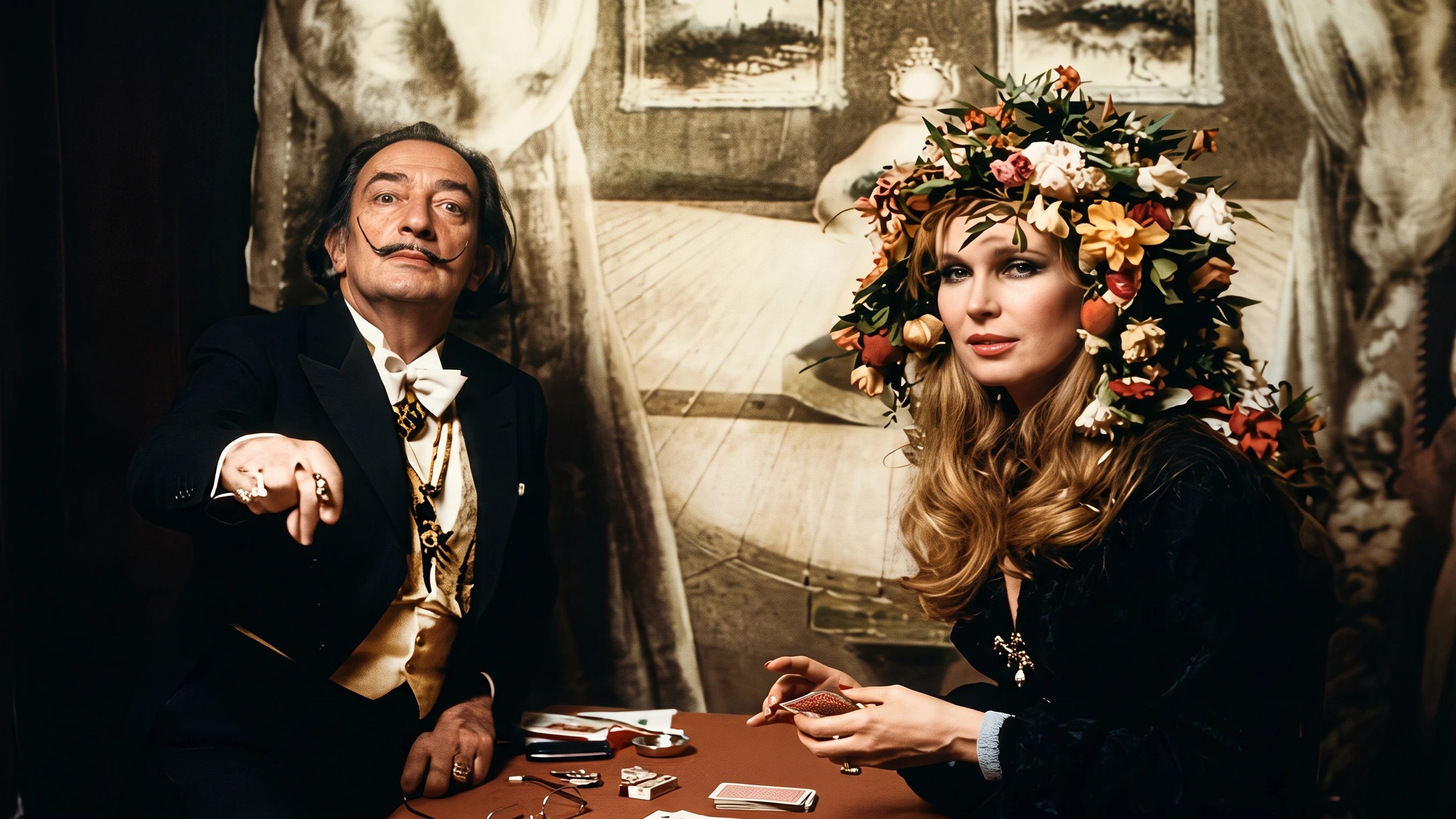
Marie-Hélène Naila Stephanie Josina van Zuylen van Nyevelt van de Haar was born in New York City on November 17th, 1927. Her father was a Dutch diplomat, while her mother was born in Egypt to parents of Syrian origin.
But her Rothschild connection came through her paternal grandmother, Baroness Hélène de Rothschild.
Hélène lost her inheritance after marrying a Roman Catholic, then built a life that resisted other expectations as well.
In 1898, she became the first woman to compete in an international motor race when she entered the Paris-Amsterdam-Paris rally. She also maintained a long relationship with the poet Renée Vivien.
Marie-Hélène therefore approached the Rothschild world from its edge. She understood its codes through blood and family history, but distance allowed her to treat them as material rather than scripture.
After attending Marymount in Tarrytown, she moved to Paris and married Count François de Nicolay in 1950. They had a son, Philippe, before the marriage ended in 1956.
The following year, she married Guy in New York. She became the first non-Jewish spouse of the head of a Rothschild family, prompting Guy to resign his presidency of the Consistoire Central, which represented French Jewry. As a Catholic, Marie-Hélène also needed a papal dispensation to annul her first marriage.
Thus, her authority at Ferrières came from neither a clean pedigree nor passive possession of the title. It came from her ability to control an evening from the first envelope to the final departing car.
After the couple reopened the château, Marie-Hélène oversaw its refurbishment and populated its rooms with a postwar aristocracy assembled from several worlds.
Yves Saint Laurent, Brigitte Bardot, Grace Kelly, Audrey Hepburn, and Salvador Dalí entered a house previously associated with bankers, diplomats, and emperors.
An invitation became a certificate of standing. Exclusion could provoke weeks of speculation, which meant Marie-Hélène’s guest list exercised power before anyone arrived.
Her annual themed balls refined that power. The 1971 Proust Ball placed guests inside an Edwardian world photographed by Cecil Beaton and established Marie-Hélène as a hostess with no obvious European peer.
The achievement left her with only one credible opponent for 1972: herself.
The Arrival
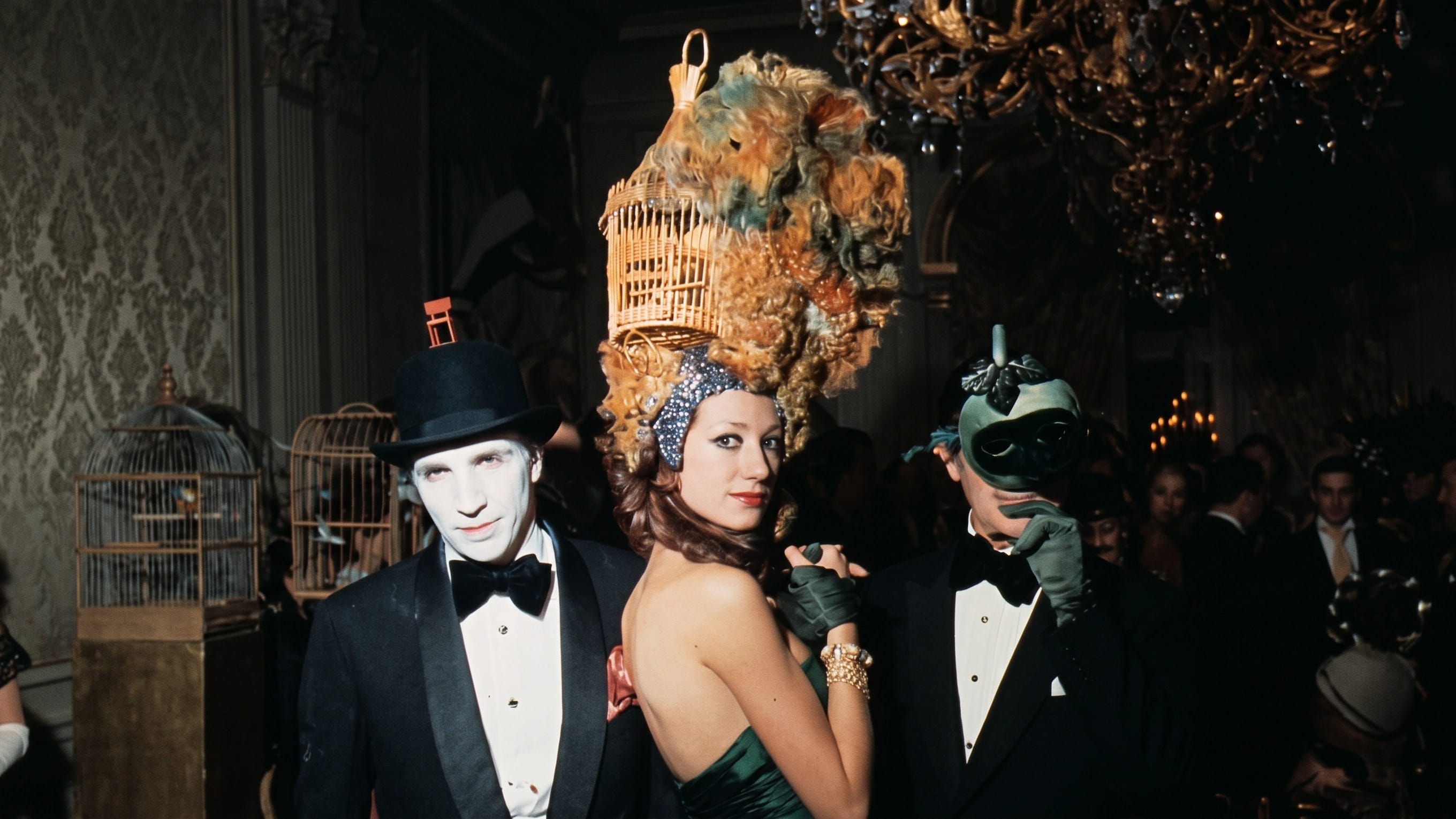
On December 12th, the guests left Paris and followed the road through the forest surrounding Ferrières. Trees concealed the château until the final approach, allowing Marie-Hélène to control the first sight of it.
When the woodland opened, the palace appeared to be burning.
Orange and red-gold floodlights shifted across the stone facade with enough precision to imitate flames. For several seconds, each arriving guest saw an impossible emergency in which the cars continued forward and uniformed servants calmly waited outside.
Hunting hounds moved somewhere through the grounds. According to accounts of the evening, they were intended to discourage photographers, but the sound also served the production: the palace burned ahead while unseen animals hunted in the woods behind.
The entrance offered no relief. Footmen dressed as cats lined the staircase, meowing, pawing at the air, or lying across the steps in elaborately staged sleep.
Beyond them, black ribbons and lace formed a cobweb labyrinth filled with false turns and dead ends. Titles offered no help inside it; a lost duchess needed to call for a cat-servant, who would emerge to guide her toward the salon.
The sequence dismantled certainty one sense at a time. The invitation disrupted language, the facade disturbed sight, the hounds supplied invisible danger, and the labyrinth made a formal entrance feel like capture.
By the time the guests escaped the web, they’d surrendered control over everything except their clothes.
At the far end of the salon, their hostess waited beneath the head of a weeping stag.
The Heads
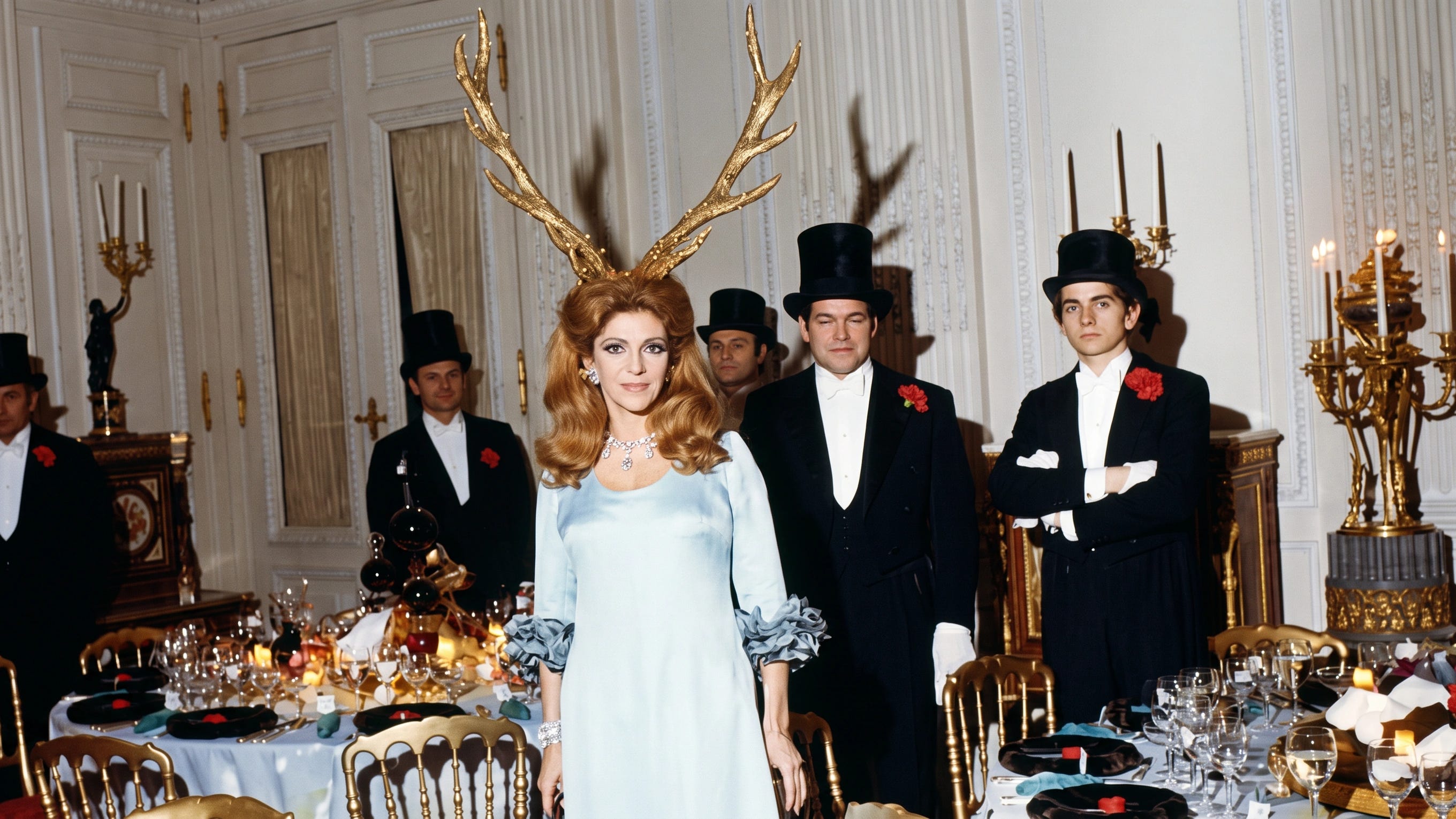
Antlers rose above Marie-Hélène’s evening gown while pear-shaped diamonds fell down the mask’s cheeks. The stones were real, turning an animal’s tears into portable family wealth.
Guy stood beside her wearing a fur hat topped with a stuffed pheasant and its skeleton arranged on a platter. The composition recalled a Dutch still life in which luxury and decay occupied the same canvas.
Together, they greeted their guests as prey, hunter, feast, and remains. A concealed pianist played Erik Satie, allowing the music to drift through the salon without an obvious source.
Salvador Dalí arrived in a wheelchair with Gala and two attendants.
He carried a laser pointer and an umbrella that automatically opened and closed, but declined to wear a costume despite helping shape the evening’s artistic direction.
Dalí needed no mask. His waxed mustache, staring eyes, and cultivated persona already made his face one of the room’s most recognizable surrealist objects.
Audrey Hepburn wore a delicate birdcage over her head.
The structure revealed her face while enclosing it, leaving her to appear alternately as bird, prisoner, and woman displaying confinement as ornament.
Baron Alexis de Redé chose a towering arrangement of four faces covered with scarab beetles. Inspired partly by Titian’s Allegory of Prudence, the headpiece reportedly incorporated portraits of Marie-Hélène, placing the hostess inside her guest’s costume.
Perfumer Hélène Rochas wore a gramophone whose horn curved into an arm and record needle. Marisa Berenson selected a more architectural cage, while Jacqueline Delubac came as Magritte’s The Son of Man, her face hidden behind a green apple.
Brigitte Bardot attended after reportedly receiving costume help from the surrealist painter Leonor Fini. Italian Princess Maria Gabriella di Savoia arrived on Dalí’s arm.
Ordinary social hierarchy remained present but temporarily lost its visual authority. A title might secure the invitation, yet the room remembered the person willing to look strangest after arriving.
Marie-Hélène turned surrender into a contest, then rewarded the guests who exposed themselves most completely to her idea.
Dinner would reveal that their faces were only the beginning.
The Dinner
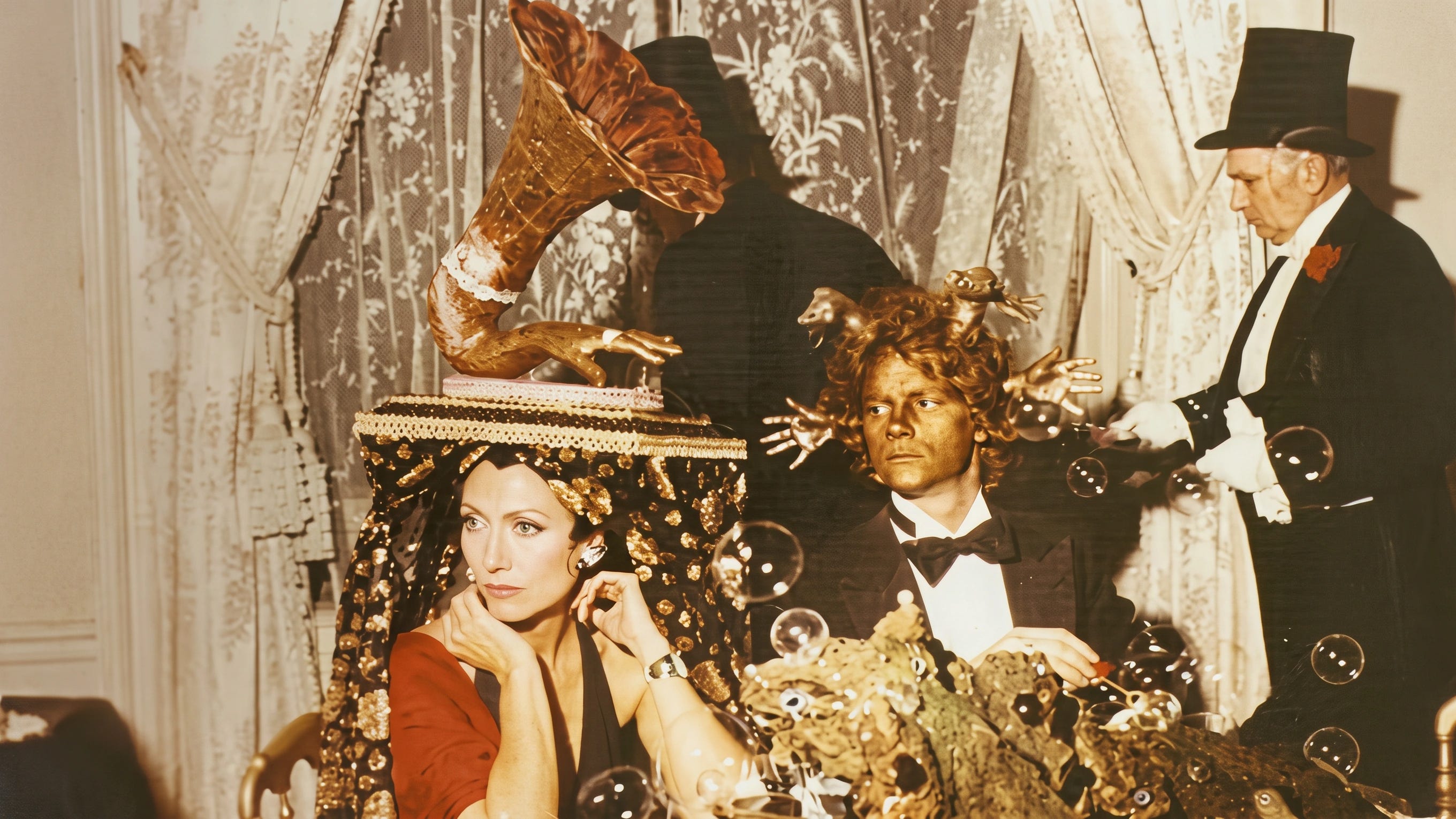
Each guest received a card directing them toward a table with a deliberately unhelpful name. Among the choices were the Dissection-Umbrella, the Erection Machine, the Table of the Dethroned Queens, the Metaphysical Perspective Table, and the Soluble Fish Table.
Butlers in top hats and carnations helped decode the assignments as guests moved through the room in formal confusion. Finding dinner became one more puzzle devised by the hostess.
The tables continued the Magritte sky from the invitations. Clouds drifted across blue cloths, while each setting contained a plate covered in dense fur.
Names appeared on squares of sky held between sculpted ruby-red lips, a reference to Dalí’s Mae West sofa. The bread rolls were pale blue and called pain peint, a French pun that came alive when spoken.
Wine glasses labeled vin vain offered another joke. Bubble blowers waited beside them without instruction, while taxidermied tortoises and deformed dolls occupied the center of the tables. At some settings, dead fish replaced forks.
Beneath the games, the kitchen produced serious haute cuisine. Each course carried a surrealist title, including peaches howling in sadness, a soup called Extra-lucide, and the meat course Lady and Sir Loin.
Dessert arrived as a life-sized sugar sculpture of a nude woman lying on roses. The edible body completed an evening filled with animals, cages, skeletons, false faces, fur, and dead fish.
As the night wore toward dawn, the surrealist theatrics finally began to wind down.
The cat-costumed footmen who had spent hours "asleep" on the staircase and the maze of cobweb ribbon guests had wandered through both went quiet, and the “household names” like Dalí and Hepburn made their way out to waiting cars.
Marie-Hélène designed the ball to dissolve any ordinary sense of sequence, but eventually the last course disappeared and morning reached Ferrières.
But the guests left without knowing they’d eaten the final dessert of an entire social world.
What Was Actually Being Buried That Night
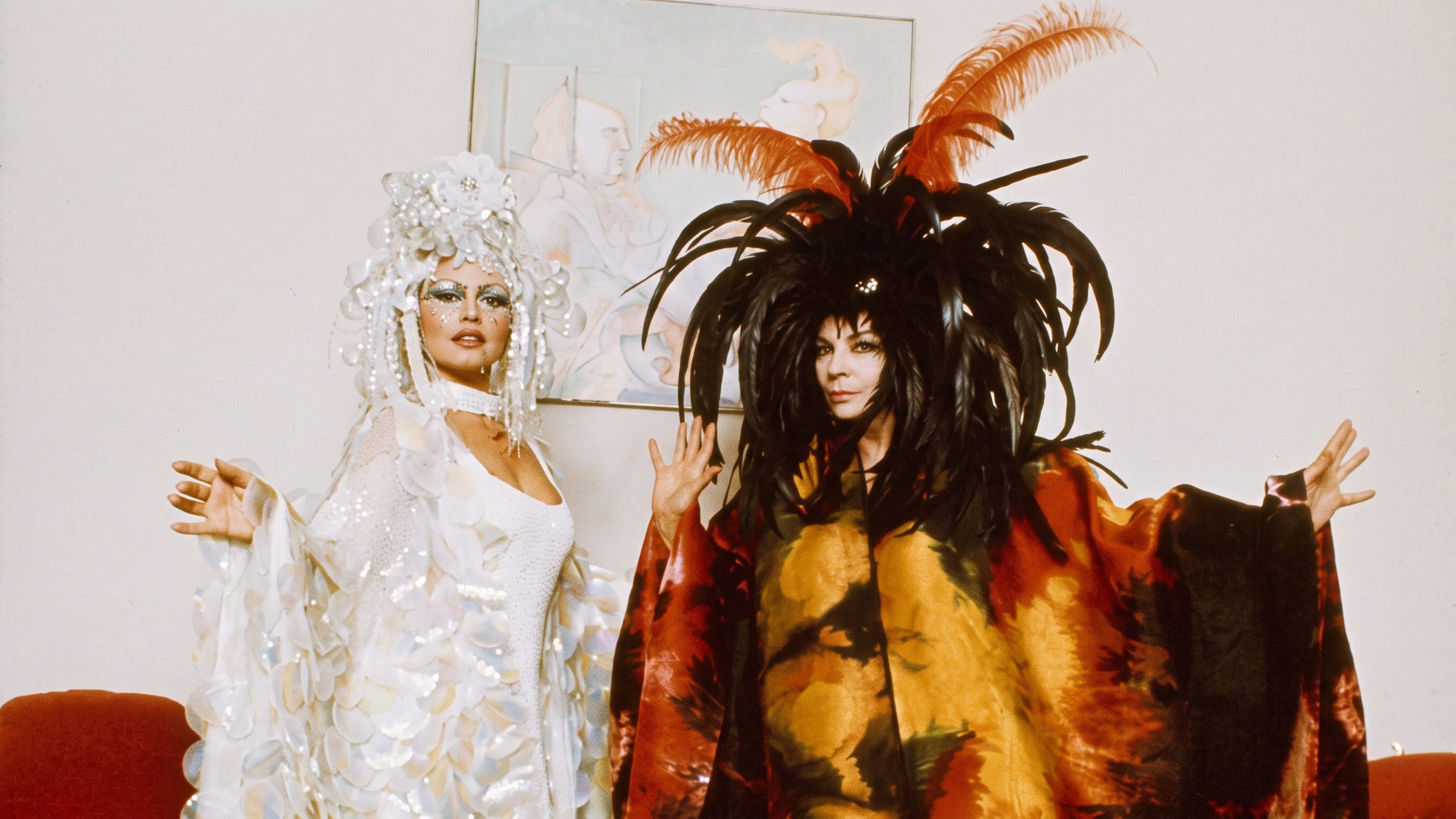
The party was covered widely and became instantly notorious, with outlets like the New York Times detailing Marie-Hélène's stag-at-the-kill mask and the surreal tableaux almost immediately after the event.
Three years later, in 1975, Guy and Marie-Hélène donated Ferrières and its surrounding land to the Chancellery of the Universities of Paris.
It later became home to a school devoted to gastronomy and hospitality.
The underground railway once used to protect private dinners now belonged to the history of a building serving education. The cobweb labyrinth never returned.
Guy and Marie-Hélène moved their social life to the Hôtel Lambert on the Île Saint-Louis, the 17th-century townhouse they shared with Baron Alexis de Redé. Its setting was magnificent, but its rooms couldn’t reproduce the scale or isolation of Ferrières.
At the château, Marie-Hélène controlled the forest, the approach road, the facade, the staircases, and every room a guest crossed. In Paris, even the finest party remained connected to the city waiting outside.
But the larger blow arrived in 1981, when President François Mitterrand’s socialist government nationalized Banque Rothschild along with much of France’s private banking sector.
Guy responded in a front-page letter to Le Monde: “Juif sous Pétain, paria sous Mitterrand, cela suffit.” A Jew under Pétain, a pariah under Mitterrand.
“Nationalizing us meant throwing the Rothschilds out of France,” he told the press.
“We are a family, not an impersonal corporation.”
The government introduced a direct annual wealth tax the following year. Although later abolished and reintroduced under another name, it confirmed that private fortunes now faced a political climate far removed from the one that built Ferrières.
Guy’s son David and nephew Eric began again in 1987, founding Rothschild & Cie with three employees. They rebuilt a powerful investment bank, proving the financial dynasty could survive another institutional rupture.
What the family couldn’t rebuild was the human machinery required to fill eighty guest suites and make a private palace the center of European society.
Marie-Hélène died in 1996 at 68 after years of cancer and rheumatoid arthritis. Guy died in Paris in 2007 at 98.
The family name endured, but the house capable of turning that name into theater belonged to somebody else.
What The Ball Was Actually About
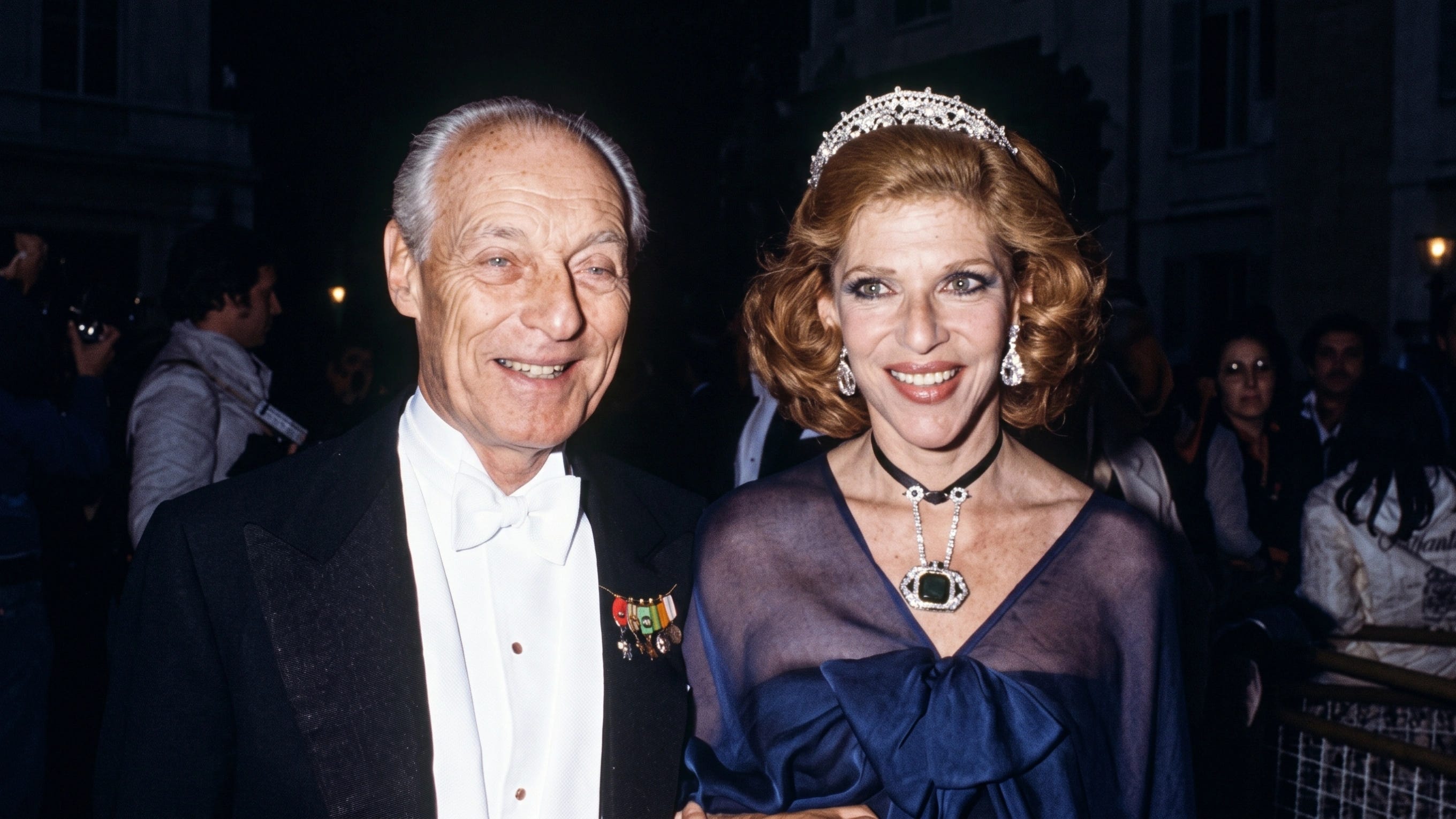
Marie-Hélène inherited an art form shaped by hosts who treated hospitality as a competitive obligation.
Every generation received a standard from the one before it, and the only respectable response was to exceed it.
Count Étienne de Beaumont staged themed balls in 1920s Paris with sets and music commissioned from Picasso, Cocteau, and Satie.
Marie-Laure de Noailles funded Buñuel and Dalí while turning her villa at Hyères into a meeting point for aristocracy and the avant-garde.
Baron Alexis de Redé commissioned Yves Saint Laurent for his 1957 Bal des Têtes, then placed papier-mâché elephants in the Hôtel Lambert courtyard for the Bal Oriental in 1969.
Marie-Hélène faced the accumulated pressure of all of them.
Her Surrealist Ball needed to surpass Beistegui’s Venice, Redé’s elephants, Beaumont’s artists, and her own Proust Ball.
She answered by making the entire guest experience unstable. The invitation required a mirror, the palace appeared to burn, hounds moved through the woods, and cat-footmen rescued aristocrats from an indoor cobweb.
Inside, the objects matched the aggression of the entrance. Dismembered dolls sat among the place settings, plates were sheathed in fur, a dessert took the form of a nude woman reclining in roses, and the soup was announced as “extra-lucid” while the cheese arrived “roasted in post-coital sadness”.
None of this was accidental excess. It was the same competitive logic that produced the elephants and the burning palace, pushed one degree further into genuine discomfort.
And that discomfort is exactly what later curdled into legend. Because the invitation could only be read by holding it to a mirror, decades of viewers seized on the reversal as evidence of ritual intent, tying it to the so-called “Law of Reversal” associated with occult practice, in which flipping sacred imagery signals an anti-Christian gesture.
The stag mask, the dolls, and the fur-lined tableware got folded into the same reading, recast as sacrificial props in an “Illuminati” ceremony rather than surrealist stagecraft.
Furthermore, because the hosts were Rothschilds, this theory fused what began as costume criticism hardened into something darker, built on the ball’s mythology and resurfacing on social media spliced alongside Epstein-era questions about his documented connection with several later members of the family.
Yet, none of this finds support in the accounts of people who were actually in the room, who describe an unforgettable night of fantasy and art rather than ceremony.
Thus, we as those viewing the history of this mysterious meeting are left with more questions than answers, leaving us to supply own explanations for what we read about this event.
What is certain, however, is that Marie-Hélène succeeded in her goal to make something the will never be repeated.
Yes. It links to allegations of ritualistic ceremonies for celebrities, politicians , ‘elite.’
I wonder if there were evil intentions - while it seems an unsettling experience, extreme, for a jaded crowd - evil …?