
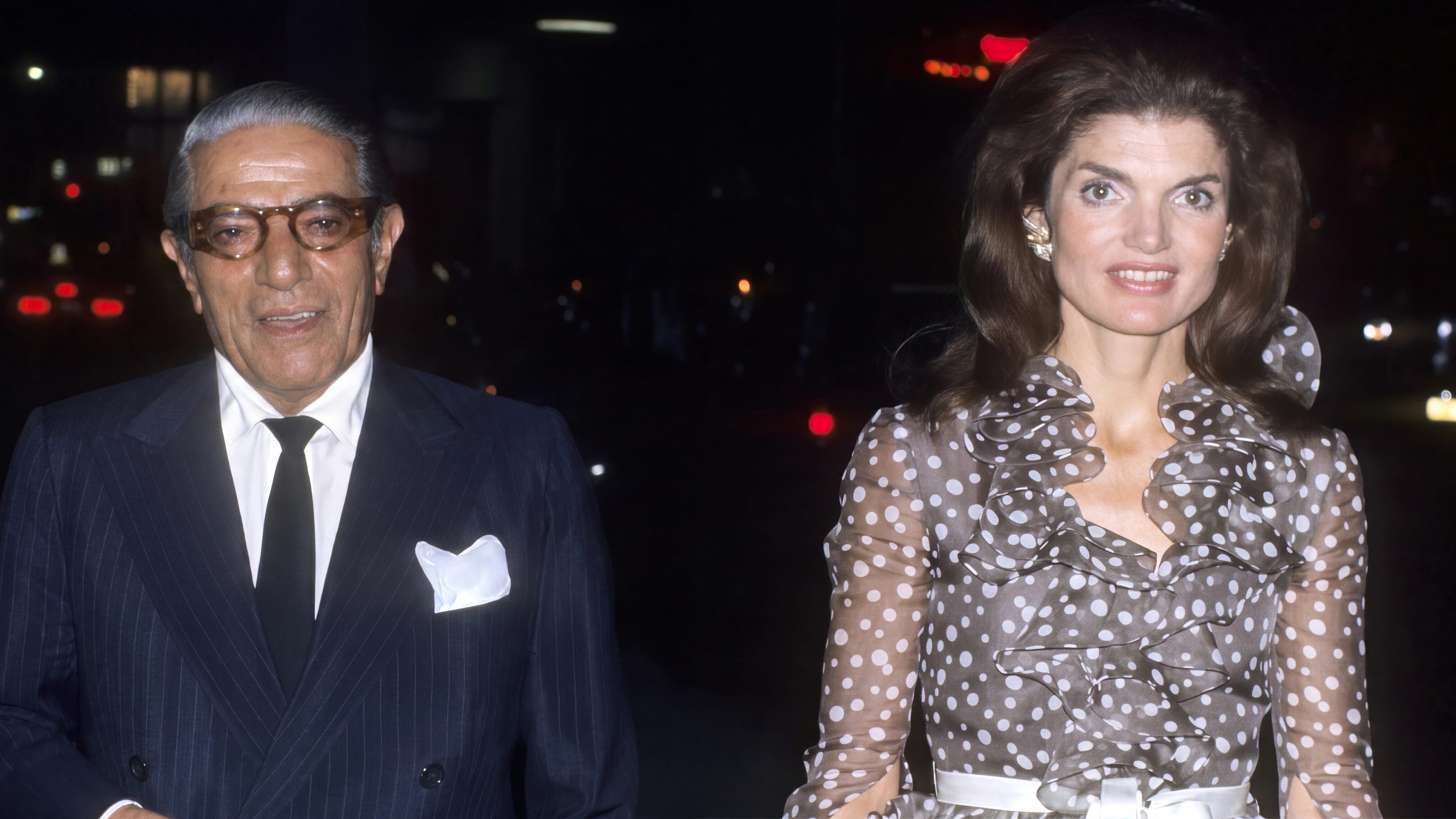
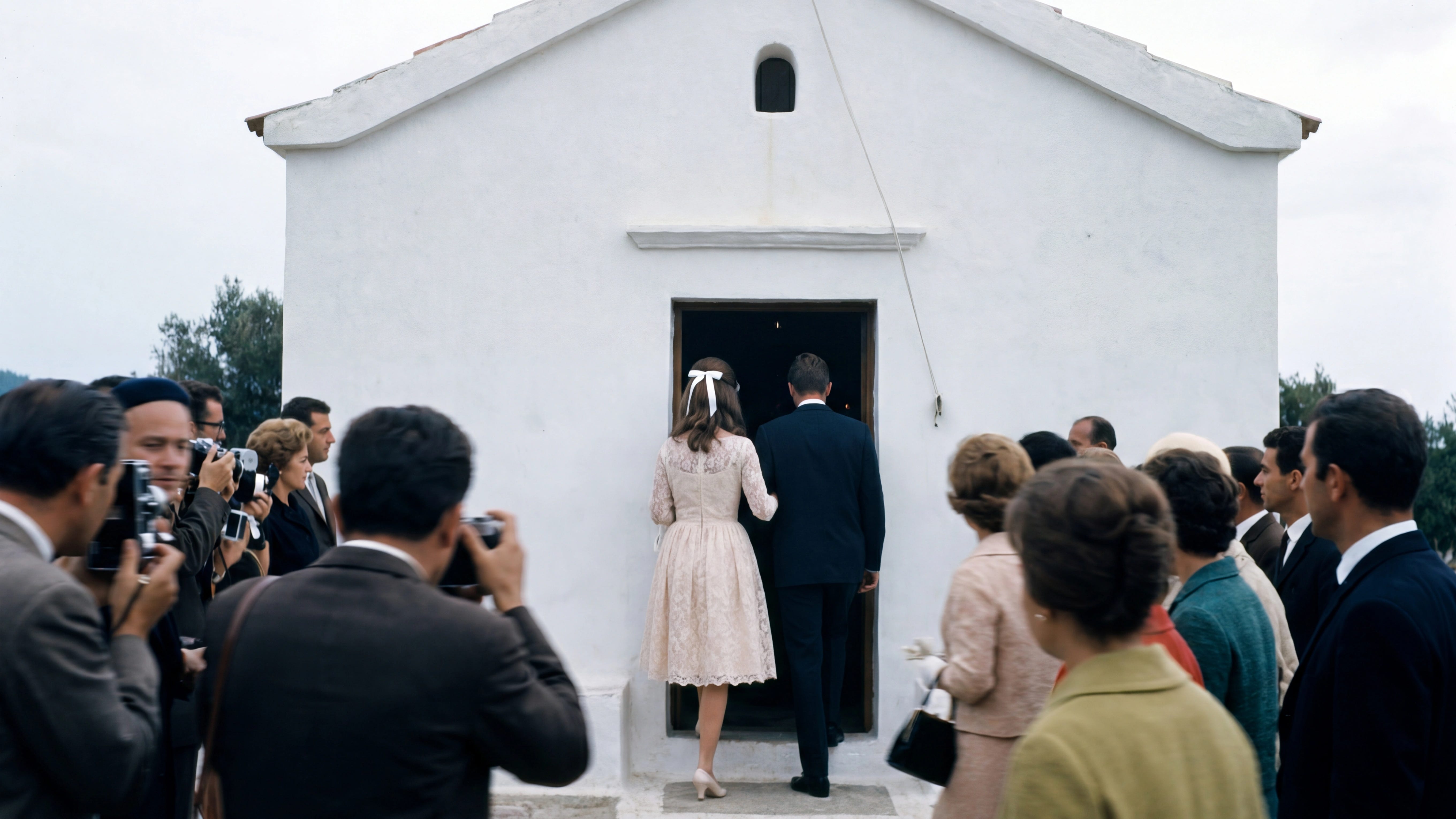
By the time the photographers caught the bride walking out of the small white chapel on Skorpios on October 20, 1968, every bad thing about the marriage had already happened.
The contract had been drafted in 170 clauses.
The mistress was already booked on a flight to meet her lover during the honeymoon.
The husband had a doctor on staff whose specific function in the household, according to his biographer, was performing abortions.
The photograph the world remembers is of the wedding. The story underneath it is one of the most transactional, abusive, and quietly criminal celebrity marriages of the 20th century.
The Man She Married
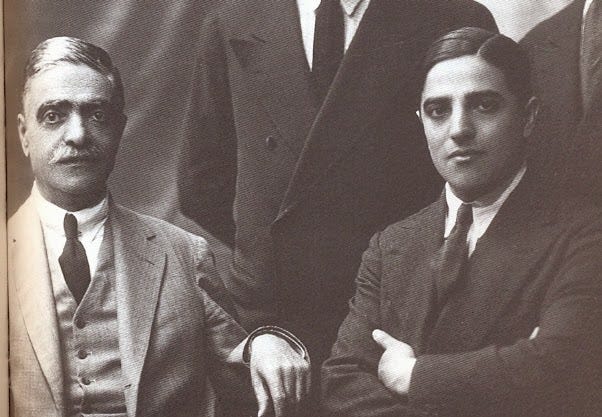
Aristotle Onassis was born in Smyrna in 1906 and was sixteen when the Turks burned the city to the ground.
By his own account, he secured the release of his father from a Turkish detention camp by entering into a sexual arrangement with an older Turkish lieutenant, using the relationship to claw back fragments of the family’s confiscated property as well. It was the first transaction of his adult life, and the lesson it taught him, that intimacy was currency, never left him.
He arrived in Argentina nearly penniless and within twenty years owned the largest privately held shipping fleet in the world. He also acquired a federal criminal record along the way.
The U.S. Department of Justice charged him and six of his companies with conspiracy to defraud the United States after the CIA produced photographs of his ships running cargo to North Korea and China during the Korean War. The case settled in December 1955 for a seven million dollar civil penalty.
The bar stools on his yacht, the Christina O, were upholstered in the foreskins of whales he had hunted illegally inside Peru’s two hundred mile exclusion zone. He would seat women on them at dinner and announce, “Madame, you are sitting on the largest penis in the world.”
Now, Jacqueline Bouvier Kennedy had been inside this man’s orbit for years before the world thought the courtship began.
He had been romantically involved with her sister, Lee Radziwill, for most of the early 1960s, while Jackie was First Lady. According to the journalist Peter Evans, whose 2004 book Nemesis remains the most aggressive account of the relationship, Onassis liked to boast in private that he had been Jackie’s lover before her husband was killed in Dallas, and that after the assassination he had “shared” her with her dead husband’s brother.
Bobby Kennedy, when he caught wind of the early flirtation, reportedly told his sister-in-law to “tell your Greek boyfriend he won’t be coming back here until Jack’s re-elected, a f**king long time after, like maybe never.”
Jack was dead five months later. Onassis was in Washington the night of the funeral. He’d called Jackie to say he was in town. He was invited in.
The man she would eventually marry in 1968 was, according to many, a criminal, a womanizer, and a sadist. None of this was a secret.
And before he ever proposed to her, the two complications that would define the marriage from inside were already in place. The man most violently opposed to him taking her, Bobby Kennedy, was running for president.
Even worse, he’d been carrying on a decade-long affair with the greatest soprano of the century, who had no intention of stepping aside.
The Mistress Who Never Left
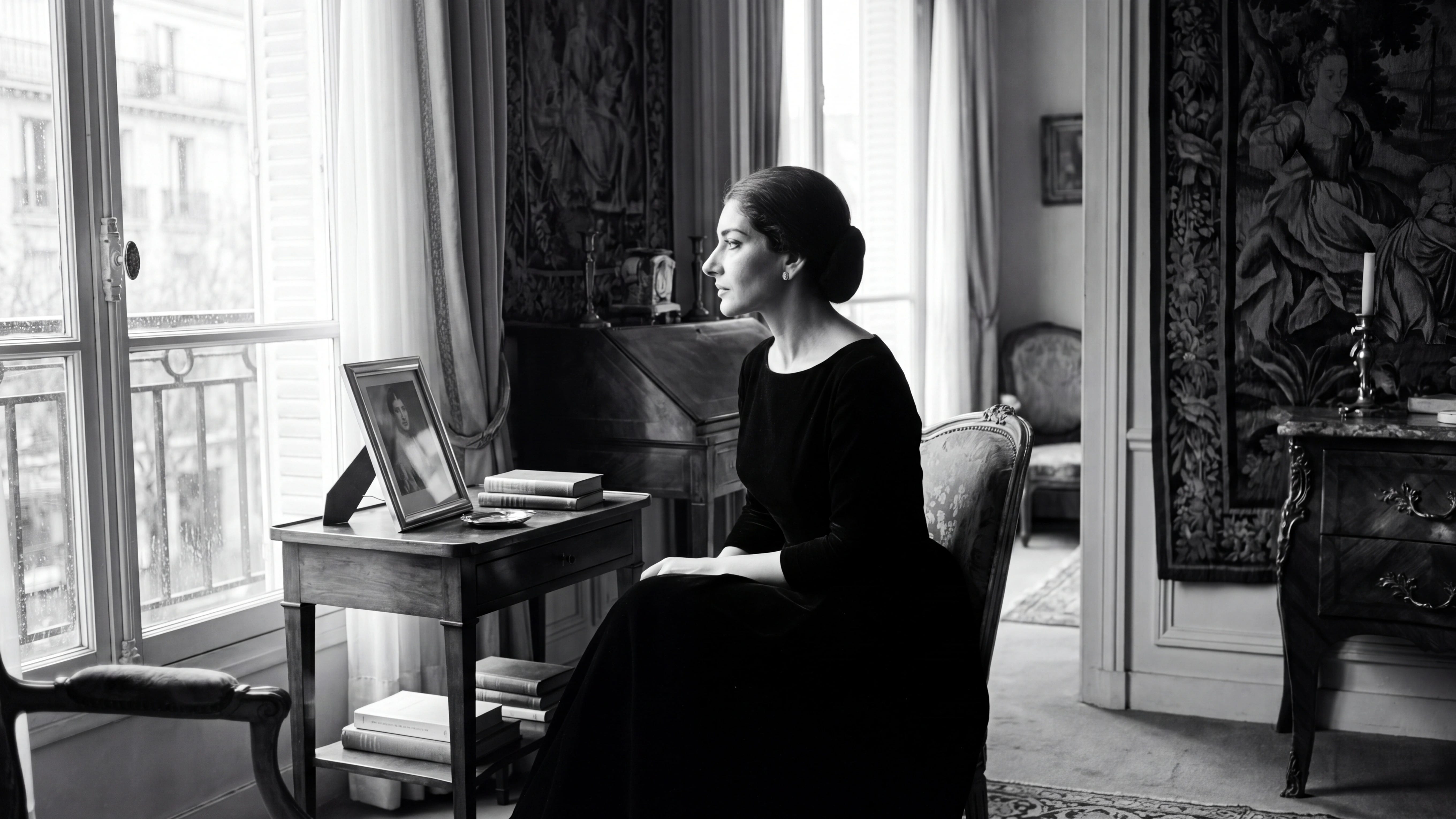
Onassis met Maria Callas, the greatest soprano of her century, at a party in 1957. They were both married.
He invited her aboard the Christina O in 1959, and the affair began on that cruise. According to his longtime personal secretary Kiki Feroudi Moutsatsos, who handled his schedule for years, it never stopped.
“They never stopped seeing each other. Never,” Moutsatsos told People magazine.
Not when he divorced his first wife, Tina Livanos, not when he began pursuing the widow of an assassinated American president… and not when he married her.
The geography was almost mocking. Onassis kept an apartment on Avenue Foch in Paris. Callas lived a short walk away at 36 Avenue George Mandel. Moutsatsos arranged many of the meetings between them herself. “When I was calling every morning,” she recalled, “the personnel were making jokes, telling me Mr. Onassis was very, very tired. And when I was asking why, they were saying again that Maria was visiting.”
He also controlled her reproductive life. Callas became pregnant during the affair on multiple occasions, and on each occasion Onassis pressured her into an abortion. The New York Times reported in 1981 that Callas had ended one such pregnancy in 1966 specifically “at the insistence of Onassis.”
This was not unusual in his household.
His first wife, Tina, had been subjected to the same coercion. So had his nineteen-year-old daughter, Christina Onassis, when she became pregnant. Spence documents that Onassis kept a doctor on his personal staff whose role she describes plainly as “abortionist.” A man on the payroll. Available to all the women in his life. This was the husband Jackie Kennedy signed a contract with in 1968. The mistress he had no intention of giving up was already, by then, the most famous female voice on earth. Jackie knew her name before she signed.
Brother Rumors
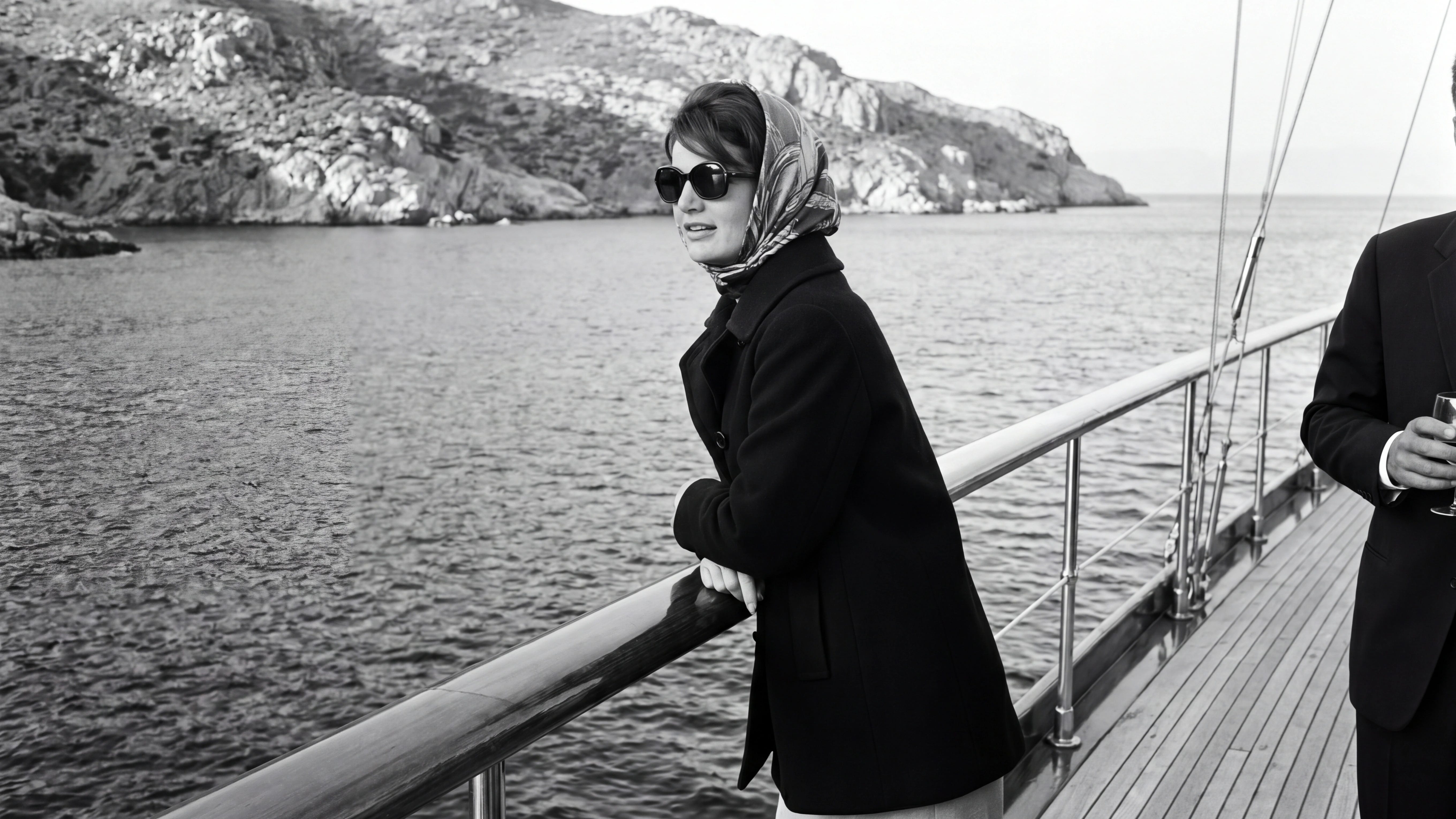
In the years that followed JFK’s death, Jackie accepted cash payments from Onassis, delivered in envelopes, reportedly running as high as one hundred thousand dollars a year.
The most incendiary version of what was happening in the same window comes from C. David Heymann’s 2009 book Bobby and Jackie: A Love Story, which alleged that Jackie and Robert F. Kennedy had begun a four-year affair within months of the assassination.
Heymann cited Arthur Schlesinger’s account of a May 1964 dinner cruise aboard the presidential yacht Sequoia, on which Bobby and Jackie “disappeared below deck” together while Ethel Kennedy stayed upstairs.
“When they returned,” Schlesinger wrote, “they looked as chummy and relaxed as a pair of Cheshire cats.” Ethel Kennedy, the book claims, eventually begged a family friend to “tell Bobby to stop sleeping with Jackie.”
Onassis knew. According to Heymann’s sources, he discussed it openly. “I could bury that sucker,” he is alleged to have said about Bobby. “Although I’d lose Jackie in the process.”
Kennedy loyalists have dismissed the affair narrative as fabrication. What is harder to dismiss is the timing the book implies: that Jackie went, in 1968, from one Kennedy brother to the man who most violently opposed the Kennedys, and that Bobby was actively trying to stop the Onassis marriage at the moment Sirhan Sirhan shot him in Los Angeles in June of that year.
Four months later, the wedding on Skorpios.
When Onassis informed Lee Radziwill, his actual girlfriend, that he was engaged to her sister, he did so by telling her himself. Jackie had told no one. Not even Lee.
Lee, devastated, confided in Truman Capote. Onassis then asked her to attend the wedding. Jackie left her nothing in her will when she died in 1994.
170 Clauses
The contract that produced the wedding ran to 170 clauses.
It was first negotiated by Ted Kennedy on Jackie’s behalf. Ted secured a lump sum of one and a half million dollars in exchange for her signing away her claims to the Onassis estate, and Jackie’s stepfather, Hugh Auchincloss, told her to push harder. Her financial advisor renegotiated the figure upward.
The final terms, reported by the New York Times in 1971, settled around $2 million dollars upfront, equivalent to roughly $17 million today.
The rest of the document read like a corporate procurement order. Thirty thousand dollars a month for personal expenses, after taxes. Trust funds for each of her children, with the annual interest paid to Jackie.
Separate bedrooms. An annual allowance for safety and pleasure of just under six hundred thousand, of which five and a half thousand a month was earmarked for her bodyguards. A divorce trigger of approximately seventeen million. Provisions on the frequency of marital intimacy, which the tabloids reported and the primary documents have never fully confirmed.
Under Greek law as it stood in 1968, with no prenup, Jackie would have been entitled to one and a half percent of his $500 million estate on his death. Roughly $6.5 million dollars. By signing the contract she gave most of it away.
She did it because she’d been raised to believe that a structured agreement with a rich husband was the only form of financial security a woman could reliably trust.
She spent one and a half million dollars in the first year of the marriage alone. Onassis was furious about it from the start.
The Photographs on Skorpios
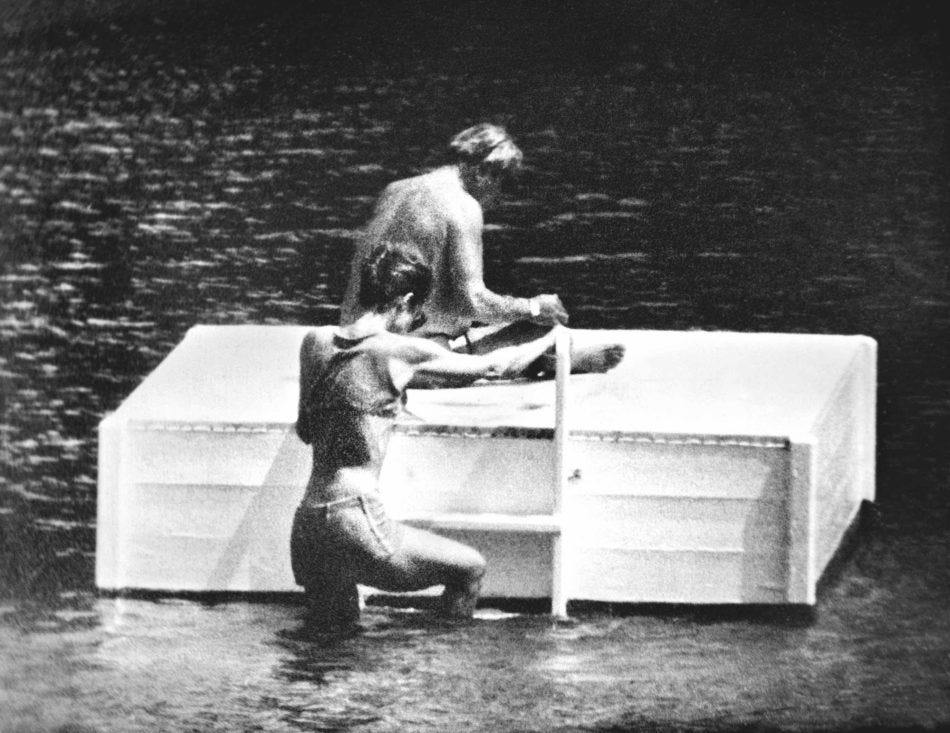
In 1972 a team of up to ten photographers spent nearly a year covertly surveilling Onassis’s private island of Skorpios. They worked from boats. They used aqua-lungs and underwater cameras. They worked from the vegetation onshore. They photographed Jackie sunbathing nude on the beach.
The pictures appeared first in the Italian men’s magazine Playmen in November 1972, fourteen images, sold across Europe in the millions. Larry Flynt then bought the American rights and ran five full-color pages of them in the August 1975 issue of Hustler. The print run sold out. Flynt later called the deal the best investment he’d ever made.
Christopher Andersen, the former People editor, reported in his book The Good Son that Aristotle Onassis himself had been the source. Bitter about her independence, furious about the spending, contemptuous of the marriage, Onassis had provided the photographers with detailed maps of the island and the timing of Jackie’s beach visits.
“The shipowner bullied his wife,” Andersen wrote, “made fun of her, and used his contacts in the press to publicly humiliate her.”
What was done to Jackie on Skorpios was, in the language we now have for it, non-consensual intimate image distribution. The operator was her husband.
He was also hiring private detectives to follow her in the hope of producing evidence of adultery he could use against her in divorce proceedings. The lawyer he’d hired to begin drafting those proceedings was the New York fixer Roy Cohn.
Onassis told Cohn he intended not simply to divorce Jackie, but to make the divorce, in the words of Callas biographer Arianna Stassinopoulos, “as humiliating as possible for her.”
In February 1970, four of Jackie’s letters to Roswell Gilpatric, a former Deputy Secretary of Defense she had been romantically involved with, mysteriously surfaced at auction. One of them had been written from the Onassis yacht, explaining to Gilpatric why she hadn’t told him about her marriage plans. The letters didn’t surface by accident.
When his only son and heir, Alexander, was killed in an Athens plane crash in January 1973 at the age of twenty-four, Onassis turned his grief on his wife. He began calling Jackie a witch. He told friends she carried a curse. He pointed to Jack, to Bobby, and now to Alexander, as proof. His daughter Christina, who had loathed Jackie from the start and called her The Gold-digger, fed the theory enthusiastically.
“He saw his marriage,” Stassinopoulos wrote, “as his life’s supreme act of betrayal. His heart had pointed him toward Maria.”
The Apartment on Avenue George Mandel
He died on March 15, 1975 at the American Hospital in Paris. Myasthenia gravis had taken him by then. His muscles could no longer hold his eyelids up. They had to be taped open during his final months.
He had been planning to divorce Jackie when he died, and had reduced her share in his will. Christina, who inherited the majority of the estate, moved immediately to limit what Jackie could claim under the prenup.
The legal combat ran two years. In 1977 Jackie accepted a settlement of twenty-six million dollars, waiving everything else. Her financial advisor, a Belgian-American diamond dealer named Maurice Tempelsman, invested the settlement and quadrupled it over the following decade.
Her public statement on her second husband’s death was the most calibrated sentence she ever wrote.
“Aristotle Onassis rescued me at a moment when my life was engulfed with shadows. We lived through many beautiful experiences together, for which I will be eternally grateful.”
Not a word about love. Not a mention of grief.
Maria Callas, two streets over in Paris, did not survive her lover’s death. Her last years were lived alone in the apartment at 36 Avenue George Mandel, increasingly dependent on Mandrax and amphetamines, increasingly unwilling to leave at all.
She died of a heart attack on September 16, 1977, at fifty-three. Onassis had told those closest to him in his final weeks that Maria had been the true love of his life, and that marrying Jackie had been his life’s supreme act of betrayal of her. He had been preparing, his secretary said, to leave Jackie and return to Maria when the disease took him first. Maria, the secretary said, had been waiting.
Jackie’s own emotional life, after 1980, settled in a third place that had nothing to do with either husband. Tempelsman had been married throughout the years he advised her. He never left his wife. She never asked him to.
In 1988 he moved into her Fifth Avenue apartment. When she was diagnosed with non-Hodgkin’s lymphoma in early 1994, he moved his office into her home and did not leave her side until she died on May 19, 1994. One publication called him her third husband in all but legal terms.
In the last months of her life she burned her letters and photographs herself. She had told a former lover, decades earlier, that every woman of her position lives three lives at once. A public one, a private one, and a secret one. She made sure, before she went, that only the first survived her.
I was once Captain on the Christina O after she was renovated and turned into a private charter yacht.
The bar stools are still there, and the footrests are made out of walrus tusks.
Churchill spent a lot of time on the yacht and it is rumoured he signed the treaty of Rome in the library on the yacht.
Calas lived on the yacht for 5 years before Mr. A threw her off and married Jackie O.
I always wondered whether O was involved in the demise of Kennedy.
https://winstonchurchill.org/churchill-bulletin/bulletin-061-jul-2013/yet-another-churchill-haunt-for-sale/
Proving once again, the rich certainly do live differently than you and I.