
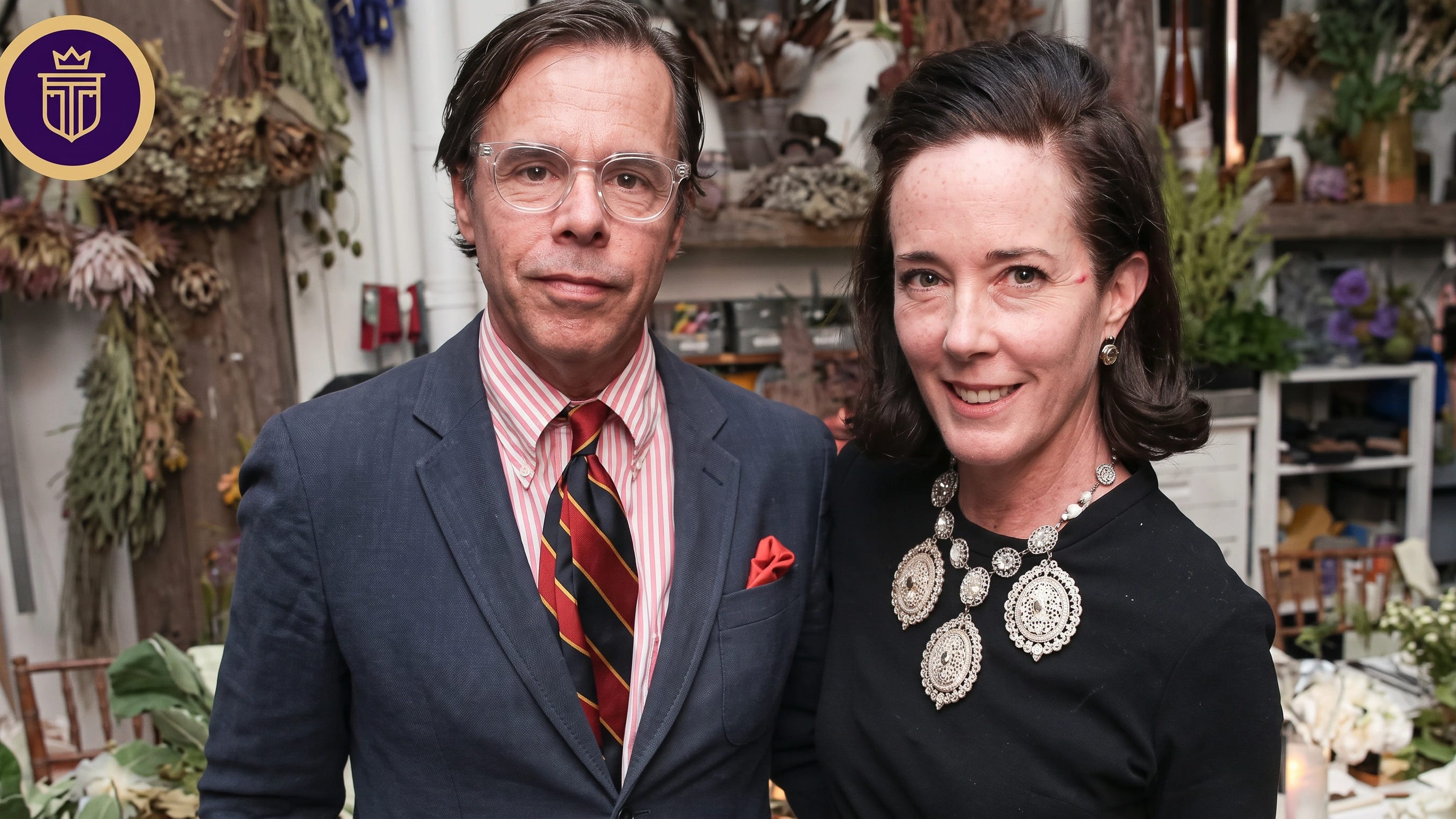
The first thing a Kansas City girl learns, if she grows up Catholic and middle-class and the fifth of six children, is that your name is the one thing nobody can take from you.
Kate Brosnahan believed this until she was thirty-six. Then she signed a piece of paper in a conference room on the forty-third floor of a Neiman Marcus building in Dallas, and Neiman Marcus paid her thirty-four million dollars, and the piece of paper transferred to Neiman Marcus, permanently and in every jurisdiction on earth, the exclusive commercial use of the phrase Kate Spade.
She left the conference room with a check and a car service to the airport. What she didn’t leave with, though it would take her nineteen years to fully understand this, was the right to sell a handbag under her own name ever again.
The nineteen years were the part that killed her.
The Editor Who Sewed
The card table came seven years before the conference room in Dallas.
Katherine Noel Brosnahan, who would later become known as Kate Spade, arrived in New York in 1985 with a journalism degree from Arizona State University and little more than a desire to start somewhere new.
Born on December 24, 1962, in Kansas City, Missouri, to June and Earl Brosnahan, she grew up in the Midwest with an appreciation for color, style, and the small details of everyday life.
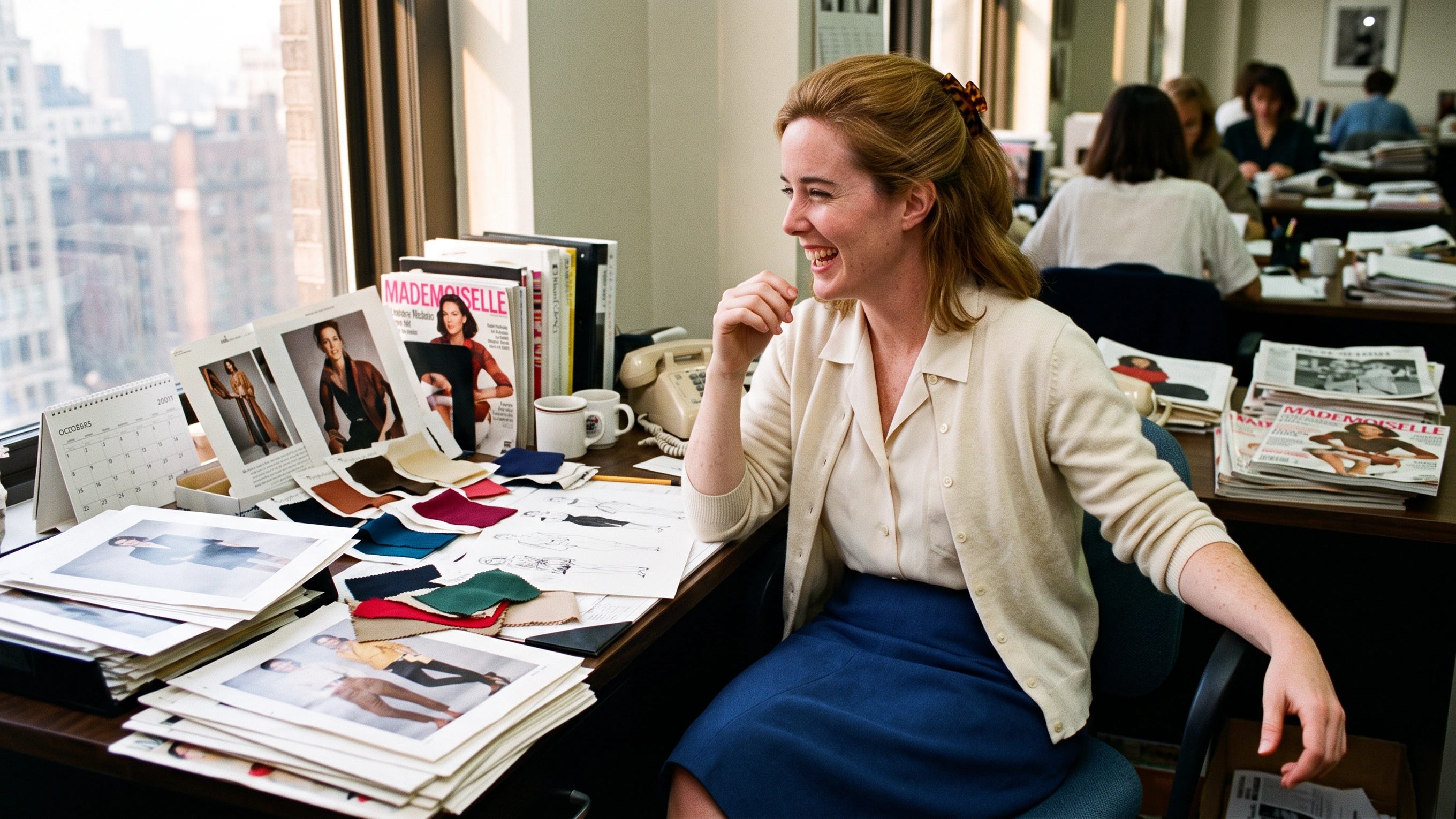
After college, she moved east and began looking for a place in the fashion world. She’d originally imagined a career in television production, but fashion journalism offered an unexpected entry point. Within a year, she had landed an assistant’s position at Mademoiselle, the Condé Nast magazine aimed at young women navigating the years between college and marriage.
Over the next six years, Brosnahan worked her way up to senior fashion editor and head of accessories. Colleagues later remembered her as someone with an unusually sharp eye for the overlooked details of daily life… especially the objects women carried, relied on, and eventually discarded.
That attention to the practical and personal would become the foundation of the design philosophy she carried from the magazine world into the handbag business.
The bag she’d been carrying around Manhattan for a year was an oversized black satin thing that annoyed her every time she opened it.
She wanted something rectangular, unfussy, with a shape you could describe in a single sentence. Nobody was making that, so at the age of thirty she decided to make it herself.
Andy
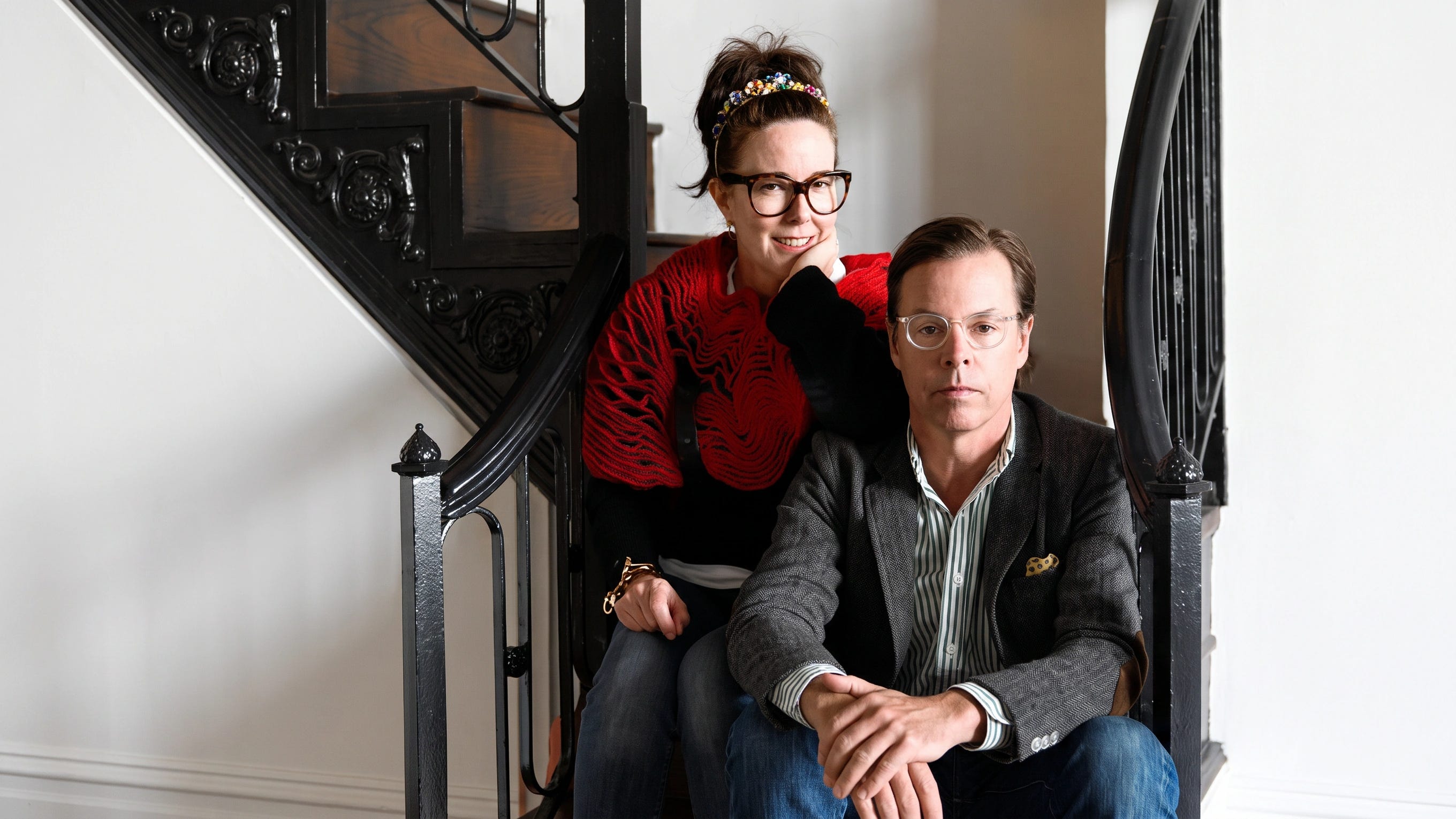
Now, Andy Spade she’d met on a blind date arranged by his older brother David, the comedian. He was funny in a self-deprecating way, and he understood advertising, and he saw immediately what she was seeing about handbags. They moved in together in 1991, and a year later she quit her editing job.
By January of 1993 they’d launched the company on $35,000 (around $81,000 today) in savings and a card table in the SoHo apartment they shared on Thompson Street.
The first six prototypes were nylon, boxy, square, in six colors, each with a small black rectangle at the corner reading kate spade new york in lowercase. She sewed them herself.
The first buyer was Barneys New York, in the fall of 1993, for a small order the store’s accessories director placed almost as a courtesy. The bags sold through in weeks, and every subsequent reorder was larger than the one before.
Andy handled the business. Kate handled the design. The division of labor was clean, and for the first several years it worked in a way that friends who watched it happen described as almost preternaturally suited to what each of them wanted from the other.
By the end of 1998 the company had done $28 million in sales. But Kate Spade the person was already beginning to disappear behind Kate Spade the label.
What Kate wanted, in the beginning, was to make something small and specific and beautiful. What the corporate structure would eventually want from her was something else entirely.
The Bag That Ate Manhattan
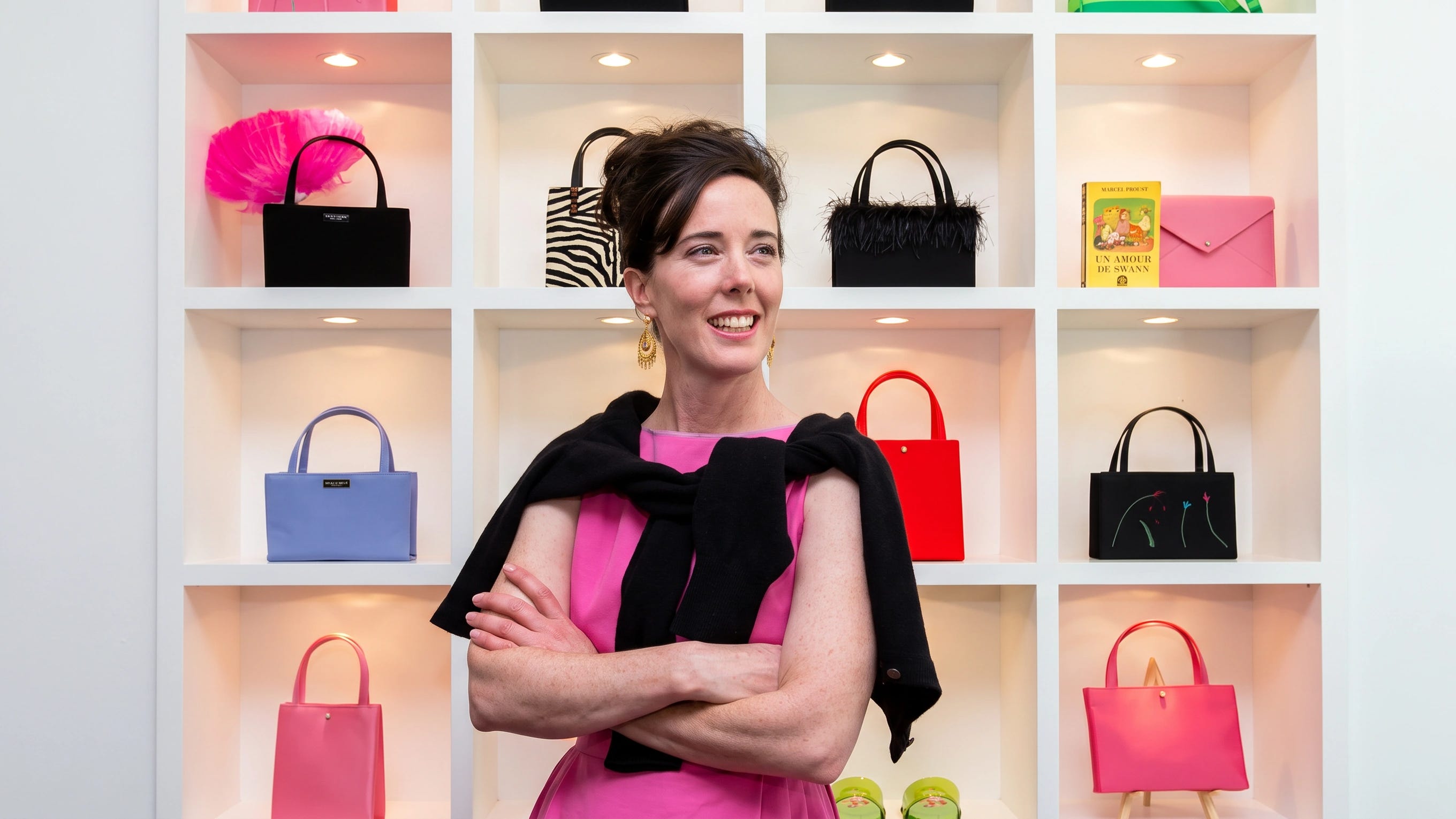
By 1996 the handbags were on the arms of women who worked in publishing, in advertising, in the middle rungs of finance, women who wanted something between the Coach signature-leather standard-issue and the Chanel quilted-flap statement piece, something that said this-woman-has-an-interior-life.
The green nylon rectangle at the elbow of a young editor at Vanity Fair did the work of an entire personality.
Stores multiplied fast after that. The first Kate Spade boutique opened on Thompson Street in 1996, followed by a stationery line in 1997, shoes in 1998, then pajamas and eyewear and diaper bags and airline uniforms for Song Airlines.
Coffee-table books, baby gifts, and pet accessories rolled out in the years that followed, until by the middle of the 2000s a young woman in Chicago or Atlanta could reasonably furnish an entire life inside the brand.
Kate and Andy moved to a Park Avenue apartment they bought in 1999 for $2.7 million, the same year they sold most of the company. They had one child, a daughter named Frances Beatrix Spade, born in 2005.
Kate cut back her hours. She was tired, and she was, per her own later statement to The New York Times, uncomfortable with what the brand had become. There was a design department she didn’t run, product categories she’d never approved, and a signature on every label that no longer belonged, technically, to the woman who had first drawn it.
She was still Kate Spade. She was also no longer Kate Spade.
The Put Option
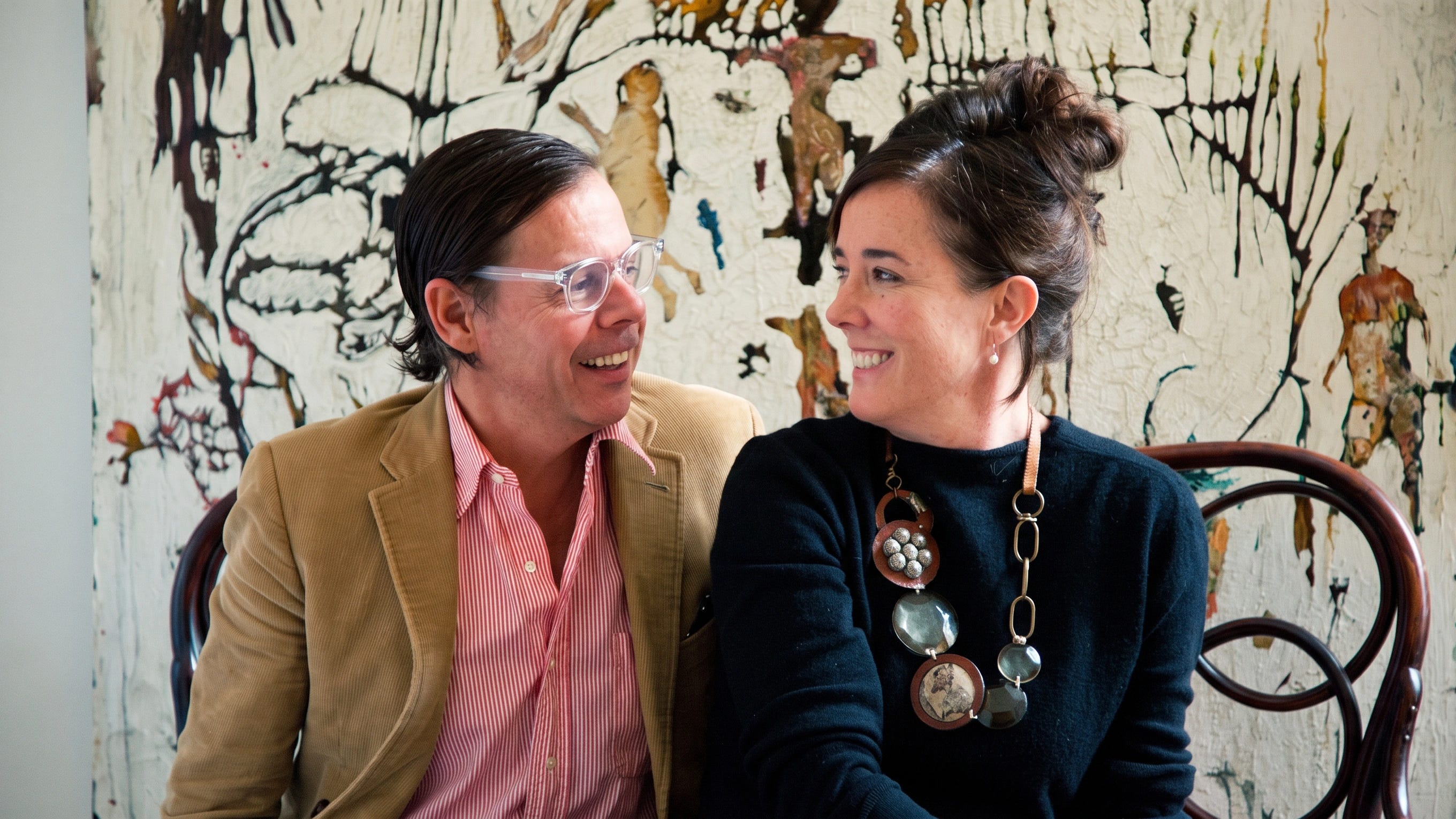
In 2005 the Neiman Marcus Group, which had owned 56% of the company since 1999, decided to sell.
Kate and Andy and their two co-founders held the other 44% under a contractual mechanism their lawyers had built into the original 1999 agreement: a put option, meaning they could force Neiman Marcus to buy their remaining stake at a valuation determined by a formula fixed years in advance.
They exercised it in the summer of 2006. Neiman Marcus paid $59 million for the last 44%, valuing the entire company at $134 million.
Consequently, the proceeds were split among the four founders and their partners;
Kate and Andy personally walked away with somewhere around $46.5 million before taxes, per Forbes.
A week later Neiman Marcus flipped the entire brand to Liz Claiborne for $124 million, and it is this number that has attached itself to Kate Spade’s name in every headline written about her since. She never saw a dollar of it.
The $124 million was what a corporation charged another corporation for the right to keep using her signature after she was no longer allowed to touch it.
She stayed until mid-2007 under the service agreement. Then she left. She was forty-four. She had a two-year-old daughter, a $2.4 billion brand growing in her absence, and the rest of her life to figure out what to do with any of it.
The problem was that “the rest of her life” turned out to be shorter than anyone had planned for.
This one is free. If you want more of these landing in your inbox on Sundays, subscribing is the whole ask.
The Middle Years

She raised her daughter, traveled quietly with Andy and Frances to places where nobody who read the tabloids happened to be looking, and read enormously, everything from Joan Didion to true-crime paperbacks.
Her sister Reta would later describe a small journal Kate kept in those years as the private counterweight to a public identity she hadn’t authored.
In 2016 she began something new: Frances Valentine, a shoe and accessories line named partly for her daughter and partly for her grandfather, launched with her old business partners Elyce Arons and Andy and her sister-in-law. The line was well-received. The company was small on purpose. Kate had learned something specific about scale.
The one thing she couldn’t do, legally, was call the new company “Kate Spade”.
That name belonged to Fifth & Pacific, which had rebranded from Liz Claiborne, and would eventually rebrand again to Kate Spade & Company, which would eventually be acquired by Tapestry, née Coach, for $2.4 billion in May 2017.
Every one of those transactions occurred at valuations built entirely on the equity of her name, and none of the transactions required her presence, or her signature, or her consent to any specific product decision. Kate and Andy saw none of that.
They’d sold the rights to the name a decade earlier. What they had was the money from 2006 and a growing awareness that the woman signing her real signature on the school forms for Frances Beatrix’s middle school and the “Kate Spade” signing the labels of $800 million a year in handbags were, in a way that the law took very seriously and that Kate herself struggled to metabolize, two different people.
She began, in the years after the sale, to drink more.
She had suffered from anxiety and depression for most of her adult life, and had treated both, off and on, since her twenties. Public reporting after her death indicated bipolar disorder, which she had reportedly resisted treating aggressively because she was afraid of what medication would do to what she called, in a note her sister released posthumously, “her creativity.”
The other thing that had been happening, quietly, over the previous several years, was that her marriage had begun to come apart.
Andy had moved out sometime in 2017 or early 2018. He and Kate maintained, publicly, a working amicability, and lived in adjacent buildings, and continued to co-parent Frances Beatrix, who was by then twelve. In private, per her sister Reta’s post-death statement to The Kansas City Star, Kate was suffering.
And the woman on the handbags, corporately speaking, was thriving.
The Doorknob

On the morning of June 5, 2018, Kate Spade’s housekeeper arrived at the Park Avenue apartment at approximately 10:20 a.m. and found her employer’s body in the master bedroom. She’d used a red scarf tied to a doorknob at the age of fifty-five.
The note found beside her was addressed to Frances Beatrix, then thirteen. Per multiple sources speaking to The New York Post and People, the note told her daughter that none of this was her fault, and that if she wanted to know why, she should ask her father, who would understand.
The New York City medical examiner ruled the death a s**cide within forty-eight hours.
The manner was never in doubt. What remained ambiguous was the shape of the twenty-five-year arc that had led to the doorknob, which is the part of the story that refuses to enter itself on a death certificate.
Her brother-in-law David Spade, the comedian, posted on Instagram a picture of himself as a boy standing next to Kate holding a birthday cake, and wrote: “Fuzzy picture but I love it. Kate and I during the holidays. She was so sharp and quick on her feet. She could make me laugh so hard. I still cannot believe it. She was a very kind soul, even when she was hurting. And she was hurting.”
Andy Spade issued a statement three days later that ran to nearly nine hundred words, describing a wife who had suffered from depression and anxiety for many years, who had been actively seeking help, who had loved her daughter in a way he considered unmatchable, and whose death had come without warning he could recognize as warning.
Whether the statement should be read as candor or as legal positioning for the coming press cycle became, briefly, a subject of speculation. Andy had never been a public figure by preference. He’d built a career specifically around not becoming one, running a small creative agency called Partners & Spade in Manhattan for the decade after the Kate Spade sale, and he lacked the machinery required for the moment his private grief became a matter of newspaper editorial policy.
Frances Beatrix Spade turned fourteen the following November. The Park Avenue apartment was listed for $6.35 million within a year. Frances Valentine, the small shoe company Kate had built in the second act she was allowed to have, kept going without her.
The Lesson
Every family with a name old enough to have survived three generations of dispersal understands one thing about intellectual property that people in the first generation of wealth rarely grasp until it is too late:
Your name is the last asset you should ever sell, because it’s the only one that can’t be reproduced.
Thus, the contract Kate and Andy signed in Dallas in February 1999 did something specific that people outside fashion law rarely understand until they’ve done it themselves.
It performed what trademark attorneys might call an assignment in gross: the permanent, unrestricted transfer of a name from the person who created it to the corporation that bought it, with no ongoing consent required, no approval rights over how the mark gets used, and no reversion clause if the buyer runs the brand into the ground or into a stratosphere the seller wants no part of.
That’s the mechanism. And every fashion designer who has built a brand around their own name has faced some version of this contract, and the case law is bleak.
Halston signed his in November 1973, selling to Norton Simon for around $12 million in stock, and by 1984 he’d been fired from his own company and legally barred from designing under his own name.
He died in 1990 still unable to put the word Halston on a garment.
Joseph Abboud sold his brand for $65 million in 2000, tried to launch a new line under his own name six years later, lost in federal court in 2008, and remains under a permanent injunction forbidding him from using the words Joseph Abboud in any commercial context.
Helmut Lang sold a majority stake to Prada in 1999 and walked away from the brand entirely by 2005, watching a Japanese conglomerate run his name for the next two decades.
What Kate signed away in Dallas was, effectively, an option on the rest of her working life, held by a counterparty whose obligations to her ended the moment the wire cleared.
The useful thing to take from her story, if you are building anything under your own name in the 2020s, is that the point at which a buyer offers you serious money for your name is the point at which your name is worth substantially more than the money.
While I don’t know all the details of this case, I do know that mental illness is a demon. A demon that some people cannot shake.
Excellent business article. Instructive and ominous.