
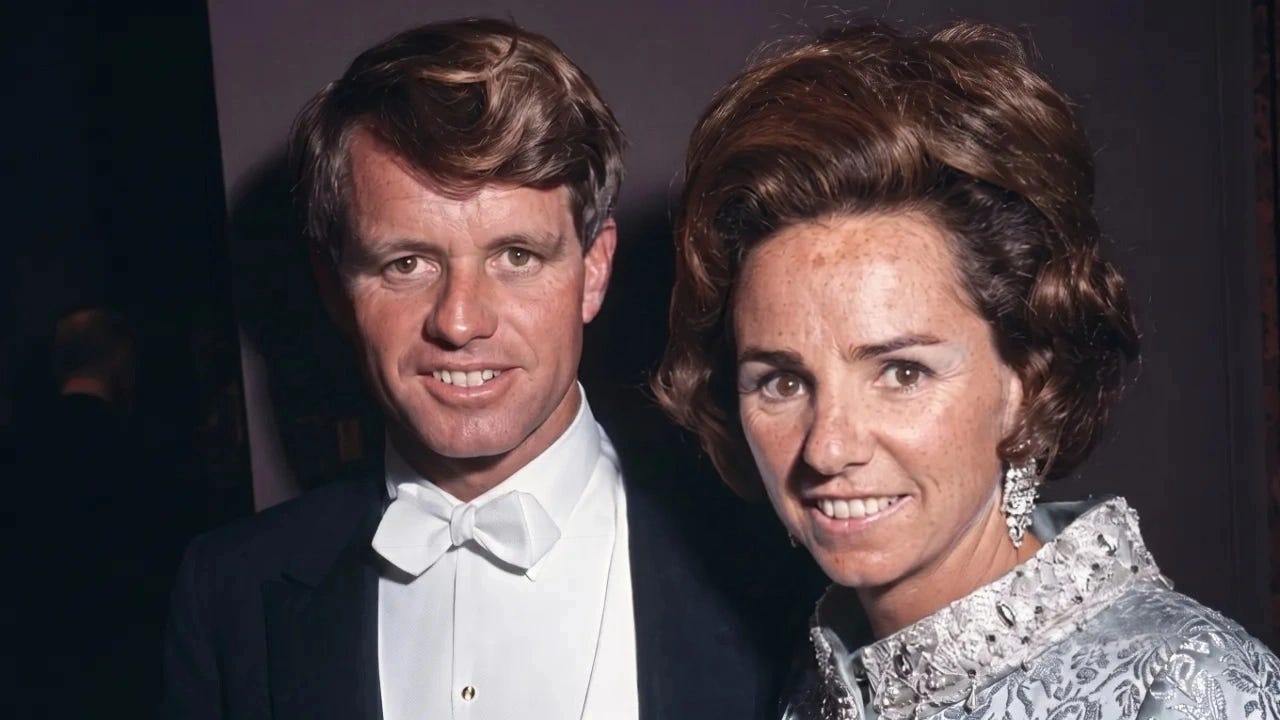
Ethel Kennedy was three months pregnant with her eleventh child on the night her husband was shot in a kitchen pantry at the Ambassador Hotel in Los Angeles.
It was June 5, 1968. She was forty years old, standing in the crowd when it happened, and she reached his side within seconds.
Both of her parents had already been dead for thirteen years, killed together when their private plane went down over Oklahoma. She’d buried them in her twenties. She would bury her husband at forty.
And the family she was about to raise alone would spend the next three decades producing a record of dr*g overdoses, criminal trials, s*xual abuse, and at least one unsolved murder that no amount of Kennedy mythology could fully paper over.
What the public received after June 1968 was the widow’s version: dignified, Catholic, draped in black, raising eleven children behind a family creed about courage and sacrifice that she would repeat for the cameras for the next fifty-six years. What the biographers eventually found was something considerably uglier.
The Fortune Before the Kennedys
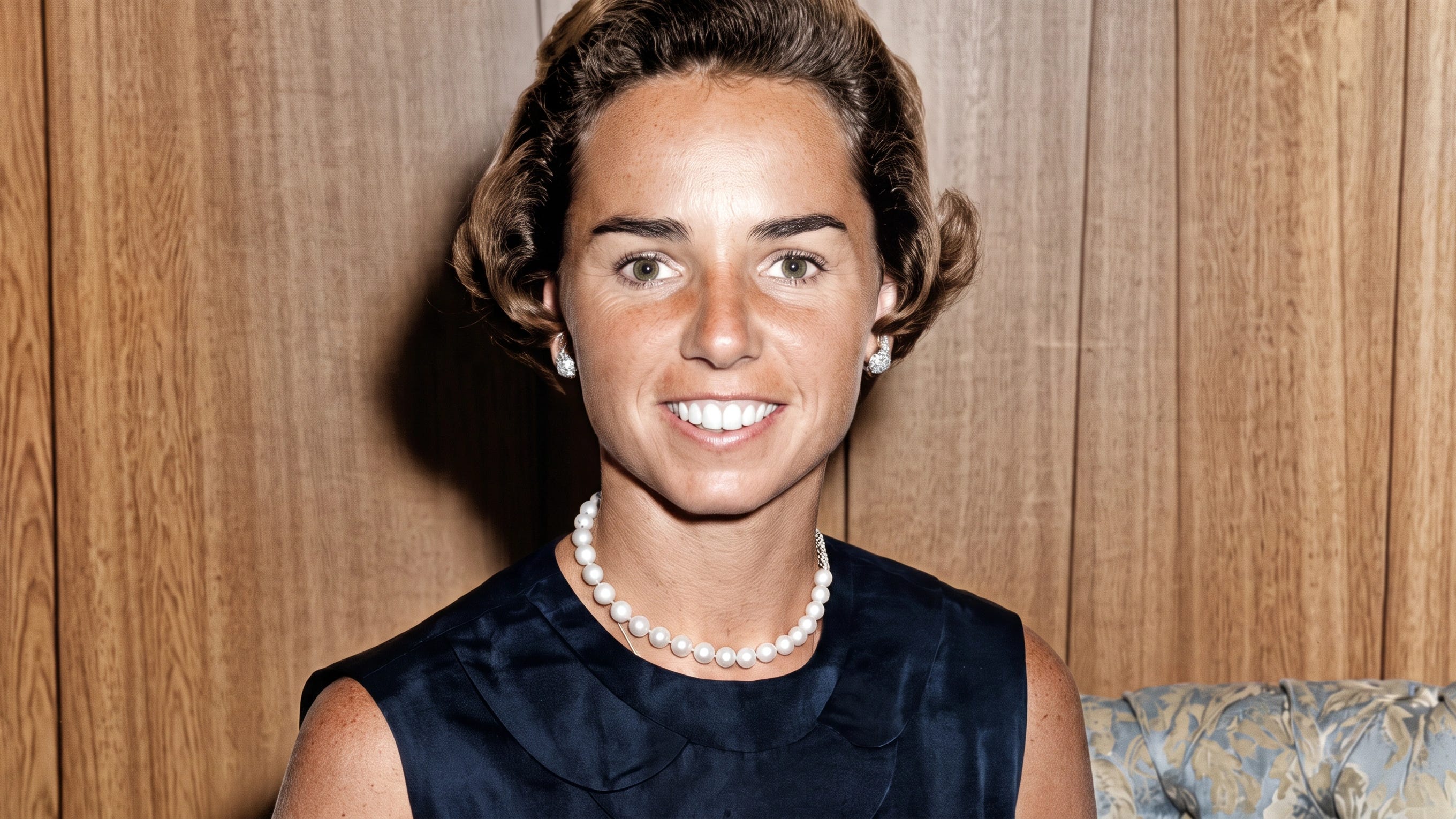
Ethel Skakel wasn’t a poor girl who married into money.
She was the sixth of seven children born in Chicago in 1928 to George and Ann Skakel. Her father started as an eight-dollar-a-week railroad clerk and built the Great Lakes Carbon Corporation into one of the largest privately held companies in the United States.
By some estimates, the Skakel fortune rivaled or exceeded the Kennedys’.
The family settled on a sixteen-acre estate in Greenwich, Connecticut, and one observer captured the difference between the two dynasties Ethel would bridge in a single line: “Old man Skakel paid to keep his name out of the paper, and old man Kennedy paid to put his name in the paper.”
What almost never makes it into the official Kennedy-family retelling is what that Skakel wealth was actually built on top of.
According to Jerry Oppenheimer’s biography The Other Mrs. Kennedy, both George and Ann Skakel were alcoholics, and their seven children, despite a household saturated in Catholic ritual, grew up what Oppenheimer describes as “virtually wild.”
Ethel’s brother Rushton, later a recovering alcoholic himself, remembered the rented family houses as stages for nonstop business entertaining. “There were parties literally every day,” he recalled, “business parties and social parties, and that’s when dad started drinking.”
As small children, Rushton and his siblings would sneak the dregs from adult cocktail glasses into the kitchen and drink them themselves.
By fifteen, Ethel’s older sister Georgeann was already what Oppenheimer describes as a “confirmed alcoholic.” Friends of the family described the Skakel name as a byword in Greenwich social circles for exactly that kind of trouble.
Ethel’s mother was described by those who observed the household as someone “busy socializing, busy shopping” and attending Mass whenever the church doors were open, but who had little time left to actually raise her children. That responsibility fell to the eldest daughter.
The contrast would become sharper a generation later. Ethel herself would face similar criticism after she had eleven children of her own in a household often described as chaotic and insufficiently supervised.
Ethel’s first route into the Kennedy orbit was indirect.
Her older sister Patricia had dated Robert Kennedy, while Ethel’s close friendship with Robert’s sister Jean Kennedy (her roommate at Manhattanville College) brought her into the family’s social world.1
By the time Ethel and Robert began seeing each other, Joseph Kennedy Jr. had already been killed in a wartime plane crash in 1944. They married in June 1950 at St. Mary’s Catholic Church in Greenwich and had eleven children between 1951 and 1968.
In October 1955, five years into the marriage, both of Ethel’s parents were killed when their private plane crashed near Union City, Oklahoma.
Thirteen years later, she would lose her husband to another sudden, public catastrophe.
The Affairs the Family Buried
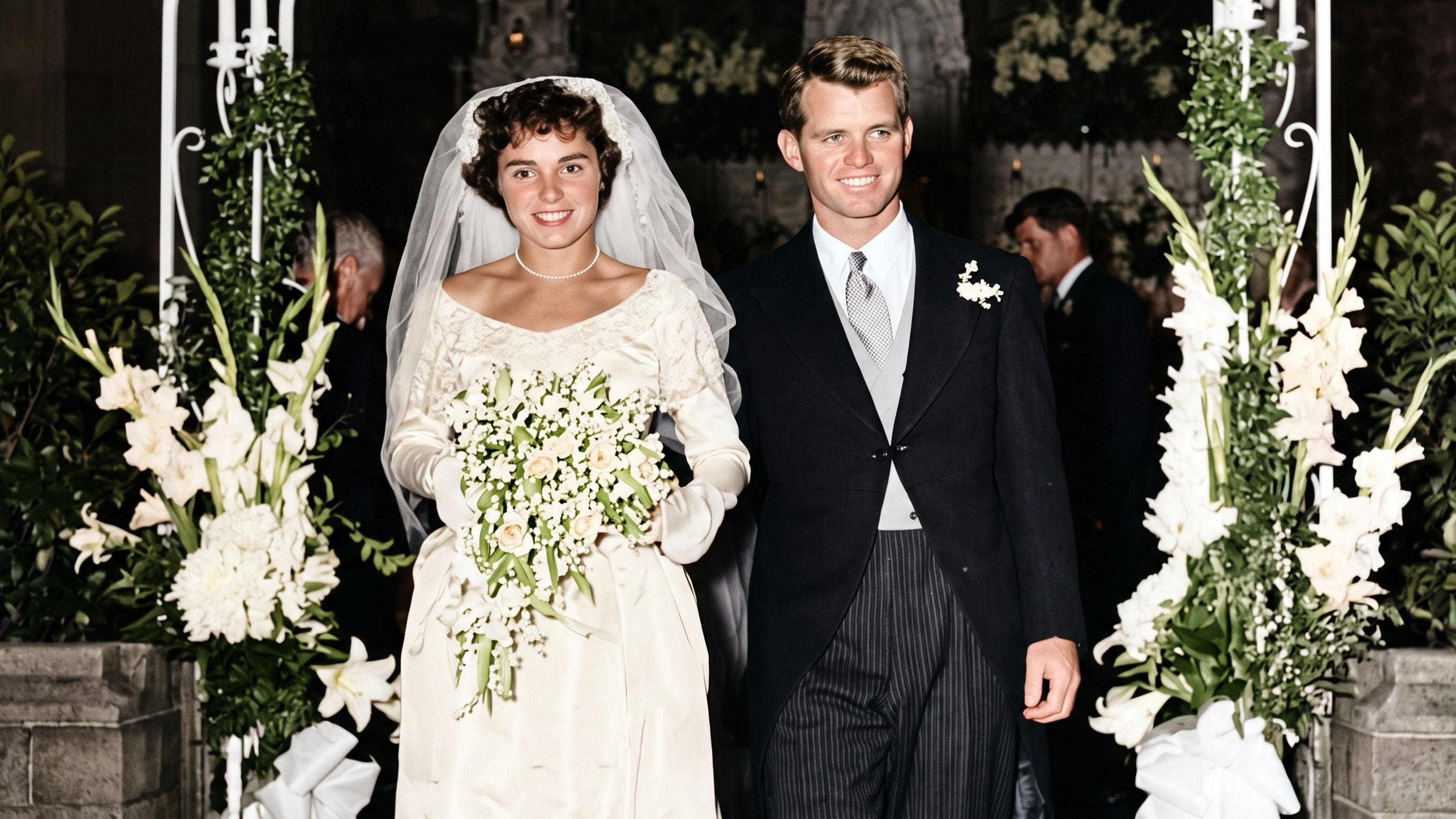
To the outside world, the Bobby and Ethel Kennedy marriage was positioned as the wholesome counterweight to Jack and Jackie’s glamour.
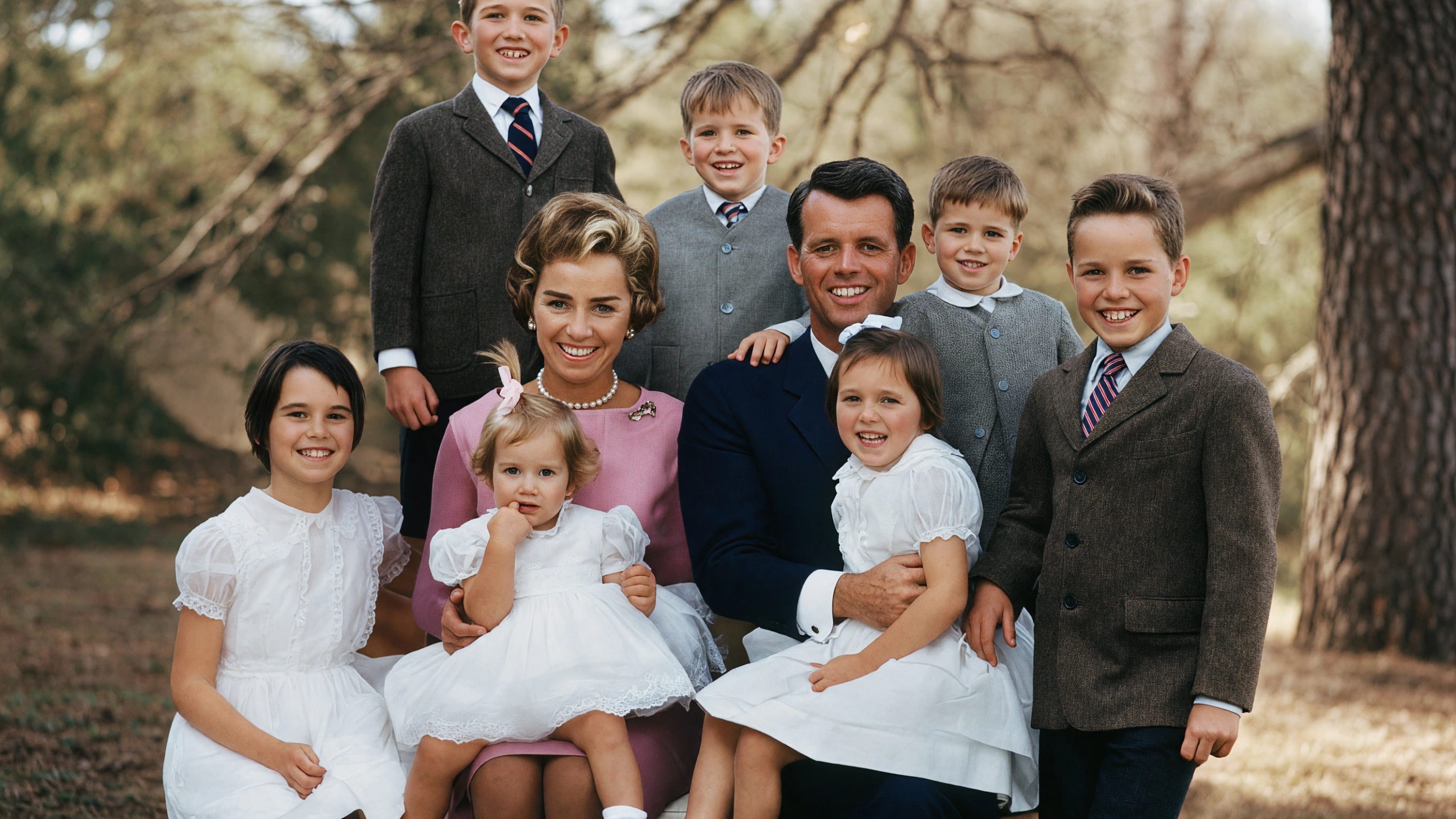
Eleven children, a sprawling Virginia estate, and a wife who seemed entirely devoted. Hickory Hill, their home in McLean, hosted parties with guest lists in the hundreds where cabinet secretaries were thrown into the swimming pool fully clothed and touch-football games ended with someone’s dinner jacket in ruins.
One contemporary account described the evenings as “an odd mixture of high sophistication and childish hijinks” and noted that even invited guests were “fair game” for pranks that could tip from playful to humiliating without warning.
The disorder wasn’t confined to the adults.
Longtime observers recalled Ethel biting the writer George Plimpton on the ankle during one of those football games, a detail that circulated for years as shorthand for how far Hickory Hill’s hospitality could go.
Her brother-in-law Peter Lawford was reportedly stunned to see Ethel berate a newly hired maid over a discarded scrap of paperwork, using language sharp enough that Lawford recounted the incident to others as evidence of a temper he hadn’t expected from the wife everyone described as the family’s moral center.
But the pranks, the chaos, and the temper were the surface noise. Underneath the swimming-pool antics and the ruined dinner jackets…
Bobby Kennedy was living a private life that the family would spend decades trying to keep out of print.
Robert Kennedy’s reputation as the faithful brother was, at best, a managed exaggeration.
Kennedy scholar Larry Tye concluded that Robert “most likely had affairs” but that Ethel nonetheless remained “his one true love,” a formulation that manages to acknowledge infidelity while protecting the marriage’s central mythology. The specific allegations that surfaced after his death demolished that careful framing.
The most explosive involves Marilyn Monroe.
Multiple accounts, including material surfaced through FBI files, allege that Robert carried on a romantic relationship with Monroe and promised to leave Ethel to marry her, a promise Monroe eventually realized he had no intention of honoring.
According to reporting from journalist Maureen Callahan, cited by actress Shirley MacLaine, Monroe was alone with Robert Kennedy in a dressing room for fifteen minutes just thirty minutes before she famously sang “Happy Birthday, Mr. President” to John F. Kennedy at Madison Square Garden in May 1962.
Both Kennedy brothers, involved with the same woman, within the same hour, under the same roof.
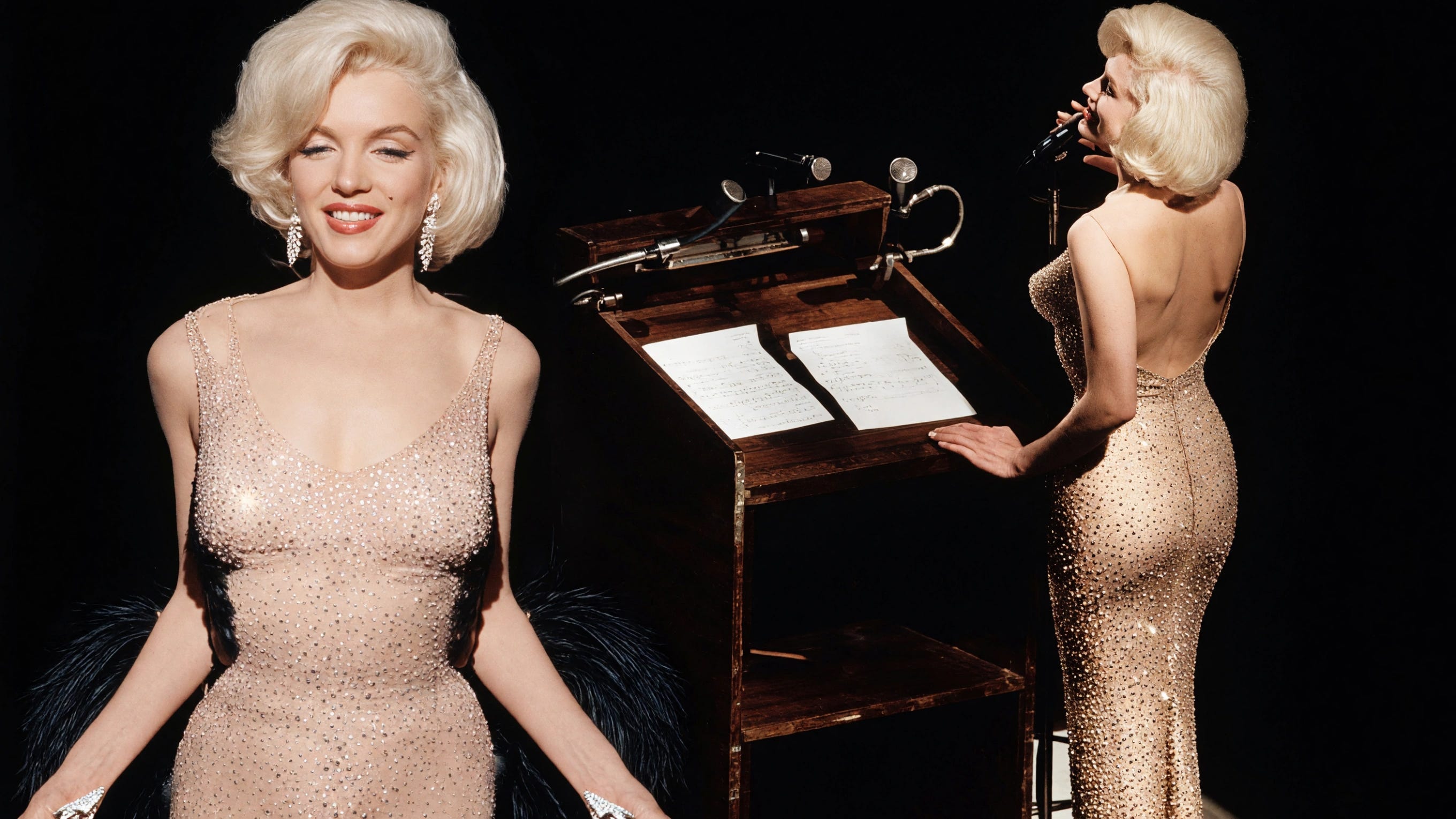
Several accounts go further, alleging that Robert visited Monroe’s Los Angeles home in the hours before her death in August 1962 to end the affair, a visit some writers argue precipitated the final crisis of her life. The claim remains contested and unproven.
Then there is the allegation that strikes closest to the family’s own mythology.
C. David Heymann’s 2009 book Bobby and Jackie: A Love Story alleges that Robert Kennedy and Jacqueline Kennedy began a romantic relationship within months of the president’s assassination, lasting roughly four years.
Heymann has said the account draws on interviews and previously unavailable Secret Service and FBI reports from 1964 to 1968, released under the Freedom of Information Act. Arthur Schlesinger’s own account, cited by Heymann, describes a May 1964 dinner cruise on the presidential yacht Sequoia during which Bobby and Jackie disappeared below deck together while Ethel remained alone upstairs. When the pair returned, Schlesinger wrote, “they looked as chummy and relaxed as a pair of Cheshire cats.”
The same account claims Ethel eventually begged a family friend to intervene, asking them to:
“Tell Bobby to stop sleeping with Jackie.”
Whether or not the affair unfolded precisely as Heymann describes, the portrait it paints of Ethel’s position is what matters. This was a wife raising a rapidly expanding family largely alone at Hickory Hill while her husband’s name kept surfacing next to other women, first in whispered Georgetown gossip, later in published biographies that neither Robert nor Ethel lived to see printed.
“Poor Ethel”
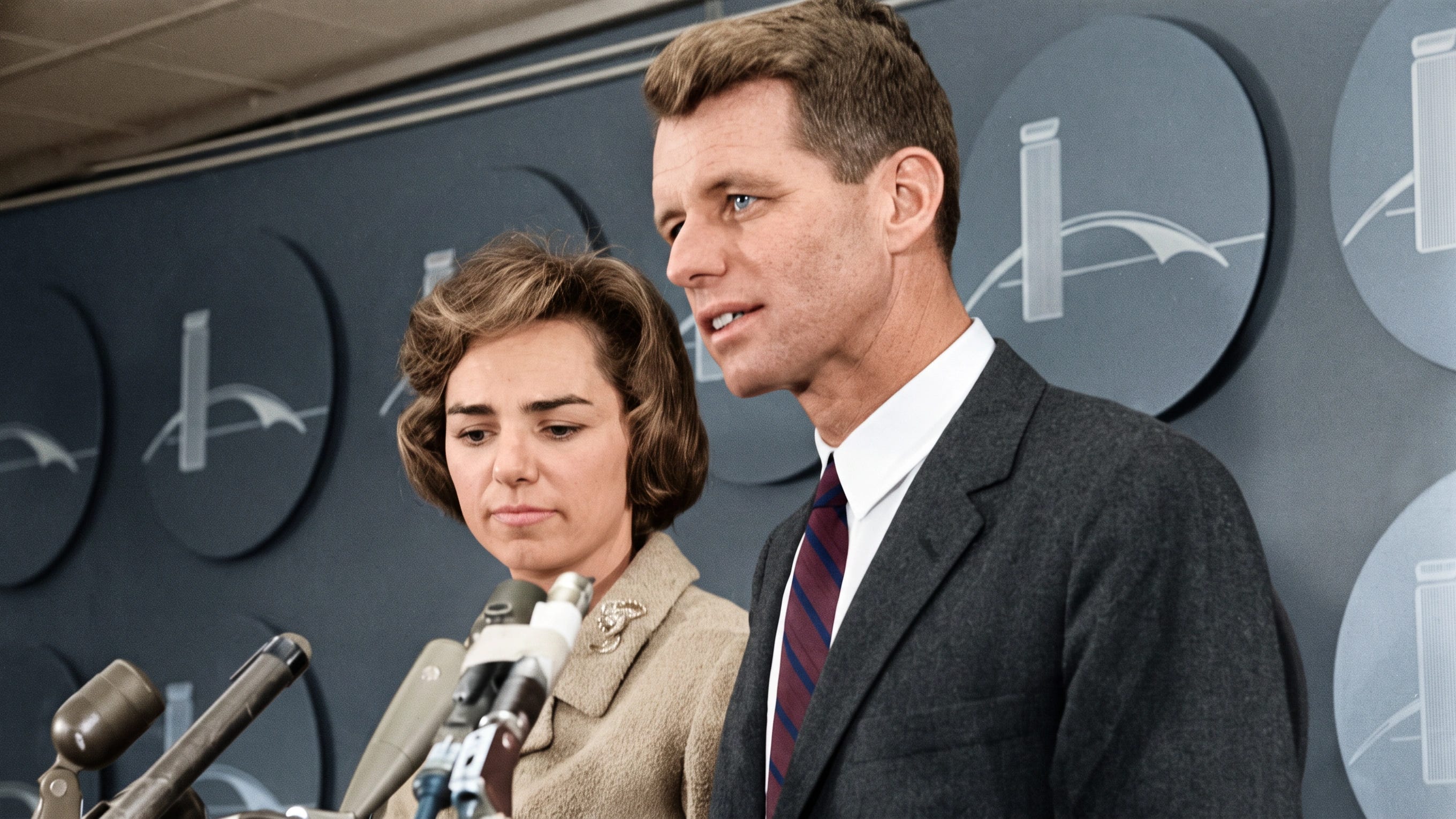
Robert Kennedy was shot in the kitchen pantry of the Ambassador Hotel moments after declaring victory in the California primary.
Ethel, three months pregnant with their eleventh child, was in the crowd and reached him within seconds. She was forty, with ten living children and one on the way, and she would never remarry.
Friends recalled that in the weeks following the assassination, Ethel would abruptly stop whatever she was doing and murmur, “Poor Ethel,” as if she were speaking about someone else entirely.
Those around her understood it as the mind’s only available strategy for surviving what it couldn’t absorb. Hate mail arrived in waves for years afterward, a reality almost never mentioned alongside the public image of stoic Kennedy composure.
She had now, twice in thirteen years, lost the people closest to her in sudden public catastrophe. Her parents together in 1955. Her husband in front of a ballroom crowd in 1968. She spent decades fighting to keep Sirhan Sirhan from parole, writing to the California Parole Board as recently as 2021 that “our family and our country suffered unspeakable loss due to the inhumanity of one man.”
What she couldn’t fight, and what no parole board could address, was what was already happening inside the house she now ran alone.
The Rap Sheet
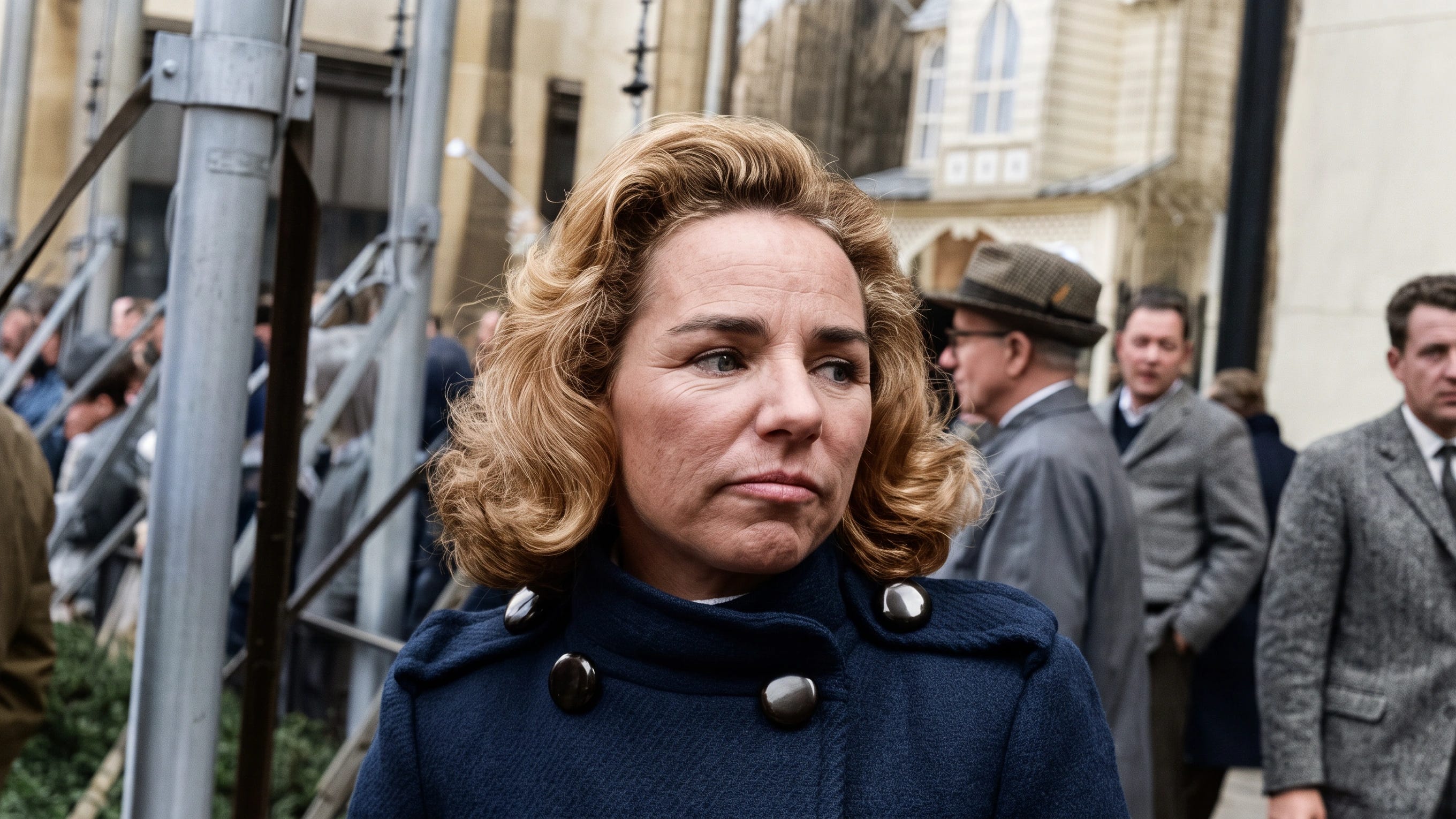
The eleven children Ethel raised after 1968, largely without their father for most of their adolescence, produced a record that Vanity Fair, in a 1997 investigation, called “a rap sheet disproportionate to their numbers.”
Oppenheimer’s biography paints a bleaker picture of Hickory Hill than the family allows. He alleges Ethel was a chronically inattentive parent even before her husband’s death and never fully recovered after it, treating her children as afterthoughts to a life consumed by causes, social obligations, and unprocessed grief.
A former nanny said it plainly: “There wasn’t anybody to say, ‘Don’t do that.’ It was hard to control them.”
Oppenheimer alleges that Ethel’s temper could turn physical, claiming she once struck her son Robert Jr. with a hairbrush, and that explosive verbal outbursts were common.
In one incident she reportedly screamed at him, “Just leave home. Get out of my life!”
His summary of the household’s default response to any crisis was memorable: “circling the wagons to protect the cesspool.” The family’s instinct, every time, was to close ranks and manage the story rather than address the damage that had produced it.
The damage, across the following decades, compounded itself with a regularity that looked less like bad luck and more like inheritance.
Robert Kennedy Jr. was expelled from a series of boarding schools, began using dr*gs as a teenager, and was arrested for heroin possession in South Dakota in 1983. He later described fourteen years of active addiction before sustained recovery.
David Kennedy died at twenty-eight of a combined c*caine, Demerol, and sedative overdose at the Brazilian Court Hotel in Palm Beach in April 1984, after what those close to him described as a long, visible spiral that no one in the family intervened to stop.
Michael Kennedy, RFK’s sixth child, was revealed in 1997 to have carried on a years-long s*xual relationship with the family’s babysitter. The relationship began when the girl was fourteen. The story broke in the Boston Globe just as his marriage was collapsing.
Joseph Kennedy II caused a car accident on Nantucket that permanently paralyzed a young woman who was, at the time, his brother David’s girlfriend.
William Kennedy Smith, Ethel’s nephew by marriage, was tried and acquitted of r*pe after a night out that also involved Senator Ted Kennedy.
Christopher Kennedy, one of the siblings, acknowledged the pattern directly rather than deflecting it. “No one has hidden behind alcoholism as an excuse for inappropriate behavior,” he told Vanity Fair, “but all of us clearly understand the link.”
He added, only half joking, that in Hyannis Port “it’s easier to get an A.A. meeting together than a touch-football team now.”
Yet, this level of instability wouldn’t be confined to Ethel’s own household.
The Golf Club in Greenwich
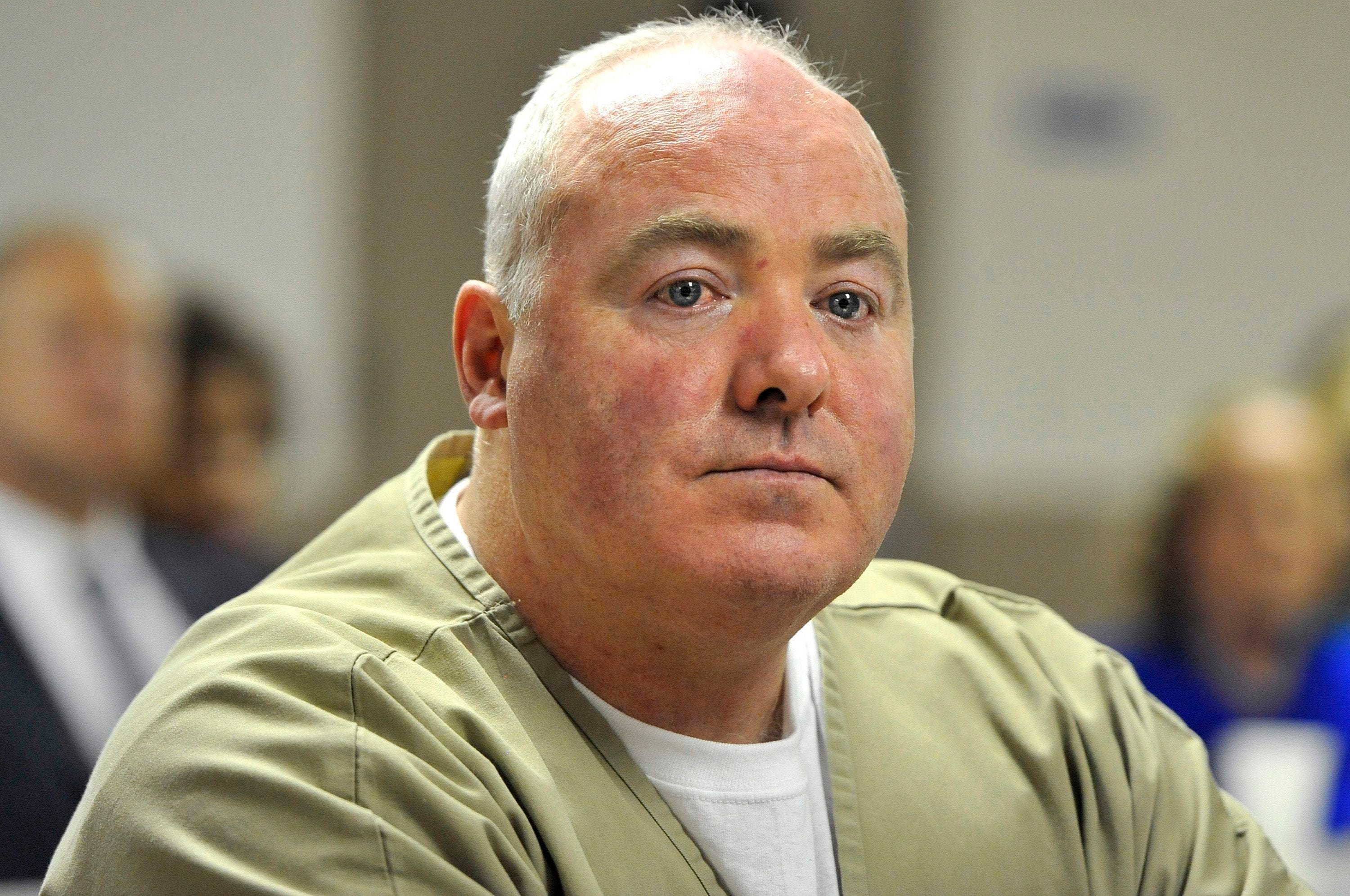
In October 1975, fifteen-year-old Martha Moxley was bludgeoned to death with a golf club in Greenwich, Connecticut. Her body was found in her family’s own backyard, directly across the street from the Skakel home.
The suspect who eventually emerged, more than two decades later, was Michael Skakel, son of Ethel’s brother Rushton.
Ethel’s nephew.
Michael Skakel was convicted of the murder in 2002 and sentenced to twenty years to life. His conviction was overturned by the Connecticut Supreme Court in 2018 after he had served more than eleven years, on grounds of inadequate defense counsel, and prosecutors declined to retry him.
Robert Kennedy Jr. publicly championed his cousin’s innocence, co-writing a book in 2016 arguing that Skakel had spent over a decade in prison for a crime he didn’t commit.
The case has never been resolved to the satisfaction of Martha Moxley’s family, who have maintained for fifty years that Skakel was responsible.
It is a detail almost never mentioned alongside Ethel’s own story, and it belongs there. The same Skakel bloodline that produced the fortune, the Greenwich estate, the cocktail-glass childhoods, and Ethel’s eventual passage into the Kennedy family also produced, one generation later, one of the most notorious unsolved murder cases in American tabloid history. The money just made it easier to contain.
The Woman at the Head of the Table
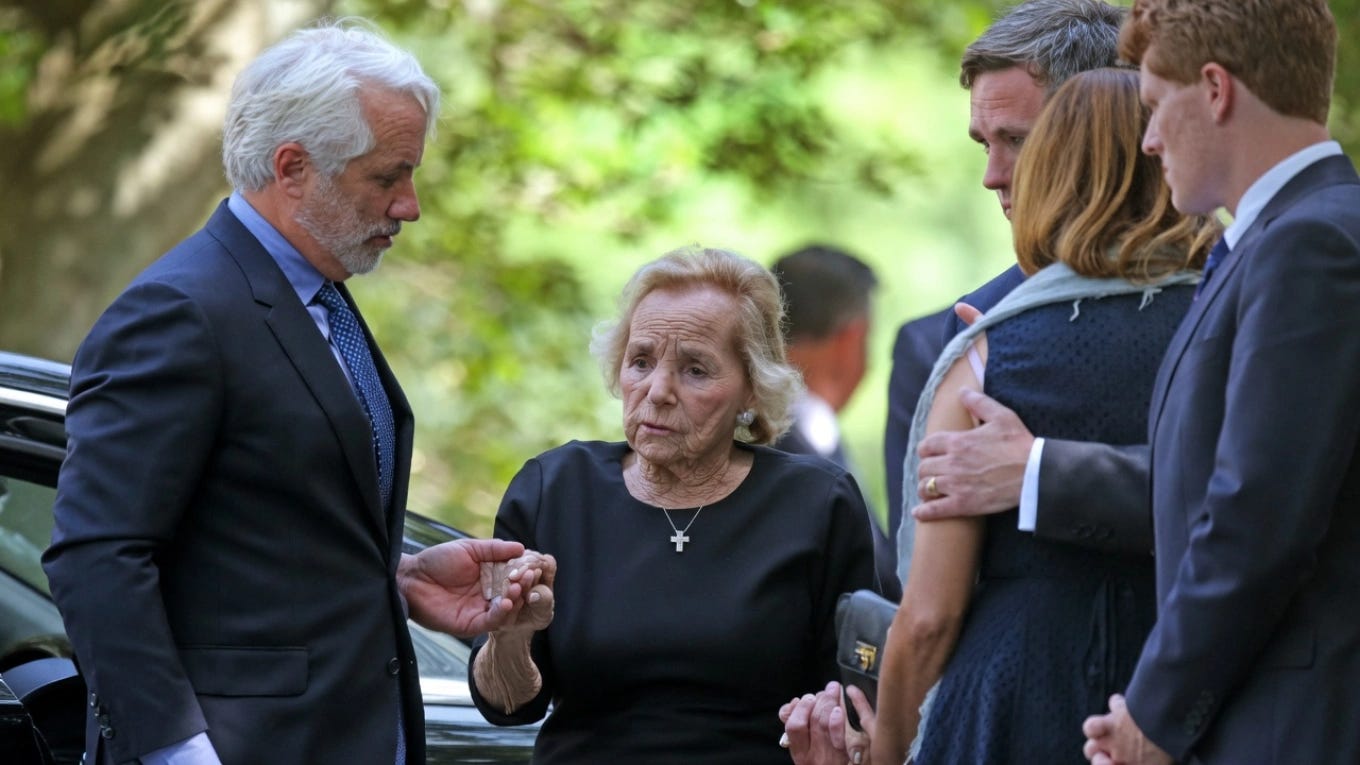
Ethel Kennedy never remarried, never retreated, and never disappeared into the fortune the way the Skakel women before her had been trained to do.
She founded the Robert F. Kennedy Memorial Center and became the family’s final authority on what it meant to carry the Kennedy name as a wife, a role she held for fifty-six years with a discipline that outlasted every scandal, every arrest, and every obituary written about her children.
Television depictions in later decades showed her interrogating a young Carolyn Bessette on gun-control policy at the family dinner table, correcting the newer generation’s manners in real time.
Her daughter-in-law Cheryl Hines, married to Robert Jr., described her upon her death in October 2024 at ninety-six in the language the family has reached for after every catastrophe for seventy years:
“Her charisma... it has been my great honor to have shared laughter and love with Ethel.”
It is the same register deployed after the plane crash in 1955 and after the shooting in 1968. A language of grace and continuity, laid on top of a record that includes an unfaithful husband, a household inherited from one generation of alcoholism and passed intact into the next, a matriarch whose grief hardened into something closer to armor than to healing, eleven children who absorbed both the fortune and the wreckage, and a nephew tried for murder in the same small Connecticut town where the Skakel money was first spent.
Ethel sat at the head of that table for more than half a century. The photographs show a woman in command. The biographies describe a woman who survived by deciding, early and permanently, that the only version of her story the world would ever see was the version she chose to tell.
COMMENT: Is it worse to be born into two powerful dynasties than just one? We’ve seen a lot of tragedy in Athina Onassis and now Ethel’s children’s life stories.
Correction, August 8, 2026: An earlier version of this article incorrectly stated that Ethel Skakel dated Joseph P. Kennedy Jr. RFK Sr. biographer Michelle Mahoney has indicated that Robert F. Kennedy first dated Ethel’s older sister, Patricia Skakel, and that Ethel’s connection to the Kennedy family developed later through her friendship with Jean Kennedy. The text has been updated.
I was in a salon room in Cambridge Mass in the 1980s next to Ethel Kennedy and could hear her berating and humiliating the attendant
She was a horrible person and the children she raised shows it
I always have problems with the Camelot myth around the Kennedys. The truth is that they were human and money and “the myth” gave them a cover and latitude most people do not have and they hurt many people along the way.