
The apartment was modest.
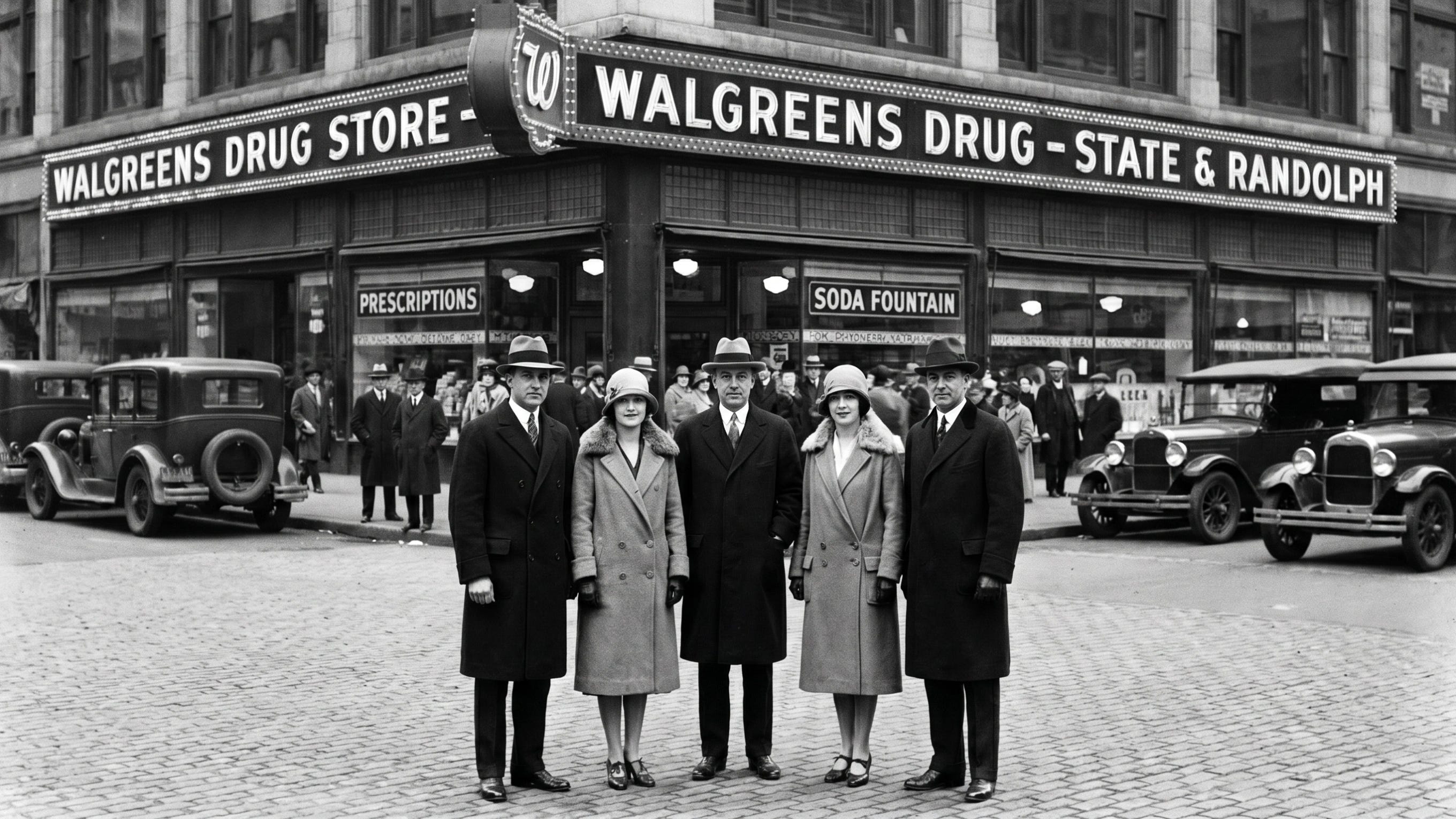
Berkeley, Illinois sits 40 miles from Lake Forest, the North Shore enclave where his father lived in a home worth more than most people’s lifetimes.
And, in the spring of 1996, police found the body of Tad Walgreen in that apartment, second son of the man who had run America’s most recognized pharmacy chain for three decades.
He was 36, facing criminal charges for stealing prescription painkillers from a Walgreens store, and he died of a cocaine overdose.
His grandfather Charles Rudolph Walgreen Sr. had built the company from a single Chicago drugstore in 1901, and his father Cork Walgreen III had taken annual sales from $817 million to $13 billion. The family name was on the door of nearly 3,000 stores nationwide, yet Tad died in a town most Americans have never heard of, in the inverse of everything the name was supposed to guarantee.
40 miles… the precise distance between the inheritance and what it produced when it reached a man the dynasty could not accommodate.
Today’s story is about architecture.
About the specific structure of a dynasty built on controlled substances, and what happens when that structure meets its own blood.
The Empire Built on Controlled Substances
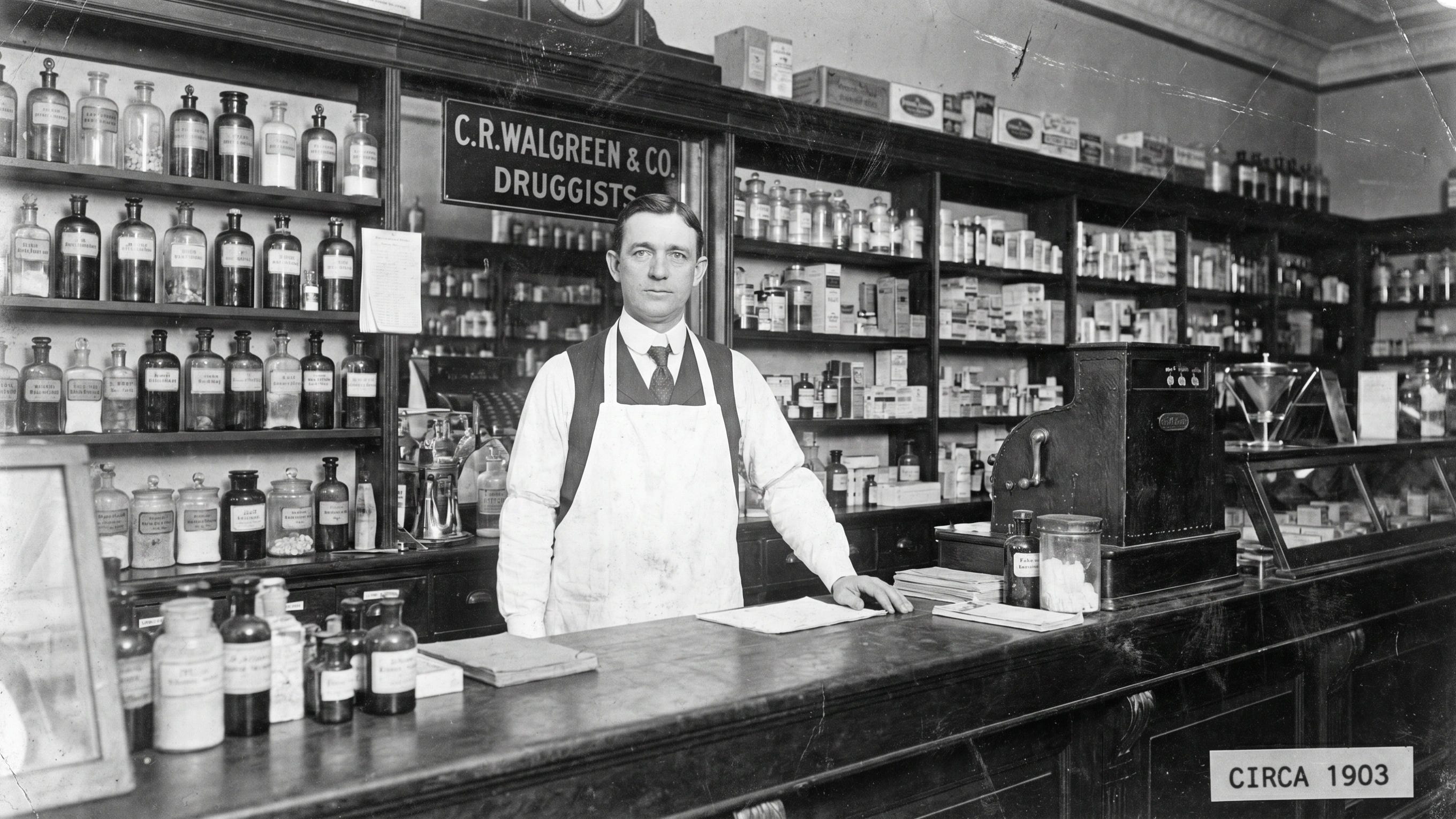
In 1901, Charles Rudolph Walgreen Sr. paid $6,000 for a drugstore on Chicago’s South Side. The seller was a man named Isaac Blood, and the original sign above the door read: “Blood-Walgreen Drug Company.”
The name would not last, but the ambition would.
Now, Walgreen Sr. had been born in 1873 in Dixon, Illinois, the son of a Swedish immigrant. He was a merchant with an eye for systems and the geometry of retail. He opened a second store in 1909, and by 1916 he owned nine stores and had incorporated as Walgreen Co.
Then came Prohibition.
The Volstead Act of 1919 prohibited the manufacture and sale of alcohol, but it included a provision that would prove enormously profitable for the right kind of business: pharmacies could fill prescriptions for “medicinal whiskey.” Physicians could write the prescriptions, pharmacists could fill them, and the government had effectively created a licensed distribution channel for the very substance it had banned.
Walgreen understood this immediately. He had 20 stores in 1919.
He had 525 by 1929.
The official Walgreen story has always credited the malted milk shake, introduced in 1922, and the soda fountain became the company’s public face. Yet historian Daniel Okrent noted with precision that “milkshakes alone did not produce that growth.” The growth came from being, in the most literal and legal sense, America’s preferred conduit for a controlled substance that its citizens could not otherwise obtain.
The model was elegant: give the public access to relief, wrap it in the language of medicine, and scale the delivery infrastructure to industrial size. Furthermore, the demand was already there, written into the bodies of its customers.
Walgreen Sr. died in December 1939. There were more than 490 stores by then, the Blood-Walgreen sign had been taken down long ago, and only one name remained above the door.
The Man Who Made It Permanent
Charles Rudolph Walgreen Jr. held the company steady after his father’s death and handed it, intact, to his own son. Yet it was his son who made the name synonymous with American retail dominance.
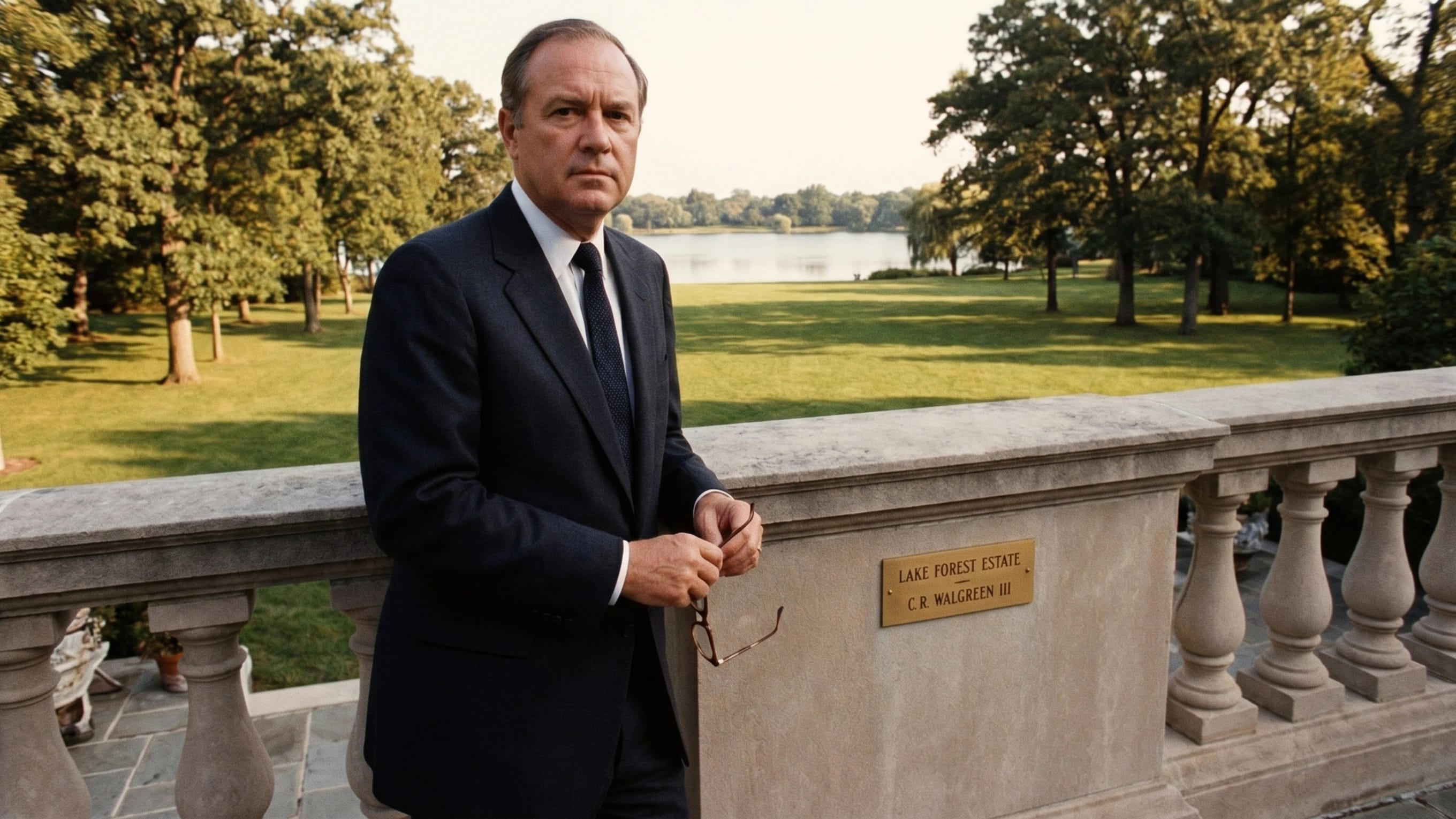
Cork Walgreen III took the chairmanship and built it into something the founder could not have anticipated. Under his leadership, annual sales rose from $817 million to $13 billion, the market capitalization increased from $164 million to $19 billion, and the chain expanded to 2,894 stores. The third generation had multiplied the inheritance by orders of magnitude.
He lived in Lake Forest, sat on boards, and the Walgreen name preceded him into every room he entered.
Cork had two wives. With his first he had three sons, of whom Tad was the second. That marriage ended, and the sons grew up far removed from the Lake Forest lifestyle their father came to occupy. The estrangement was widely known among those close to the family, yet it received no coverage in the business press.
Cork remarried his second wife Kathleen and built a life in Lake Forest. He stepped down as chairman in 1999, and in January 2009 the last member of the founding family formally separated from the institution. The Walgreen name remained on the sign above 3,000 doors. No Walgreen remained inside any of them.
It was the end of an era… though something had gone very wrong years before the retirement announcement. The Walgreen name was on the door of the store where a man with that name was arrested for stealing painkillers from the shelves.
That man was Cork’s son.
The System Could Not Tell Who Was at the Counter

In the grammar of dynasty collapse, an outsider usually introduces the poison: a bad marriage, a hostile creditor, a rival who sees the weakness. The Walgreen story follows a different grammar. The operator here was the system the family had built, running forward into a generation that could not use it the way the founders had intended.
Tad’s full name was Charles Alexander Walgreen.
He grew up far from the Lake Forest estate his father came to occupy after the divorce, and the estrangement was documented in the texture of his adult life: jobs held in Colorado and Arizona, a sequence of legal problems, no visible connection to the company his family had built. He struggled with alcohol, and in the late 1980s ended up in a suburban rehabilitation hospital outside Chicago. That is where he met the woman who would become his wife.
Loren was born in 1968 and had been living with chronic depression since her teenage years. She was being treated at the rehabilitation hospital for that depression when she met Tad, and they married in 1988. He was a Walgreen. She was 20 years old. They had two children in rapid succession: Alex in 1989 and Brooke in 1990.
There was no inheritance flowing in, no corporate position, and no formal support structure from the family. There was only the name, and the distance between what it meant on the door of 3,000 stores and what it meant inside the apartment.
By the early 1990s, the marriage was in active collapse. Tad was incarcerated at Joliet Penitentiary for drunk driving, and Loren’s depression had deepened into a condition documented in numbers that would later be read aloud in open court.
In 1993, following a s**cide attempt, her mother Patricia Goldbortin took temporary custody of Alex and Brooke, and the Walgreen family stepped in to arrange a nanny. Then, in October 1993, Cork and Kathleen obtained their own temporary custody order.
Loren began fighting to recover her children in 1994. She retained legal counsel, entered treatment, and documented her progress, yet the fight pitted a woman with a psychiatric history and no money against the legal infrastructure of a multibillion-dollar family whose name appeared above the pharmacy counter in cities across America.
The asymmetry was the outcome.
Two Deaths, One Ledger
The custody trial came before Circuit Judge Stephen Yates in 1996. The Walgreen family’s attorneys presented a systematic documentation of Loren’s history: 13 alleged suicide attempts (a number she disputed), 35 hospitalizations, and 9 drug-related arrests. Cork had been sending Loren $900 per month while Tad was incarcerated, and when the money was not being applied to rent, he redirected the payments directly to her landlord. The financial support was real, and so was the surveillance required to administer it.
Loren’s words in court were precise: “Money equals power. It grants them permission to take my children.”
By the time of the trial, Tad was facing a different set of charges. He had been arrested for stealing prescription painkillers from a Walgreens store. From the company his grandfather had built from a $6,000 purchase in 1901, from the shelves that bore the name he had inherited.
He was 36. He was broke. He was a Walgreen.
Before the trial concluded, Tad agreed to allow Cork and Kathleen to legally adopt Alex and Brooke. His legal situation was deteriorating, his health was deteriorating, and his ability to provide for the children was near zero. He was agreeing to give his children the protection of the very name that had already failed him personally.
He signed the paperwork and did not survive to see what it produced. In the spring of 1996, police found him dead in the apartment in Berkeley.
C**aine overdose.
The criminal charges were rendered moot, and Loren was left to continue the fight alone. Without the resources to match her opponents, she eventually agreed to the adoption. The children remained in Lake Forest, and the legal file appeared closed.
Then she tried to reverse it.
She filed an appeal to rescind her consent, arguing that she had agreed under circumstances of grief and legal exhaustion that called the voluntariness of the consent into question. A hearing was scheduled, and the machinery of family court was still in motion when, in December 1999, police discovered her body in a rundown basement apartment on Chicago’s West Side. She was 31, the cause was apparent drug overdose, and no charges were filed.
The Chicago Tribune called it “a devastating conclusion to one of the nation’s most publicized child custody disputes.” Cork’s response came through his attorney: “Despite our efforts to assist Loren in overcoming her struggles, sadly, the drugs proved to be too powerful in the end.” Alan Toback, Loren’s attorney, offered a different accounting: “The Walgreens possess immense wealth, yet they did nothing beyond taking her children away.”
Their biological father had died at 36 stealing pills from the family store, while their biological mother had died at 31 in a basement apartment on the West Side of the city where the dynasty had begun.
Alex and Brooke were Walgreens now, in the full legal sense, with all the protections and all the weight that name could provide.
In 2021, Walgreens Boots Alliance agreed to pay $6 billion to settle opioid-related claims connected to its role in the pharmaceutical distribution system. By then the founding family had been out of management for years, and the settlement did not bear the Walgreen name in any personal sense. The company’s attorneys negotiated it. The Walgreens themselves were not in the room.
The Rule: You Cannot Sell the Antidote to the Poison You Distribute
A family that builds its fortune on the distribution of controlled substances is in the access business. The product is proximity to relief, not relief itself.
That distinction is invisible during the growth phase, when the stores are multiplying and the revenue is compounding and the name is becoming synonymous with American consumer life. It becomes visible at the point of inheritance, when the system that built the fortune encounters the people who were supposed to benefit from it and reveals what it was designed to do, and for whom.
The Walgreen family sold relief from pain. By the time Tad Walgreen was stealing prescription painkillers from a Walgreens store, the direction of the transaction had simply reversed.
The original sign said Blood-Walgreen. It was more accurate than anyone intended.
So, if you look closely at any family fortune built on something addictive, you will see the same shape. The product reaches everyone eventually. Even the people whose name is on the door.
Killed his own son with his neglect, then buys his children.
I watched the YouTube of this as well. Very interesting look at a family that spiraled.