
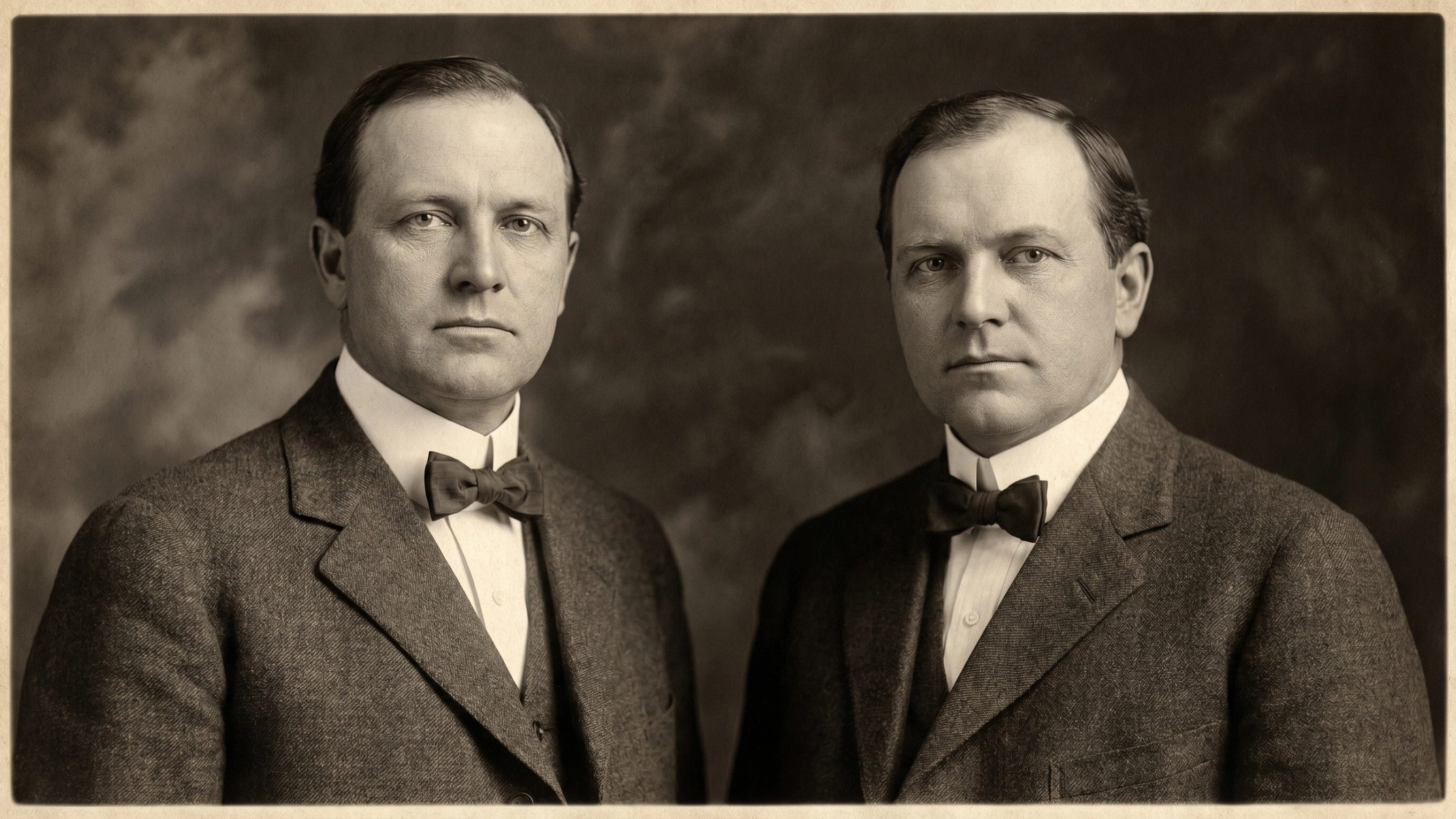
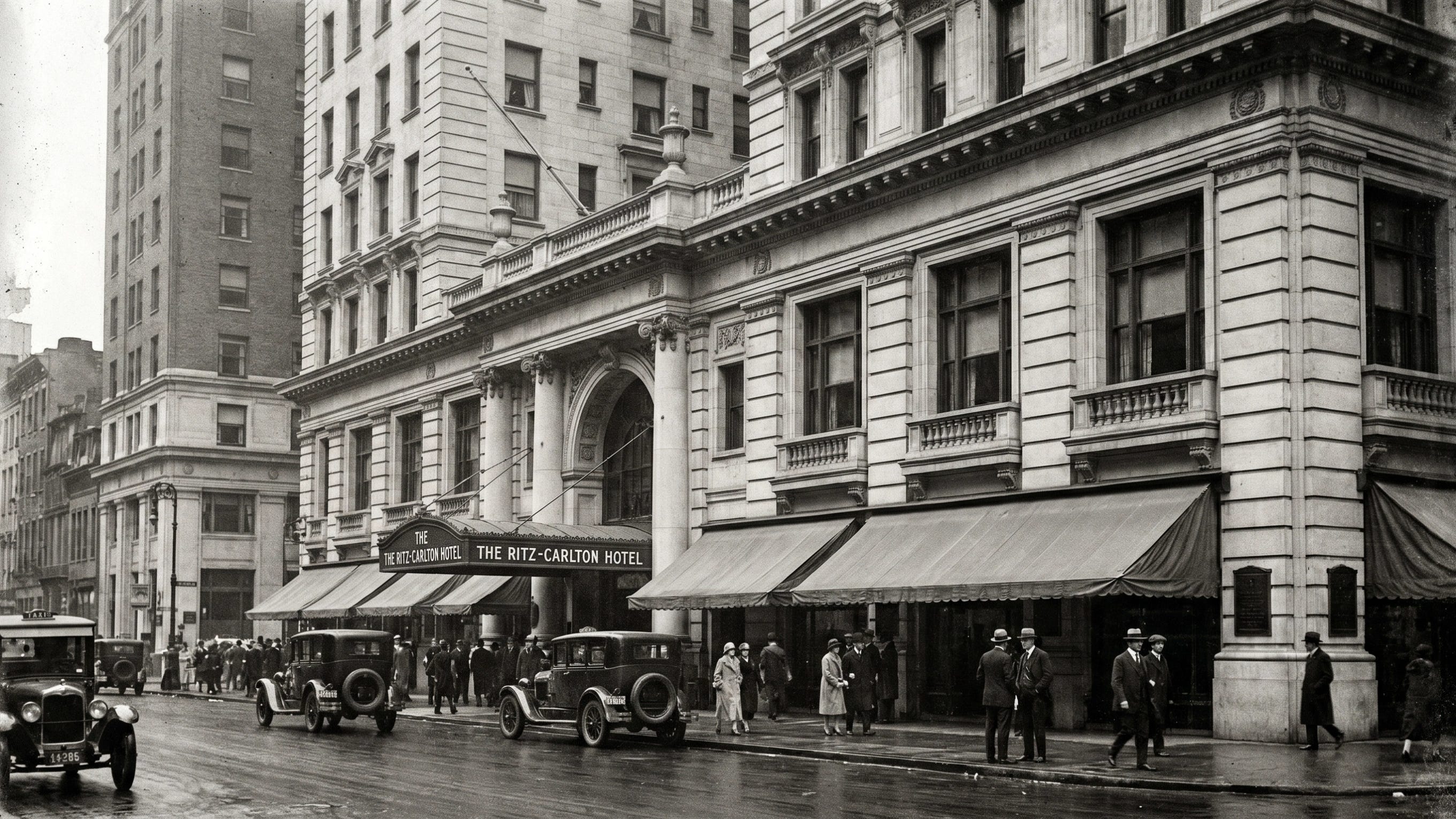
The hotel suite at the Ritz-Carlton smelled of cut flowers and cigarette smoke. Outside, January 1920 pressed against the glass of Manhattan, cold and indifferent. Inside, the New York Auto Show moved through banquet rooms and motor displays. Olds. Chevrolet. Ford. And the Dodge brothers. John, red-haired and enormous, working a crowd. Horace, quieter, watching.
Neither brother would survive the year.
John Francis Dodge would be dead in 14 days, at 55, in that same hotel. Horace Elgin Dodge would follow him 11 months later, at 52, in Palm Beach. They had built Henry Ford’s entire drivetrain, then left him, built their own car, and within 5 years become the second-largest automaker in America. They had done everything right.
$146 million.
That is what their company sold for, 5 years after they died. Neither widow understood what she held. Neither understood what she was agreeing to. The man who wrote that check understood both.
This is the story of how elite families lose dynasties not through incompetence, but through the precise application of financial architecture they were never taught to read.
Detroit, 1913: When the City Was Still Possible
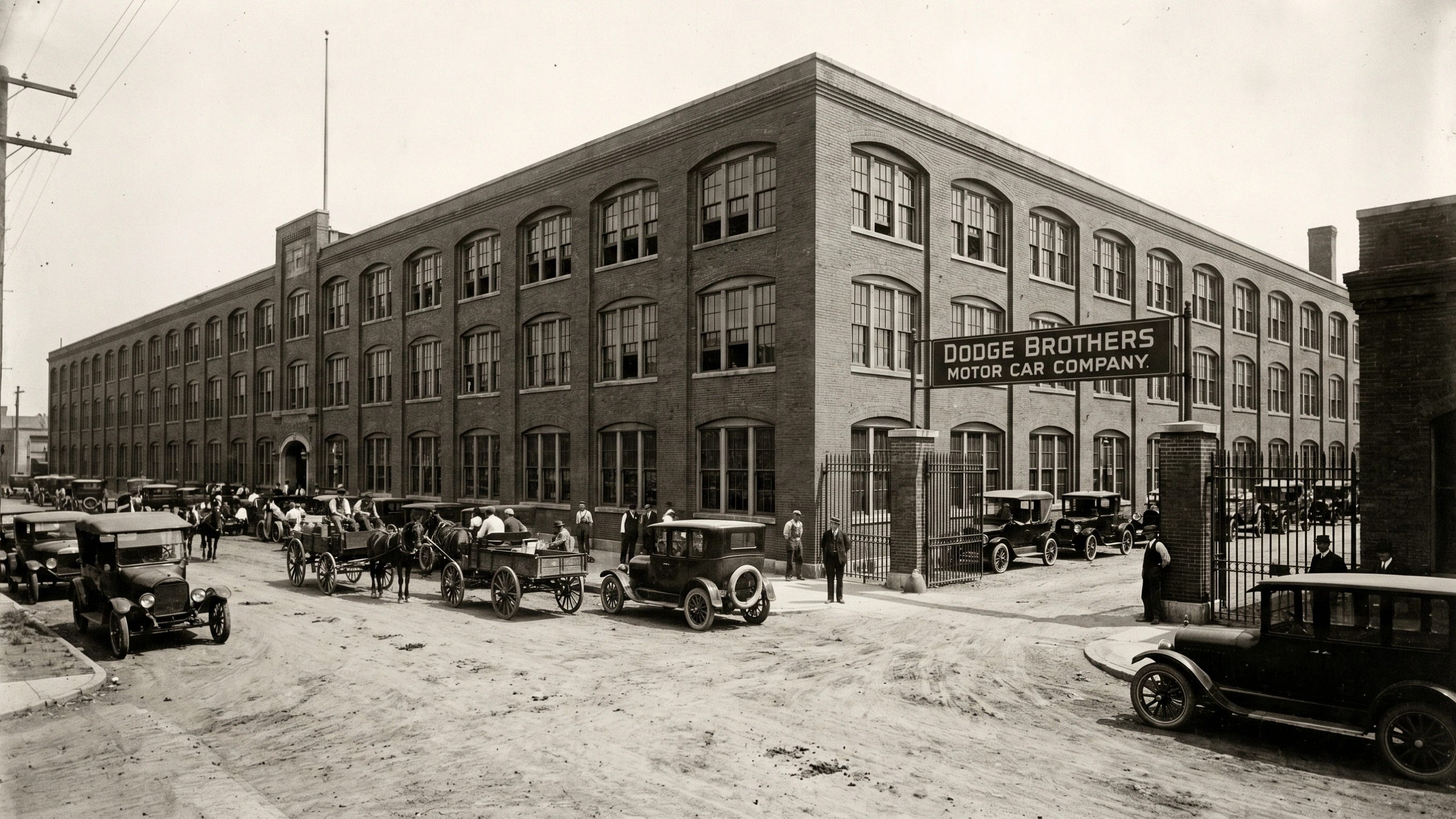
There are cities that understand, briefly, that they are at the center of the world. Detroit in the first decade of the 20th century was one of those cities. The automobile was not yet a consumer product. It was still an event. The men who built it were still young enough to be surprised by their own fortunes.
The Hamtramck plant sat on 24 acres.
It employed 5,000 workers. It was capable of producing a quarter-million transmissions, rear axles, crankshafts, and front axles per year. Every one of them went into a Ford.
By 1913, the machine shop the brothers had opened 13 years earlier with borrowed capital had made them worth $50 million. Ford’s 10% stake in their portfolio alone accounted for $10 million of that. They were not speculative millionaires. They were operational ones. Their wealth sat on real, running machinery, on patents, on floor space, on trained labor.
Detroit’s automotive elite had crystallized into a hierarchy recognizable to anyone who has studied American industrial aristocracy: the founders at the top, the engineers below them, the bankers circling at the perimeter, waiting. The Dodges occupied a peculiar position. Richer than most. Tougher than most. Not socially acceptable to the drawing rooms of Grosse Pointe, which is not an opinion but a documented social fact.
Matilda Rausch had married John. Anna Thomson had married Horace. Both women understood their husbands built things. Neither was prepared to be a widow in the financial architecture business.
The city believed it was permanent. The factories were permanent. The names on the buildings were permanent. Every fortune that has ever believed it was permanent has believed it for approximately the same duration: long enough to stop paying attention.
Protagonist Built For It
John Francis Dodge was born October 25, 1864, in Niles, Michigan, the son of a machinist named Daniel Rugg Dodge. He arrived in Detroit in 1886 earning $16.50 a week as a foreman. He was red-haired, physically imposing, possessed of a temper that could rearrange the temperature of a room. He drank. He fought. Detroit’s old money did not invite him to dinner and he did not require the invitation.
Horace Elgin Dodge was born May 17, 1868, also in Niles. He arrived the same year earning $13.50 a week as a machinist. He was shy where John was loud. He was a gifted mechanical engineer when that phrase still meant something specific: the ability to hold a complete running system in your mind and locate the failure before it happened. He loved music. He loved boats. He built things that worked.
They moved to Windsor, Ontario in 1894 to work at Dominion Typograph Company. In 1896, Horace patented a dust-shielded bicycle hub bearing. In 1900, they opened their own machine shop in Detroit. Their first contract was Ransom Olds. Their second was Henry Ford.
In February 1903, Ford contracted them to build the running gear for his Model A. He could not pay cash. He gave them 50 shares of Ford Motor Company stock, then worth $10,000, representing a 10% stake in the company, plus $10,000 upfront in cash. The brothers borrowed $75,000 in tooling, gave up every other piece of business they had, and concentrated entirely on Ford.
The Dodge brothers had just become the most important supplier in American automotive history without being given the title.
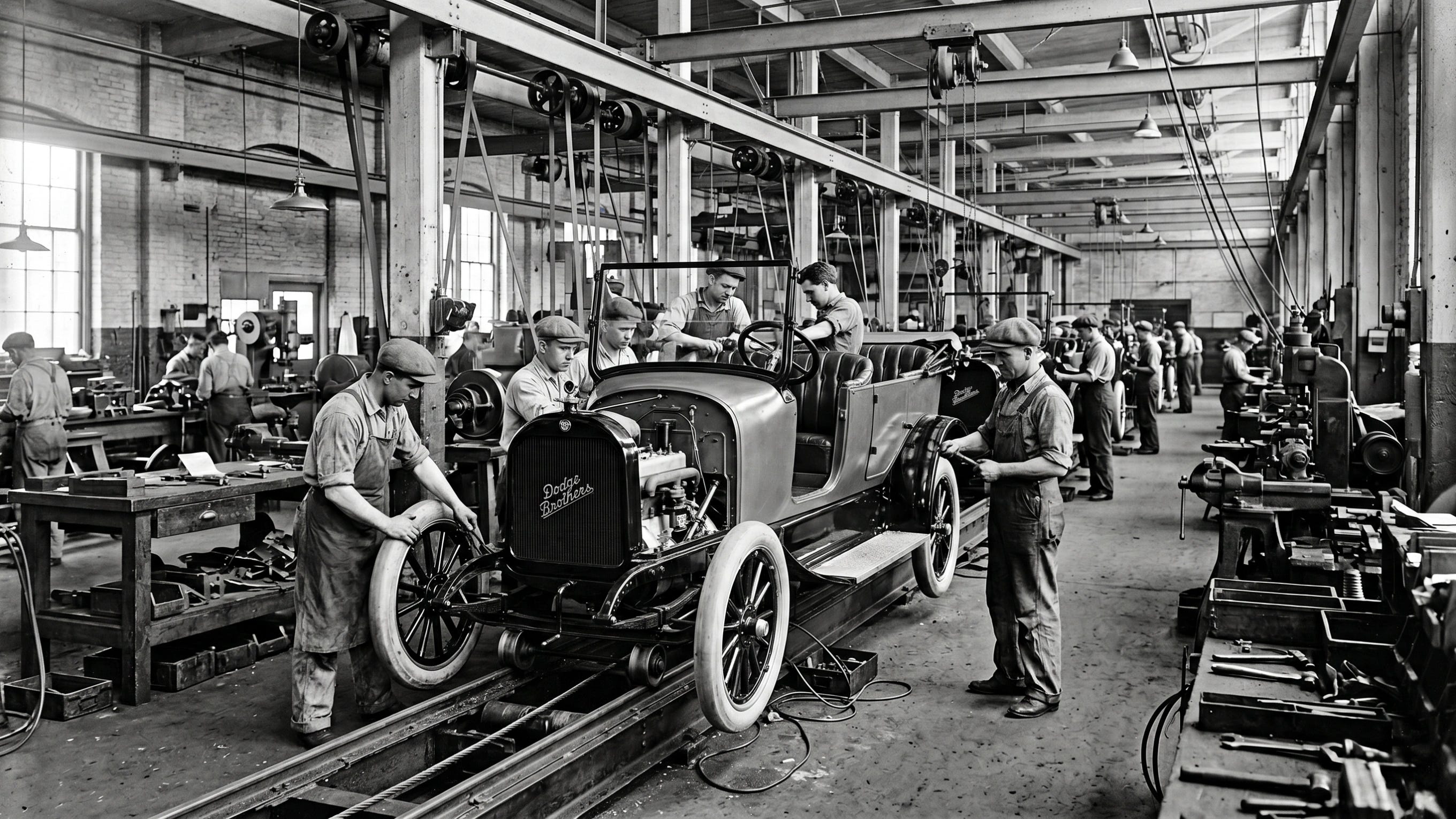
For 11 years, from 1903 to 1914, they built the complete Model T drivetrain. Without publicity. Without credit. They were the engine room of the most successful mass-production enterprise in the world, and the ship bore another man’s name.
In 1913, the brothers gave Ford one year’s notice. They had the stock. They had the capital. They had 11 years of manufacturing knowledge no one else in Detroit possessed. They had every credential for what came next.
What they did not have was a lawyer who understood financial architecture.
“The happiest days of my life were when I was packing his lunch pail”
The hidden rule in the world of great American industrial fortunes is this: the men who build the asset rarely understand the asset as a financial instrument. They understand it as a machine. As a thing that requires maintenance and labor and floor space. They do not understand it as a structure that can be recapitalized and reassembled for a profit that accrues to whoever holds the instrument, not whoever built it.
Anna Thomson Dodge said that later in life, when asked about her time with Horace. The happiest days of her life were when she was packing his lunch pail. She meant it without irony. She was describing the time before the money, before the widowhood, before the sealed envelopes.
The brothers understood tolerances and metallurgy and production rates. What they did not understand, and what no one in their world had cause to teach them, was the financial instrument they had become. A company with 20,000 employees, capacity for 1,000 cars per day, and the number-2 position in American sales is not a machine. It is a security. It has a price that can be engineered. It has a spread that can be captured.
Henry Ford understood this. In 1916, Ford cut dividends. He said publicly the company existed to employ men and lower prices, not to generate returns for shareholders. John and Horace sued him. The Michigan Supreme Court decided in the brothers’ favor in 1919. Ford was ordered to pay dividends and, eventually, to buy out their stake for $25 million.
The court handed them a victory. The victory cost them the stock.
A Wall Street banker reading the trade press in 1919 would have recognized the Dodge Company for what it was: a business about to be run by 2 women who had never structured a capital transaction, positioned at number 2 in the most consequential industry in the country. He would have opened a file. He would have started to wait.
That banker was already waiting.
The Operator Enters
Late January 1925. Detroit. The Detroit Trust Company building. A sealed envelope room.
The widows had managed the company for nearly 5 years without their husbands. Under their direction, or more precisely under the direction of the executives they had hired and cycled through, the Dodge Brothers Motor Car Company had slipped from the number-2 position in American sales to number 5. The machinery still ran. The brand still existed. The 20,000 employees still came to work. But the company needed capital, needed operational leadership, needed something the widows could not supply from the estates they were building on the proceeds of the Ford buyout.
Meadow Brook Hall. Rose Terrace. Each a monument to a fortune the brothers had spent their lives constructing. Each now requiring its own maintenance staff, its own operating budget, its own institutional logic. The women who had married machinists from Niles, Michigan were now managing 2 of the largest private estates in America while simultaneously trying to run the second-largest automaker in the country without the men who had known how to do it.
They decided to sell.
![Photo brief: Detroit Trust Company building exterior, circa 1920s. Suggest archival photograph from the Detroit Public Library Burton Historical Collection or the Walter P. Reuther Library at Wayne State University.]
2 bids arrived at the Detroit Trust Company building in late January 1925. The House of J.P. Morgan submitted $132 million. It was not a cash offer. It was structured to include stock, which meant the widows would be accepting an instrument rather than a payment. An instrument whose value would depend on market conditions they had no training to evaluate or control.
Clarence Dillon was born into a Texas family, educated at Harvard, and had built Dillon, Read and Company into one of the most technically sophisticated investment banks operating in America in the 1920s. He had been described by peers as having singlehandedly shaped the modern architecture of corporate financing. Some accounts credit him with pioneering the leveraged structure that would later be called the leveraged buyout, issuing debt instruments that the market would later call junk bonds, and engineering recapitalizations that laid the groundwork for modern corporate bankruptcy law. Paramount Pictures chairman Stanton Griffis would later describe him as “the greatest financier of our times.” He was not a man given to public statements about his methods. His methods were in the structure of his offers.
He submitted $146 million. All cash.
$14 million higher than Morgan. No stock. No instruments. No footnotes.
The widows preferred cash. They had spent 5 years watching hired executives make decisions about their inheritance using vocabularies they could not fully parse. Cash was money you could hold. Cash was a number that required no translation. They understood what $146 million meant in a way they could not have explained what $132 million in Morgan stock meant, or what it might be worth in 3 years, or what conditions could make it worth less.
The widows accepted the offer on the last day of January 1925.
The Dodge Brothers Motor Car Company, built by two men from Niles, Michigan, who had once earned $16.50 and $13.50 a week between them, changed hands for the largest single check ever written in American history.
It cleared.
The Check
April 30, 1925. A check in the amount of $146 million was drawn by Clarence Dillon. The New York Times covered it on May 2. It was, at that moment, the largest check in American history. Nobody at the ceremony appears to have asked how the financier planned to recover his capital.
He had already planned it.
$75 million in Dodge Brothers debentures, issued within weeks of closing.
Dillon had priced the acquisition at a number that reflected not just the company’s current value but its value as a financial structure. A company with 20,000 employees, a nationally distributed dealer network, production capacity for 1,000 cars per day, and a brand that had been second in American sales 5 years earlier does not require the buyer to hold the full purchase price. It holds the purchase price itself. He issued $75 million in Dodge Brothers debentures and sold them into a bond market that absorbed them without difficulty. He had recovered more than half the purchase price before most Americans knew the company had changed hands.
The company was now a vehicle for financial engineering. That is not a condemnation. It is a description of the mechanism.
He sold the company to Walter Chrysler in 1928 for $170 million.
The spread, the underwriting fees, the recapitalization premium, the appreciation on the 3-year hold: approximately $50 million in total extraction across the full transaction arc. Historians have continued to refine this number. The rough shape of it has not been disputed.
$146 million paid. $50 million returned. The sellers received the first number. Only Dillon knew the second.
The widows did not go poor. That part of the story must be stated plainly.
Anna Thomson Dodge used proceeds from the Ford stock sale to purchase a 5-strand pearl necklace once owned by Catherine the Great, acquired through Cartier. She commissioned architect Horace Trumbauer to build Rose Terrace, a private residence larger than any estate then standing in Newport, Rhode Island. By the end of her life she held more than $6 million in jewelry alone. She died in 1970, age 100, in a metal hospital bed surrounded by priceless French furniture, watching a battered television and listening to Guy Lombardo albums. The pearl necklace was eventually broken up and sold at auction. 3 strands changed hands in 2008 for $800,000.
Rose Terrace was demolished in 1976. It was on the National Register of Historic Places. No buyer could be found.
Matilda Rausch Dodge built Meadow Brook Hall: 88,000 square feet, completed between 1926 and 1929 at a cost of $4 million. It still stands.
The Dodge Brothers Motor Car Company, which the brothers had built from a machine shop into America’s second-largest automaker in 5 years, ceased to exist as an independent entity in 1928. It became a division. Then a brand. Then a logo on the grille of a vehicle built by a corporation the brothers had never heard of.
The Hamtramck plant eventually closed.
The world the brothers built was already ended.
Capital Reads Structure. Builders Read Machines.
The rule is this: every industrial dynasty built by operators is eventually a target for financiers because operators and financiers are reading 2 different documents about the same asset.
The Vanderbilt railroad network, after Cornelius died, was progressively absorbed by banking interests that understood a rail system as a security before a transportation asset. The Carnegie steel operation was sold to J.P. Morgan in 1901 for $480 million, converting Andrew Carnegie into the wealthiest private individual in the world and converting the operation itself into U.S. Steel, thereafter managed as a balance sheet. In both cases, the builder understood the thing. The acquirer understood what the thing could be made to represent on paper.
The Dodge brothers understood the automobile. They did not understand the automobile company as an instrument.
This distinction is not legible from the inside. When you have borrowed the capital yourself, hired the labor yourself, and watched production numbers climb for 20 years, the company feels like a fact. Like a physical object. It does not feel like a structure that someone else could disassemble for a fee. But a company is a legal and financial instrument. It can be recapitalized by anyone who understands its architecture better than its current owners. The widows of John and Horace Dodge did not lack intelligence. They lacked the specific vocabulary of capital markets that would have let them read Dillon’s offer as a mechanism rather than a number.
The modern version of this transaction happens in every industry where operational expertise and financial architecture fail to overlap. The founder understands the product, the customer, the production floor. The acquirer understands the instrument. The gap between those 2 forms of knowledge is where the spread lives.
Dillon did not deceive anyone. He made a legal offer. He paid a real price. He was simply operating in a language the sellers could not read.
The $146 million check was real.
The $50 million that came back out of the deal almost immediately was also real.
The sellers did not know that second number existed.
The winter of 1920 pressed against the glass of the Ritz-Carlton. 2 brothers contracted influenza at the most important automotive trade show in America and did not recover.
They left behind a company, 2 widows, and a vocabulary problem that no one in their world had thought to solve.
Such an interesting story. Thanks for sharing, Honey Hive. My answer to the final question below.
“What is the specific gap in financial literacy that most protects an operator-built company from extraction after the founders are gone: legal structure, board composition, or advisor selection?”
In my view, it is board composition. The company must design and populate a resilient board with binding rules first. Legal structure and advisors support their governance, but won’t prevent extraction if the board is weak.
Great story, i like a parrarel two brothers - two widows. I didn’t know that without Dodge wouldn’t be Ford. Thanx!