
There is a peculiar shift that happens somewhere around the 100 million dollar mark.
Below that threshold, the wealthy are surprisingly visible. The five‑million‑dollar entrepreneur posts on LinkedIn… or the twenty‑million‑dollar real estate developer has a Wikipedia page, a local newspaper profile, maybe a podcast appearance.
Often, their real name is attached to their businesses. Their biography is searchable. They exist, publicly, as rich people.
Then the pattern changes.
Cross that invisible line somewhere between 100 and 200 million and the wealthy do not just accumulate more capital. They almost always begin to withdraw.
Indeed, that withdrawal is deliberate, structured, and guided by professionals.
And they do not vanish because they have done something wrong… they vanish because they have learned, often the hard way, that visibility itself behaves like a liability.
Why $5 Million Is Searchable, but $500 Million Becomes a Ghost
Mid‑level wealthy individuals are easy to find for a simple reason: their income still depends, in some way, on the public knowing who they are.
The ten‑million‑dollar entrepreneur still has something to sell.
That might be a personal brand, a growing company, a real estate portfolio, or connections that benefit directly from public recognition. They sign contracts under their own name. Their companies are registered directly to them.
Every layer of their professional life leaves a trail because there has not yet been a compelling reason to erase one.
The dynamics change once wealth reaches a higher scale, and often, at 100 million and beyond, the person no longer needs visibility to keep money flowing.
Returns come from private equity stakes, family trusts, real estate vehicles, and funds that do not require the public to know who stands behind them. The link between public identity and financial outcome breaks. At that point, visibility stops behaving like an asset and starts behaving like a risk vector.
Even Forbes, which dedicates a large research team across multiple countries to its Billionaires List, openly admits that many figures rest on “educated estimates.”
That gap often appears where wealthy individuals refuse to cooperate or have made deliberate moves to obscure their holdings. Absence from the list does not always mean lower wealth. It often signals stronger control over information.
You see, the threat landscape at that level is very different from what a conventional millionaire faces.
Individuals with tens or hundreds of millions become significantly more attractive targets for organized crime, cyber extortion, kidnapping, aggressive litigation, and political resentment.
Security firms that specialize in this world describe a dramatic increase in targeted cyberattacks and physical threat assessments once families cross into ultra‑high‑net‑worth territory.
Seen from that angle, the quiet does not look mysterious. It looks rational.
Where Do They Actually Go?
There is no single bolt‑hole where the ultra‑rich disappear to. Instead, they distribute their lives across a geography designed around privacy, legal protection, and controlled access.
The American Enclaves
In the United States, a handful of micro‑communities express this logic in physical form.
Indian Creek Island in Miami, often called “Billionaire’s Bunker,” contains only a few dozen residential lots, a private golf course, and its own dedicated police force patrolling land and water.
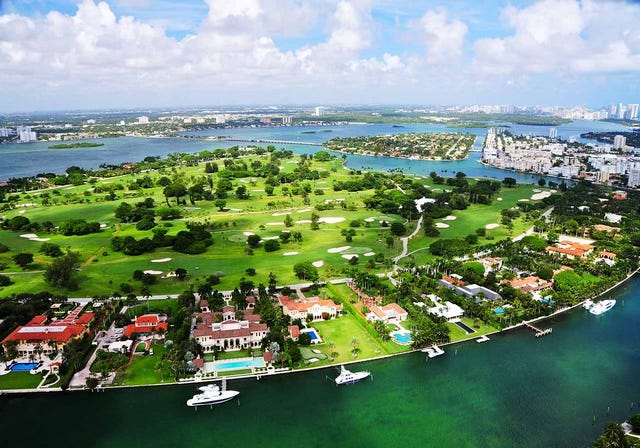
A single guarded bridge controls access. High‑profile owners such as Jeff Bezos and Tom Brady have drawn attention, but the majority of residents remain largely unknown to the wider public by design.
Cashiers, North Carolina. This is the one that consistently surprises people. Tucked into the Blue Ridge Mountains near the South Carolina border, Cashiers is a small mountain community with no traffic lights and no notable tourist infrastructure, yet it holds one of the highest concentrations of billionaire households anywhere in the United States.
Much of that wealth sits hidden inside private golf enclaves with names largely unknown to the public, accessed through unmarked gates off winding mountain roads.
The Wall Street Journal described it in 2025 as a community “designed for seclusion,” where the entire social and residential apparatus has been built to keep its residents invisible to the outside world.
The Offshore Map
Physical residence is only one layer. The more significant shift often happens where the wealth itself resides.
The Cayman Islands hosts an enormous share of the world’s hedge funds and offers a zero‑tax environment for corporate income, capital gains, and inheritance.
Switzerland continues to function as a global center for private banking, with legal and cultural norms that emphasize confidentiality, even after changes in formal bank secrecy laws. Singapore plays a similar role for Asia‑Pacific wealth, combining political stability, strong financial regulation, and tools designed to attract high‑net‑worth capital.
Certain jurisdictions have gone further and built legal frameworks explicitly optimized for asset protection.
Cook Islands trusts are often described by lawyers as the most protective in the world, structured in ways that make it extremely difficult for foreign courts or creditors to access assets once they have been placed there.
Other small jurisdictions, such as Liechtenstein or Nevis, market slightly different versions of the same core idea: break the obvious link between person and property.
Research on offshore wealth suggests that somewhere between several trillion and tens of trillions of dollars now sits within this global architecture, a range wide enough to illustrate how hard it is to see clearly into the system.
The Architecture of Invisibility
From the outside, “disappearing” can look like a simple choice to avoid social media or say no to interviews. Up close, it is a carefully engineered structure.
Estate lawyers sometimes describe the core privacy toolkit as a “trifecta”: a network of LLCs, one or more trusts, and strict anonymity rules applied across all major assets.
Instead of “Jane Smith” appearing on the deeds to a forty‑million‑dollar house, the ownership record might list something like Copper Cactus Trust.
That trust can be controlled by a Wyoming LLC, which was formed in a state that does not require public disclosure of its members.
The Wyoming LLC may in turn be owned by another holding entity. Following that chain requires both time and expertise, and each extra layer raises the cost and complexity of any attempt to dig into it.
The guiding idea here is simple: retain control over the assets while minimizing the number of places where the owner’s name appears.
The yacht is held through a company registered in a favorable jurisdiction. The art collection lives inside a trust.
The jet is technically operated by a management firm. On paper, the individual might look relatively modest. In reality, the structure behaves like a private constellation of entities orbiting a single family.
The digital side follows the same philosophy. Some families use hardened devices and customized communication systems to avoid location tracking and casual data leaks. They pay for services that routinely scrub public records, remove geotagged photos, and audit their online footprint. Staff and contractors sign strict NDAs that explicitly cover social media, photos, and private details of the household’s routines.
The point is not to be mysterious in a cinematic sense. The point is to reduce surfaces. Every unnecessary connection between the real person and their assets is treated as a liability and then systematically removed.
The Social World They Inhabit
If their names and properties vanish from Google, where do these people actually live their lives socially?
The answer is a parallel social infrastructure that operates on invitation, reputation, and vetting.
In New York, the CORE Club is a well‑known example. Membership requires a very high initiation fee, substantial annual dues, and sponsorship. Its members include hedge fund managers, CEOs, investors, and a selection of people who offer value to that group.
London’s Annabel’s and 5 Hertford Street have long been meeting places for royals, global tycoons, and senior political figures, and they maintain strict membership controls and a culture where discretion is part of the product.

These environments are not “status clubs” in the Instagram sense. They function more as filters. The fact that someone is inside the room signals that other members have already decided that person belongs there. Standards of conduct revolve around discretion, unspoken rules about not recording or broadcasting anything, and avoiding behavior that brings scandal back to the group.
There is also the quieter layer of philanthropy, boards, and shared investments. Studies of ultra‑wealthy networks show that each individual at this level typically maintains connections with dozens of other families through charitable foundations, advisory boards, co‑investments, and family‑office‑to‑family‑office deals. Those relationships grow in private, behind closed doors, often over many years.
Thus, the social universe of the ultra‑rich is not empty. In fact, it is dense… but walled.
The Transition: How “Merely Rich” Becomes Hard to Find
People do not wake up one day and instantly adopt full invisibility. The move from visible success to structured obscurity tends to unfold in phases.
Phase 1: $10–$50 Million – Accumulation
In the first serious‑wealth stage, the person still lives in “builder mode.”
Most of their attention goes to expanding the business, scaling the portfolio, and increasing their net worth. Visibility often still helps. Publicity supports deal flow. Industry recognition opens doors. They may have one or two basic holding companies and an accountant, but the primary goal remains acceleration, not protection.
Phase 2: $50–$100 Million – Architecture
The next stage felt by many is not just numerical, it is psychological.
At this level, a setback can still be painful, but the family’s position is now substantial enough that protecting the base matters as much as growing it.
This is where “wealth architecture” becomes a project in its own right. Income starts flowing through multiple entities. Estate planning and tax planning become constant processes rather than one‑off events.
Multi‑family offices, which serve several wealthy families at once, often step in here with bundled legal, tax, and investment services. The person is still public enough to be found, but the structure beneath them becomes more intricate and layered.
Phase 3: $100 Million and Beyond – Infrastructure
Once wealth moves into nine‑figure territory, it becomes economically rational to build an in‑house apparatus.
Single‑family offices, dedicated entirely to one family, are common. Studies suggest that operating a full family office often costs several million dollars a year and employs around ten or more staff members across investment, legal, and administrative roles.
Privacy and security now sit alongside investment returns as core responsibilities. Physical security systems get upgraded. Private aviation replaces commercial flights for both safety and discretion. Detailed threat assessments and cyber‑monitoring become part of the annual budget.
In some documented cases, families have spent close to a million dollars a year on integrated security and privacy infrastructure after media coverage drew attention to their wealth, with the rationale that preventing even a single serious incident more than justified the cost.
At this stage, the person ceases to be the main point of contact with the outside world. The family office, the lawyers, and the entities speak on their behalf.
Phase 4: Generational Solidification
The final phase is intergenerational. Assets pass through trusts and structures that keep them out of public probate processes. In many jurisdictions, the details of those trusts never become public record. The family name appears on fewer documents with each passing decade/
This is how old money becomes hard to trace. What remains visible might be a surname on a museum wall, a family foundation, or a few surviving press clippings. The real balance sheet lives elsewhere.
How People Actually Get Into These Circles
For outsiders, the obvious question is how anyone without inherited ties ever crosses the barrier.
The real answer is that wealth alone does not guarantee entry. The doors that do open tend to respond to usefulness, not raw net worth.
One path runs through serious, long‑term philanthropy.
Large cultural institutions, hospitals, and universities often bring together donors, trustees, and advisory board members whose net worths span from single‑digit millions to hundreds of millions.
Simply writing a big check is not enough. The people who become part of the inner circle usually serve on committees, attend working meetings, and contribute expertise or time. Over years, the shared work turns into real relationships.
Another path runs through professional excellence in fields that ultra‑rich families absolutely require: private wealth law, complex tax structuring, estate planning, investment management, cybersecurity, executive protection, and highly specialized architecture or design.
Advisors in those zones are not treated as “staff” in the conventional sense. They become trusted allies, and those relationships often outlast individual projects.
The third path passes through selectively open networks such as elite clubs and executive education cohorts.
As mentioned, membership‑only clubs in New York, London, Singapore, and similar hubs often require both existing member sponsorship and a long vetting process.
High‑level programs at institutions like Harvard or Oxford can serve as nodes where entrepreneurs, investors, and inheritors of large fortunes study together and stay in touch long afterward.
What all three routes share is a slow time scale. Access grows through repeated contact, consistent behavior, and demonstrated discretion, not through a single move or a single purchase.
The Deeper Point
The story of the disappearing ultra‑rich is not just a tale of secrecy. It is the outcome of a shift in priorities.
At lower levels of wealth, exposure and visibility support the climb. A public profile attracts opportunities, investors, press, and status. Once wealth crosses into the ultra‑high‑net‑worth range, the calculation reverses. Public attention begins to function like a tax: it invites scrutiny, unwanted approaches, and risks that no longer bring corresponding benefits.
At that stage, privacy becomes one of the most valuable things money can purchase. Not as an abstract ideal, but as a concrete, engineered condition: fewer public records, less searchable data, fewer open doors, fewer unknown eyes.
They have not vanished in the sense of no longer existing. They now occupy a parallel architecture that was built, at considerable expense and with deliberate intent, to live just out of sight.
Jeez! I had no idea. Thanks for giving us this info.
Personally I don’t see this as a number threshold so much as an old money/new money difference in values. I am in the US so money of either ilk behaves vastly differently here than the UK. Not necessarily in a good way, either.