
In 1977, Louis Vuitton was still a family business.
It had two shops, about a hundred employees, and $14 million a year in sales, roughly $73 million today.
Four generations of Vuittons had kept it small and closely held since the founder opened a trunk-making shop in Paris in 1854.
The brand was famous. The business behind it was modest.
Then, a man named Henry Racamier, who’d made his fortune in steel, not luxury, married into the Vuitton family in 1943. His wife was Odile Vuitton, a great-granddaughter of the founder. For decades he ran his own company while the Vuittons ran theirs.
When Odile’s father, Gaston-Louis, died in 1970, nobody in the next generation was positioned to take over. The family turned to the son-in-law who’d already built and sold one business, and Racamier stepped in at 65.
What he inherited was a name recognized worldwide attached to an operation that barely reflected it. Over thirteen years he closed that distance, building 135 stores and pushing annual sales toward $1 billion while keeping distribution tight enough to protect what the name was worth.
“We would not be happy if everyone in the world owned a Vuitton bag,” he said.
Translation: scarcity was the product as much as the leather.
He spent a decade building the brand, only to lose it in two moves. First, a defensive merger with Moët Hennessy that was supposed to make Vuitton too big for a raider to grab, but diluted the family from owners into a minority voice inside a conglomerate.
When the merger turned against him, he invited in an “ally” named Bernard Arnault, gambling that Arnault’s money would tip the board back in his favor.
But Arnault didn’t want balance; he wanted the whole group.
By April 1990, no Vuitton governed the business that carried their name, and Racamier resigned rather than wait to be pushed out.
In his Daily Telegraph obituary, Racamier’s verdict on the whole affair was reduced to a single line:
“I have made two mistakes. The first was merging with Moët Hennessy. The second was inviting Arnault into the company.”
The Monogram

Racamier’s two mistakes cost the family their company, but the asset that made it worth fighting over was already more than 80 years old when he arrived.
The trunk maker at that 1854 Paris shop was Louis Vuitton himself. He’d walked nearly 300 miles from the Jura mountains to Paris as a teenager, apprenticed under a successful trunk maker named Maréchal, and built a reputation packing luggage for Parisian society before opening his own workshop the year he married.
His clients included Empress Eugénie, and his flat-topped rectangular trunks, made with treated canvas instead of leather, were an innovation practical enough to stack on steamships and train carriages.
By the time he died in 1892, the name on the shop meant something in every European capital with a first-class departure lounge.
His son Georges took over and immediately faced the problem that would shadow the company for the next century: everyone was copying the product.
He created the interlocking LV monogram in 1896, partly as a tribute to his father and partly to distinguish the real trunks from the fakes already in circulation.
It is one of fashion history’s biggest ironies that a symbol designed partly to fight copies outlasted the family’s control of the business.
Even before the monogram, he had opened the first Vuitton store abroad, on London’s Oxford Street in 1885, and shown the brand at the 1893 Chicago World’s Fair. He spent four decades expanding the line into automobile trunks, patented locks, and travel books.

When he died in 1936, his son Gaston-Louis succeeded him, and the business stayed exactly what it had always been: small, closely held, and run by a Vuitton.
It also stayed deliberately modest.
By the mid-1970s the company had no stores of its own outside Paris, didn’t advertise, and served a select clientele through limited, loosely controlled distribution.
The family valued tradition over growth, and for more than a century that instinct had protected them. But it also meant the brand’s commercial potential sat untouched, and when Racamier arrived in 1977, the distance between what the name was worth and what the company earned was enormous.
“We understood the potential of our brand name,” he told The New York Times.
He spent the next decade proving it, opening company-owned stores in the world’s wealthiest cities and keeping supply short enough that scarcity did the marketing.
His fastest growth came in Asia, where Vuitton’s own shops carried the monogram into markets the founder never entered. By 1989, the two shops had become 135, and annual sales were approaching $1 billion.
But the family’s sole ownership had ended years before any of that growth attracted a predator.
Moët Hennessy
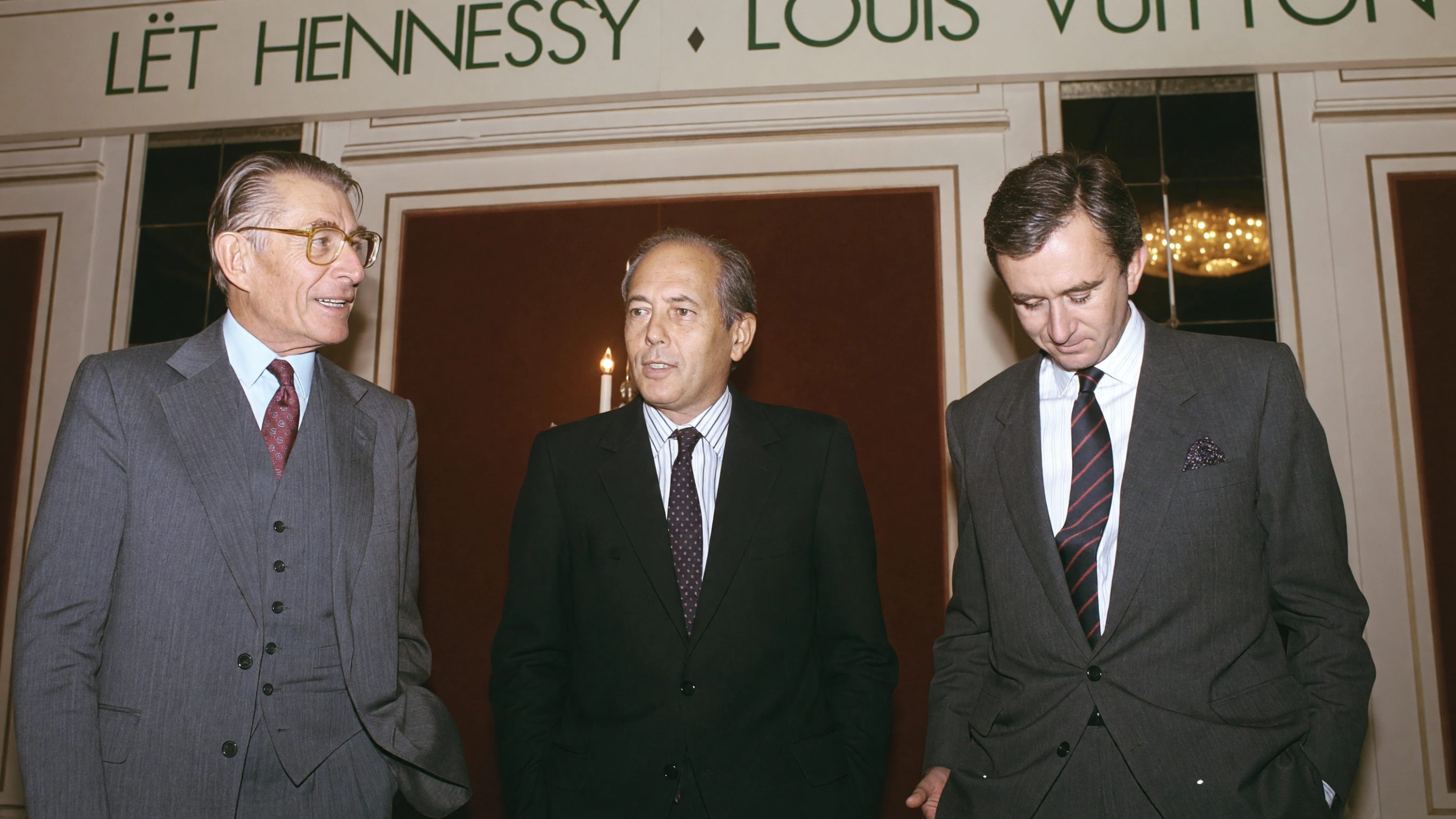
In June 1984, Vuitton sold shares to outside investors for the first time in 130 years. The money funded the expansion Racamier was building, but it also meant strangers now owned a piece of what the family had always kept to themselves.
Three years later, the phone rang.
Alain Chevalier ran Moët Hennessy, the group behind Moët & Chandon champagne and Hennessy cognac.
He was a professional manager, not a family patriarch, and he had a problem Racamier would have recognized: the founding families behind his company held only about 22% of the votes, nowhere near enough to stop a raider from buying his way in through the open market.
Chevalier’s solution was to merge Moët Hennessy with Vuitton.
Together, the two companies would be too big for anyone to swallow, and the founding families on both sides would keep control.
The deal was announced in June 1987. The new company, LVMH, put Vuitton’s leather goods, along with the Veuve Clicquot champagne and Givenchy perfumes Vuitton had recently acquired, under the same roof as Moët & Chandon and Hennessy, with combined revenues forecast above $2 billion.
On paper it looked like a fortress. In practice, Chevalier became chief executive and Racamier became his deputy.
The merger put Chevalier above Racamier and called it a partnership.
One company history later estimated that a controlling family stake of roughly 60 percent of Vuitton before the merger translated into about 17% of the combined group.
The Vuittons went from owners to minority shareholders in the time it took to sign the paperwork.
The friction started almost immediately.

They argued over management appointments, over a proposed acquisition of Lanvin, and, by one account, over whose company’s name came first on the stationery.
But the real fight was about something deeper.
“Champagne can be found on the shelves of every corner supermarket,” Racamier said. “But our leather goods require exclusive distribution.”
He’d spent a decade keeping Vuitton scarce, and now a champagne executive was telling him how to run the business.
Chevalier’s side saw it differently. Frédéric Chandon de Briailles, the LVMH board chairman, told the New York Times: “Mr. Racamier never knew how to conduct himself as part of a group in which someone else was chairman. He continued to manage Louis Vuitton as if he were its sole owner.”
Racamier saw it the other way.
“They saw the merger as an absorption,” he said. “We saw it as a marriage of equals.”
Then Chevalier made a move that turned the argument into a crisis. He started talks with Guinness, the British drinks company, about buying into LVMH, a position that started at 3.5% and climbed toward 20%.
Racamier understood what a Chevalier-Guinness bloc would mean: the drinks companies would control the parent, and the leather-goods house would answer to champagne.
So he went looking for a counterweight of his own, and the investor he found already owned Christian Dior, had a banker at Lazard Frères, and wanted the entire luxury group.
The Counterweight
The investor Racamier chose already had a name in luxury.
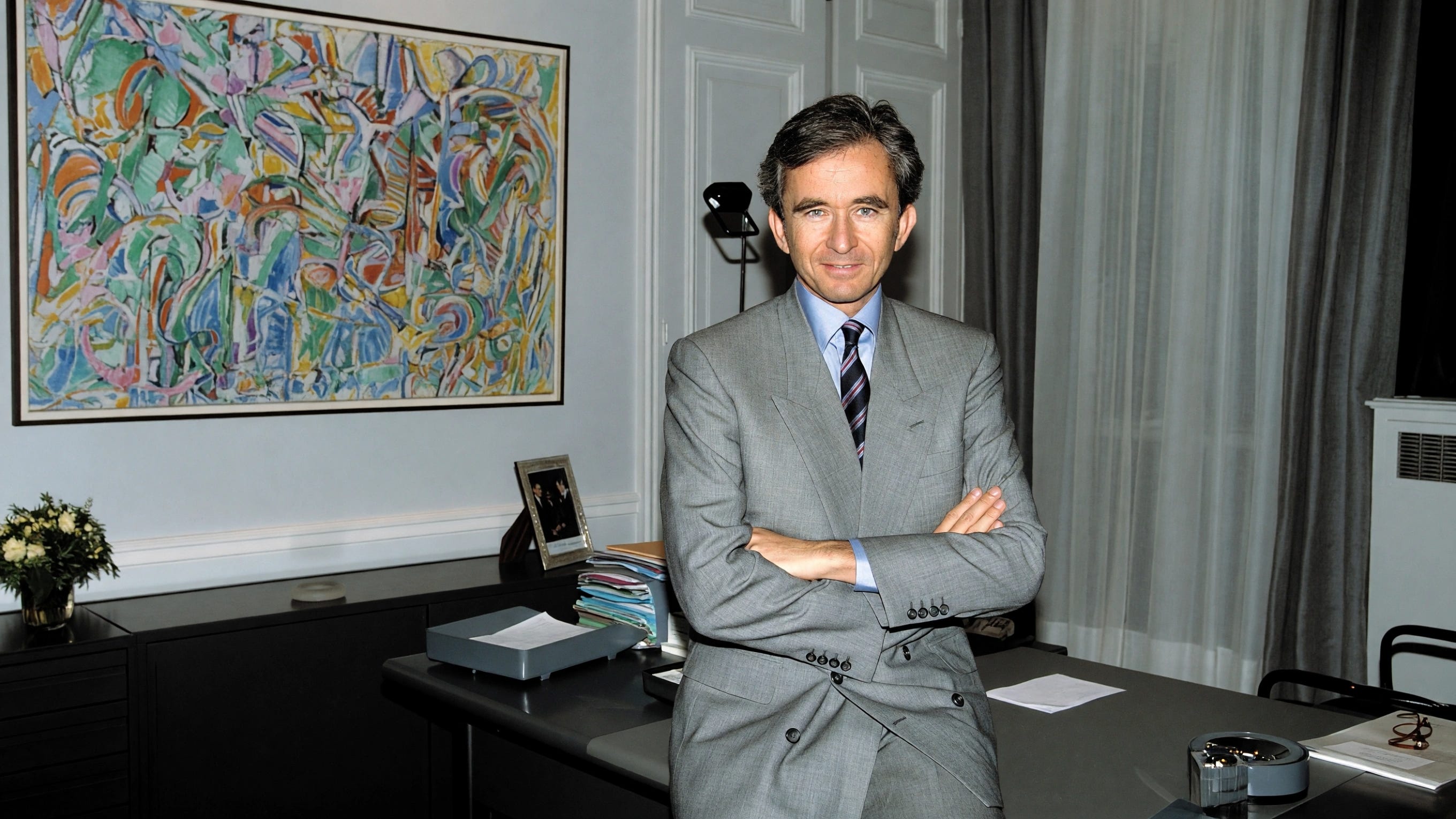
Bernard Arnault controlled a textile and retail group called Agache, and through it he owned Christian Dior. His adviser was Antoine Bernheim of Lazard Frères, and neither man treated the invitation as a favor to a struggling family.
Racamier wanted Arnault’s money to balance Chevalier and Guinness. Arnault wanted the whole group.
The Vuittons invited Arnault, the so-called “Wolf in Cashmere”, through the front door.
By the summer of 1988, Arnault and Guinness had quietly pooled their shares into a single vehicle. Together they held enough of LVMH to outvote the Vuitton family on anything that mattered.
On January 13, 1989, Arnault became head of LVMH. Chevalier resigned.
Chevalier’s parting assessment appeared in The New York Times: “There once was an epoch of professional managers. Now we’re seeing things taken in hand by capital, by financiers who have lots of money.”
Arnault offered his own reading: “This whole story shows how important it is to have a stable core of shareholders.”
The family had one legal fight left.

Before the merger, Moët Hennessy had issued a set of financial rights that converted into LVMH shares, diluting everyone else’s ownership in the process.
Vuitton shareholders sued, arguing the rights were improperly created. If a court cancelled the resulting shares, Arnault’s control would shrink enough to reopen the contest.
In November 1989, a Paris commercial court gave Racamier half a victory. The judges agreed the rights should never have been issued, but declined to cancel the shares that already existed because of them.
The court found the problem and let the shares survive.
That same month, LVMH’s board dismissed Racamier from the parent company. He still chaired Louis Vuitton itself, the most profitable subsidiary in the group, but it was a narrow perch: he was a man running a brand inside a parent he couldn’t influence, protected only by a pending appeal.
For five months, Racamier ran the brand that made Arnault’s company valuable.
It couldn’t last, because the man above controlled the votes of the man below.
The appeals court ruled in April 1990, and its answer was the one Racamier couldn’t survive.
The Last Vuitton
Racamier’s last card was a pending appeal, and on April 26, 1990, the court played it for Arnault.
He resigned as chairman of Louis Vuitton that same day rather than wait for the meeting where Arnault’s allies planned to remove him.
Arnault’s response appeared in the New York Times the next day: “The battle on the legal front is finished. Now we can concentrate on the battle on the economic front to sell our goods around the world.”
Both architects of the merger were now gone from the company they created.
Chevalier had resigned fifteen months earlier.
Racamier walked out the day the court ruled. And Odile Racamier, née Vuitton, the great-granddaughter whose name was stitched into every bag Arnault now controlled, appears nowhere in the public record of the fight.
She outlived her husband who’d steered the brand to a spectacular rise and fall by sixteen years and died in 2019 at 97.
That same year, Patrick-Louis Vuitton died too. A fifth-generation cousin, he’d joined the company in 1973 as a carpenter because his grandfather’s widow asked him to.
He’d wanted to be a veterinarian. Instead he spent forty-six years overseeing special orders, the last Vuitton who still worked with his hands in the workshops.
Racamier tried to build a second luxury empire around Lanvin after his resignation. It came to little, and he sold his stake by 1995. He died in 2003 at 90.
But Arnault moved the brand into territory Racamier once guarded against.
In 1997, Marc Jacobs was appointed artistic director and expanded Vuitton into ready-to-wear clothing, turning a trunk maker into a full luxury house. By 2022, annual revenue surpassed €20 billion.
Today the Arnaults hold two thirds of LVMH’s voting rights, and a 2026 filing proposed a restructuring designed to keep control in their family for decades.
The monogram Georges created in 1896 turned 130 this year. The company celebrated with four new editions. No Vuitton had a say in any of them.
what I learned from reading this article, never ever let any tiny little bit of your business go to someone else/another business in any way shape or form or eventually, you lose it.
👩🏻🎨 “LV” Symbol of Luxury!