
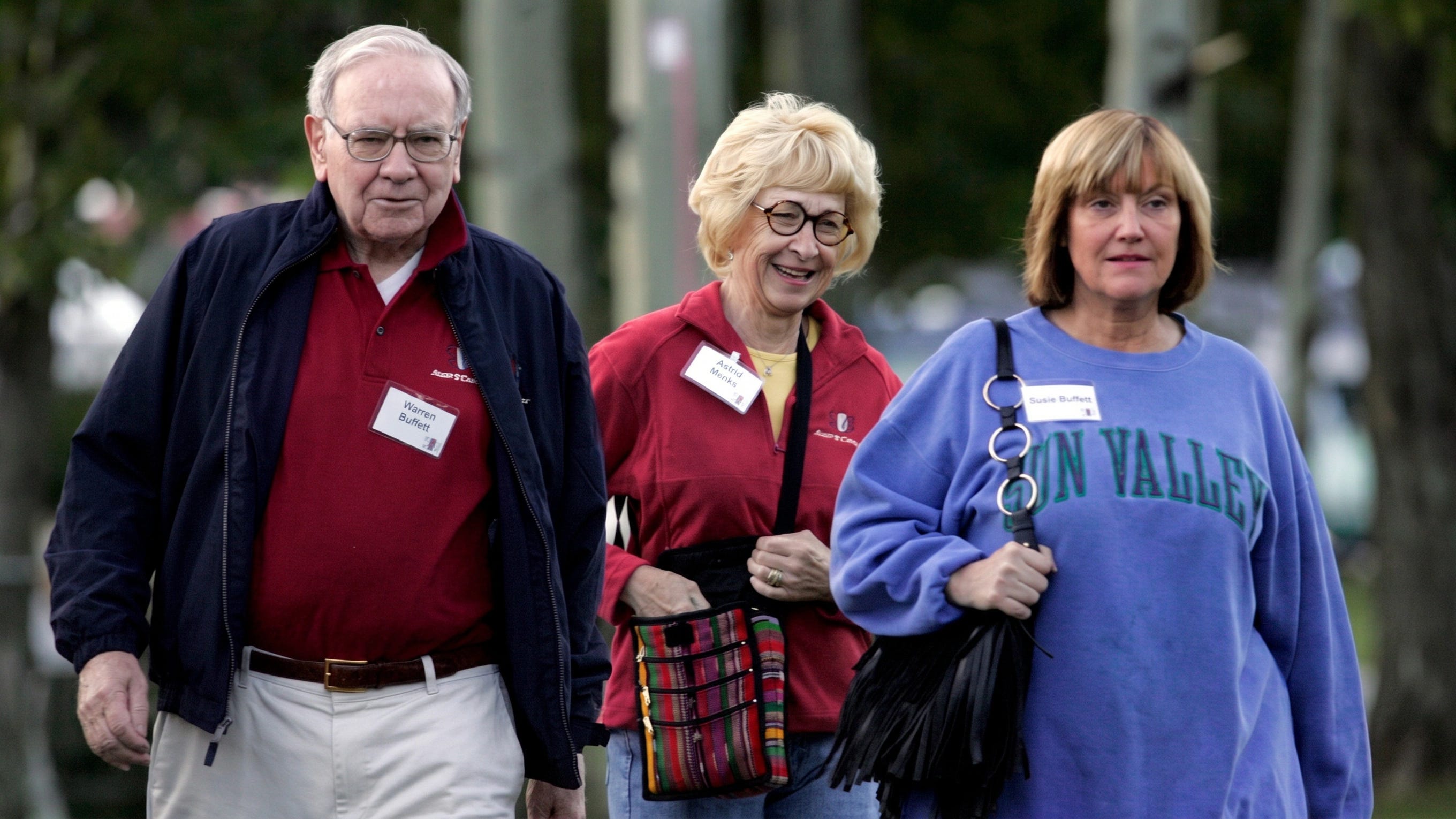
For more than two decades, friends of Warren Buffett opened a Christmas card from Omaha every December signed by three people: Warren, Susie and Astrid.
Susie was his wife, Susan Thompson Buffett, and she lived in San Francisco. Astrid was the woman who lived with him in Omaha and kept his house, and Susan had sent her there herself.
Susan lived apart from her husband for twenty-seven years and never once asked for a divorce.
She kept her seat on the Berkshire Hathaway board, a stake in the company worth nearly $3 billion, and her public role as Mrs. Warren Buffett right to the end.
Astrid spent those same years in Omaha, almost entirely out of public view. A Latvian-born former restaurant hostess, she ran the house, kept Warren fed and became the person he came home to, while the world kept seeing him beside his wife.
Susan died suddenly in the summer of 2004, at 72. Two years later, Astrid married Warren in a ceremony shorter than most board meetings, held at the home of Susan’s own daughter.
And the man at the center of it all had first found his way into his first wife’s life with a ukulele he’d bought to impress another girl.
The Minister’s Daughter

Omaha, Nebraska, in the 1930s was a Depression-era river city of railroads and stockyards, about as far from Wall Street as an American businessman could get. One of its sons was a bookish boy named Warren Buffett, born there on August 30, 1930, to a stockbroker named Howard Buffett.
Nobody in that Omaha would have looked at him and seen a future multibillionaire. Fewer still would have guessed how much of that future would depend on a girl born in the same city two years later.
In a city that size, families tended to know one another, and the Buffetts and the Thompsons moved in the same Omaha circles. The fathers were acquainted long before their children were.
The Thompsons’ daughter, Susan, was born on June 15, 1932. Her father, William Hertzog Thompson, was a minister and psychologist who served as a dean at what’s now the University of Nebraska Omaha.
He also dabbled in politics, and he once managed a congressional campaign for Warren’s father.
The parents’ friendship gave the two families a history, though it was a college roommate who made the match. At Northwestern University, Susan shared a room with Warren’s sister, Roberta.

Warren came to the courtship carrying a ukulele. A couple of years earlier, he’d fallen for a young woman whose boyfriend played one, so he bought his own to compete for her attention. He lost that contest, but he kept the instrument, and music became part of how the bookish young man found his way into Susan’s life.
She thus supplied what his temperament lacked.
Warren preferred balance sheets and annual reports to most people, and Susan could manage the human side of a life he’d rather spend reading.
He’d later count her among his greatest teachers, in the same company as his father and Benjamin Graham, the Columbia professor whose books taught him how to invest.
They married in 1952 at Dundee Presbyterian Church in Omaha, and the children came quickly: a daughter, Susan, known as Susie, in 1953, followed by two sons, Howard and Peter.
Warren would describe the turning points of his life in almost biblical terms. There were two of them, he said, “once when I came out of the womb and once when I met [Susan].”
“I was a lopsided person, she put me together.”
Their daughter went further. Susie told People she didn’t think “there would be any Berkshire Hathaway if he hadn’t married my mother,” and she remembered parents who “never fought and were always supportive,” calling their marriage “this wonderful role model of a relationship.”
Susan had spent two decades putting Warren together.
In the 1970s, she started building a life of her own, and it led her to a small restaurant in Omaha’s market district and the hostess who worked there.
The Singer at the French Café
In 1956, Warren started an investment partnership in Omaha with money from family and friends, and by 1962 the partnerships had made him a millionaire.
Subsequently, Omaha came to know Warren as the quiet man buying up companies, and the more he bought, the more the work took over his life.
Susan raised their three children, Susie, Howard and Peter, while his attention went to annual reports.
She also believed the two of them had an understanding: according to Alice Schroeder’s biography, she thought Warren would stop investing once he’d made $8 million to $10 million.
He sailed past that figure and kept going.
Susan poured her own energy into Omaha, becoming one of the city’s most outspoken activists for civil rights, abortion rights and birth control. As president of the family’s Buffett Foundation, she steered millions of dollars toward education, medical research and family planning.
Then, in 1973, when Berkshire began buying shares of The Washington Post Company, Warren grew close to its publisher, Katharine Graham, a widow thirteen years his senior.
“He became her closest advisor, and she completely relied on him,” said the Graham biographer Carol Felsenthal, adding that “whatever Warren said was gospel.”
One biography describes the relationship as an affair, and Susan’s response hinted at the “arrangement” to come.

She told several friends she was furious and humiliated. Then she sent Graham written permission to see her husband.
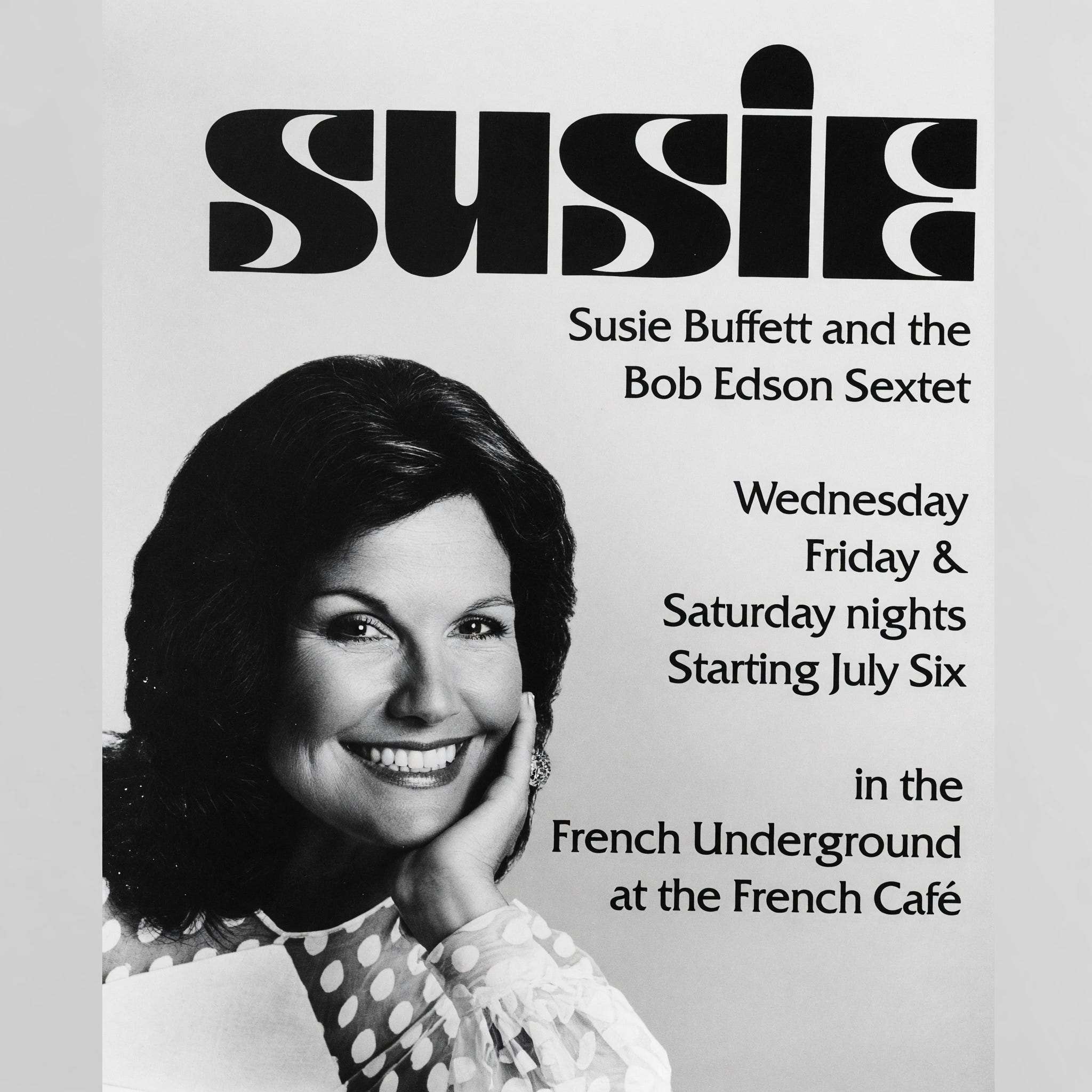
With her children nearly grown and Warren’s attention elsewhere, Susan turned to something she’d loved for years. She began singing in public at the French Café, a restaurant in Omaha’s Old Market district.
The hostess there was Astrid Menks, a Latvian immigrant who’d worked a string of jobs around Omaha before landing at the café.
She and Susan became friends, though the Buffetts’ daughter Susie later said she’d personally known Astrid before either of her parents did.
By 1977, the Buffett children had mostly left home. Their daughter Susie and her brother Howard were in their twenties, and Peter, the youngest, was a student at Stanford. For the first time in a quarter century, Susan’s days belonged to her.
That year she gave a one-night performance at an Omaha theater, and the songwriter Neil Sedaka, the man behind “Breaking Up Is Hard to Do,” encouraged her to take her voice seriously. Coming from someone who’d written hit records, the encouragement suggested her singing might carry well beyond Omaha.
Their daughter later said Susan had no interest in being known only as a billionaire’s wife.
Warren supported the singing, according to his first biographer, Roger Lowenstein, but what Susan wanted went well beyond an occasional set at the French Café.
Their daughter later said she had no interest in being known only as Warren Buffett’s wife. “She basically wanted a room of her own,” Susie said: a life shaped by Susan’s music, friends and choices, separate from her husband’s business.
Later that year she found it, in a city halfway across the country. Warren would one day call letting her go the biggest mistake of his life.
Make Him Some Soup
In 1977, after twenty-five years of marriage, Susan moved into a small apartment in the Gramercy Towers on Nob Hill, the hilltop neighborhood above downtown San Francisco.
The reasons she gave were simple. She wanted to sing, she wanted a place of her own in an art-friendly city, and she wanted to be closer to friends and to Peter at Stanford.
There was more to it. According to Schroeder’s authorized biography, The Snowball, Susan had begun a romance with her tennis coach, John McCabe, who took an apartment nearby.
She didn’t tell Warren that her move was tied to another man until 1984, seven years after she’d gone.
Their daughter Susie remembered it differently, insisting the move “didn’t have anything to do with her not completely loving my dad or not wanting to stay in the marriage.”
However the family explained it, the timing was brutal for Warren. Berkshire Hathaway was taking off and his name was becoming famous far beyond Omaha, yet by Lowenstein’s account, the man the financial world was starting to revere was heartbroken.
Schroeder wrote that he called Susan every day and sometimes wept on the phone.
Susan understood better than anyone what her absence meant in the house on Farnam Street.
Shortly before her death, she told the television interviewer Charlie Rose that Warren had never been equipped to live alone. He couldn’t cook, he didn’t do laundry, and he’d never handled the ordinary business of running a household.
So before she left Omaha, Susan asked several friends to look in on him, and one of them was the hostess from the French Café.
“I called Astrid,” Susan recalled. “I said, Astrid, will you take Warren, make him some soup, go over there and look after him?”
Astrid took the soup over, and she would never leave.
Within a year she was living in Susan’s house, and Susan wanted it that way.
