
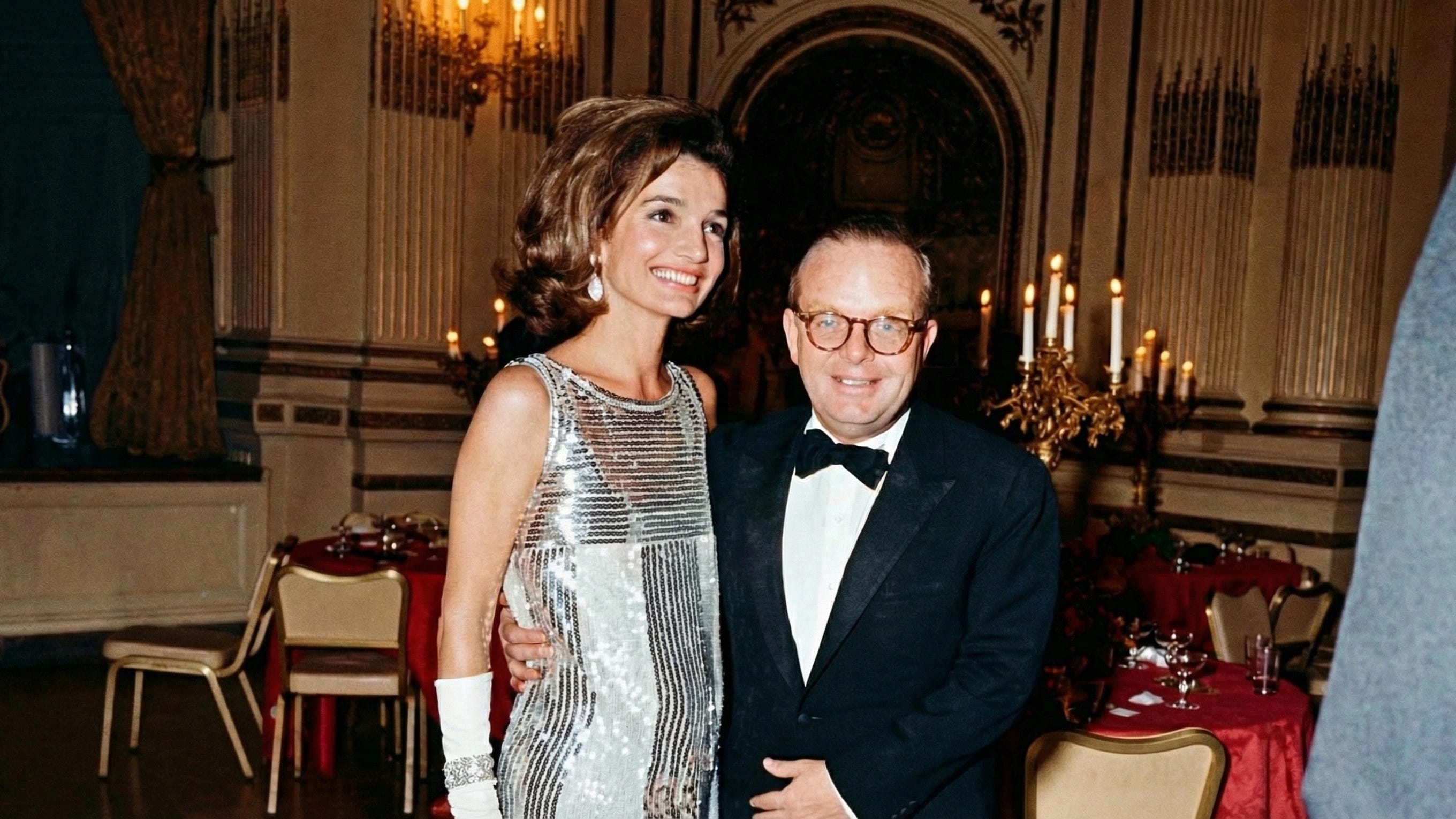
On November 28, 1966, a rainy Monday night in Manhattan, Truman Capote hosted 540 guests at the Plaza Hotel for what the press immediately called “the party of the century.”
The Black and White Ball commanded more media attention than the Beatles did when they stayed at the same hotel two years earlier. Crowds gathered behind police sawhorses outside the entrance, a dozen officers monitored the doors, and Secret Service agents checked every guest riding the elevator to the Grand Ballroom.
Inside, the Maharani of Jaipur wore gold and emeralds. Princess Luciana Pignatelli suspended a walnut-sized Harry Winston diamond from her headdress. Frank Sinatra, Andy Warhol, Mia Farrow, Norman Mailer, and Gloria Vanderbilt moved through a room where masks were supposed to erase the boundaries between aristocrats, artists, politicians, and Kansas townsfolk.
It cost Capote about $16,000 — roughly $150,000 today. For that price, he pulled off the most spectacular single evening in New York’s social history.
And it was the last truly great night of his life.
The Party as Power Play
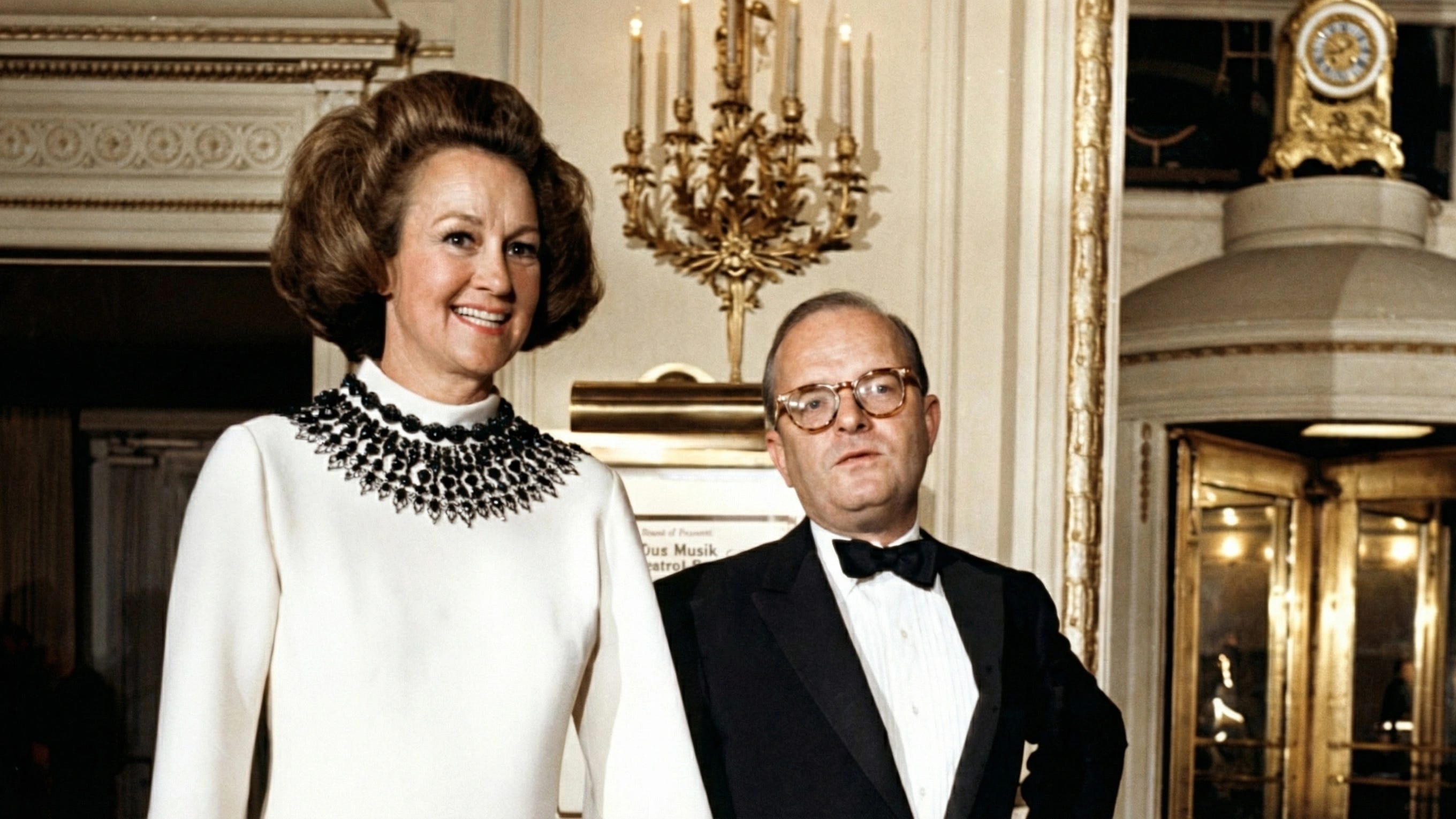
Officially, the ball was held in honor of Katharine Graham, publisher of The Washington Post, whose husband had died by suicide three years earlier. Capote told her he wanted to “cheer her up.”
Graham saw through it almost immediately.
“I felt a little bit that Truman was going to give the ball anyway and that I was part of the props,” she later told Esquire. “Perhaps ‘prop’ is unfair, but I felt that he needed a guest of honor and with a lot of imagination he figured out me.”
She was right. The ball was not really for Graham. It was Capote’s coronation.
He had just published In Cold Blood, which made him both famous and wealthy. The book had turned a grim Kansas murder case into the most talked-about work in America. Now he wanted to prove something else: that a short, flamboyant writer from the Deep South could command the most powerful room in New York.
The guest list was the weapon.
Capote spent months curating it in a small black-and-white composition book, adding and removing names with surgical precision. He invited European royalty alongside Kansas townspeople — the local doctor, a banker, a judge’s widow, all flown in from the small town where he had researched his novel. He seated Hollywood next to old-money dynasties. He even brought his own elevator man from his building at UN Plaza, then watched a famous actress dance with the man all night, enchanted, never knowing who he really was.
“It was complete autocratic hosting,” recalled socialite D. D. Ryan.
The masks were the final stroke of strategy. Capote required every guest to wear one — men in black, women in white — with the disguises to be removed at midnight. Anonymity, he believed, would free people to mingle across social barriers they would never cross in daylight.
It worked. For exactly one night.
What The Ball Actually Revealed
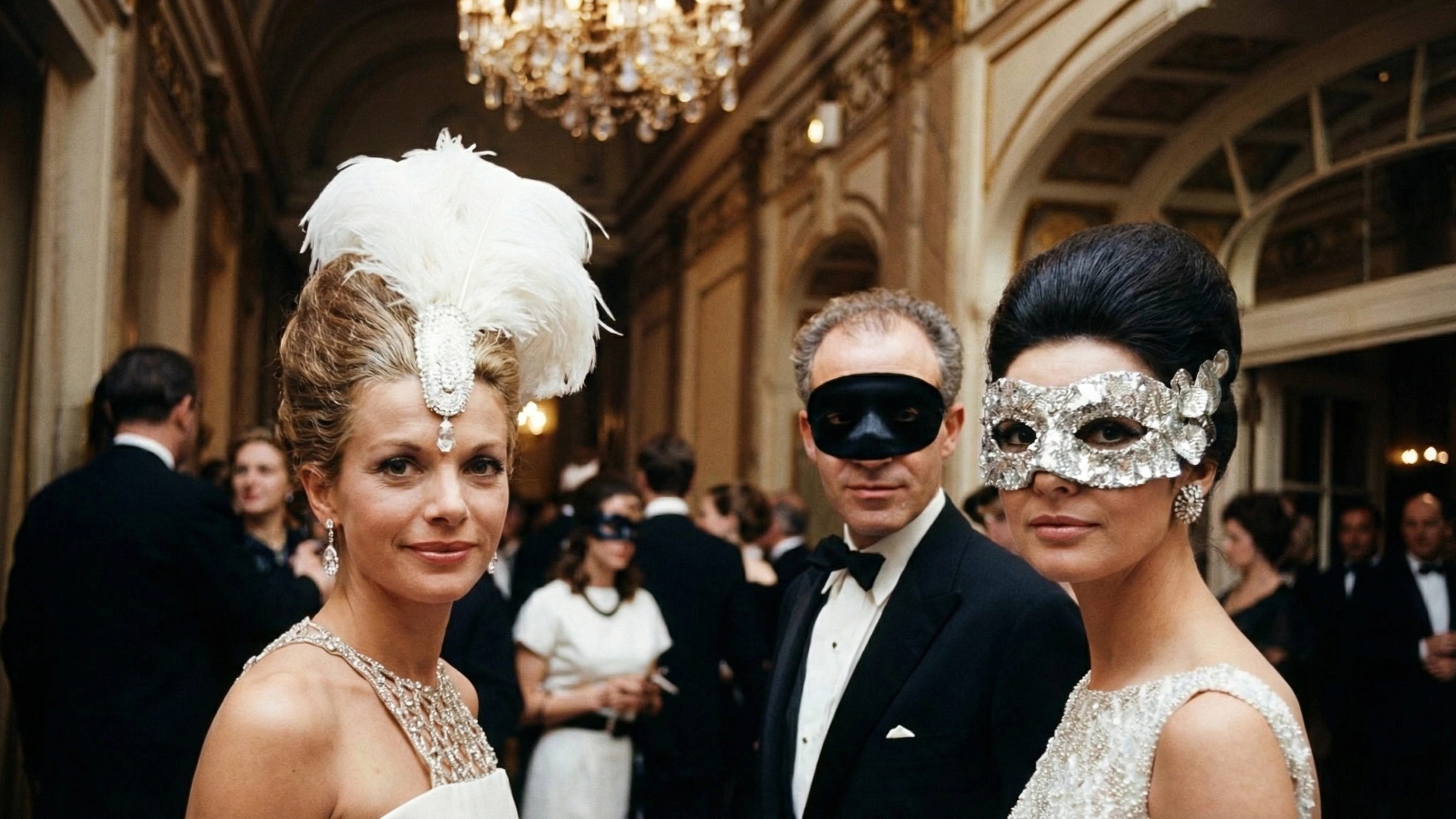
The Black and White Ball is usually remembered for its glamour. The more interesting story is what it exposed about the architecture of American high society.
Capote did something no one had managed before: he merged worlds that had been carefully kept apart. Old-money families, new-money celebrities, artists, politicians, journalists, and ordinary people from a small town in Kansas all stood in the same room at the same time.
Designer Zac Posen later called it “a real cultural changing moment… when the old world at its height met the contemporary world that we know today,” and “our moment of American royalty.”
But people tend to overlook the fact that everyone at the ball knew exactly where they “stood”.
The masks came off at midnight, but the social hierarchy never dissolved. The Kansas guests flew home. The socialites resumed their closed circles. The artists went back to being entertaining companions rather than equals.
Capote believed the ball proved he had transcended class. In reality, it proved the opposite. He had been granted the power to organize high society for a single evening. He had not been granted the power to belong to it permanently.
That distinction would destroy him.
The Betrayal That Proved The Rule
After the ball, Capote was at the absolute peak of his social power. The women he called his “swans” — Babe Paley, Slim Keith, C.Z. Guest, Lee Radziwill and others — treated him as their closest confidant. He lunched with them, traveled with them, and listened to their most intimate secrets. In a world where homosexuality was still criminalized, Capote had gone beyond the usual role of the decorative “walker” and become something like a trusted advisor.
He had access to everything. And he confused access with membership.
In 1975, nine years after the ball, Esquire published “La Côte Basque, 1965,” a chapter from Capote’s unfinished novel Answered Prayers. It was a thinly veiled account of his swans’ private lives — their affairs, humiliations, and their husbands’ cruelties. He named names. He described scenes that could only have come from conversations shared in absolute confidence.
One woman referenced in the text, socialite Ann Woodward, reportedly killed herself after learning the chapter was about to be published.
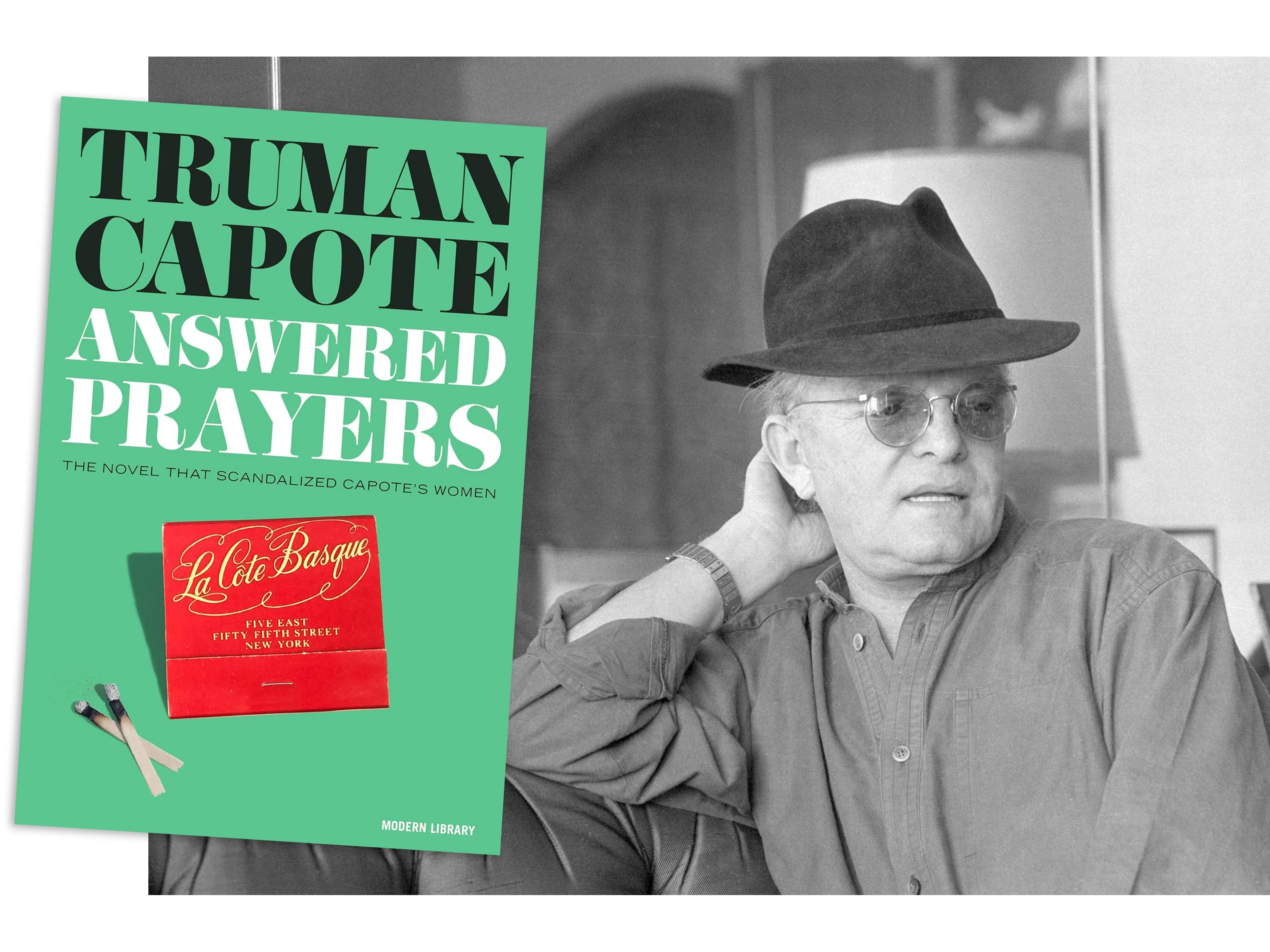
Capote’s biographer, Gerald Clarke, warned him that his friends would recognize themselves and cut him off forever.
“Naaaah,” Capote replied. “They’re too dumb. They won’t know who they are.”
They were not too dumb. And the response was immediate and total.
Babe Paley — his favorite, the woman he adored above all others — never spoke to him again. She was dying of cancer when the piece was published and died three years later without forgiving him. The other swans followed. One by one, every door that had opened for Capote closed.
He later summed up their loyalty to one another with bitter clarity: “In the long run, the rich run together, no matter what.”
The Lesson The Ball Still Teaches
Capote’s fall from the Black and White Ball to near-total exile is not just a literary tragedy. It is a case study in the invisible rules that govern access to old money — rules that have not changed in sixty years.
The ultra-wealthy will invite outsiders in. They will share dinners, vacations, and secrets. But there is an unspoken contract under every one of those interactions: what happens inside the room stays inside the room.
Capote violated that contract because he genuinely believed he was one of them. He was not. He was a performer they had decided to enjoy. The moment he treated their private lives as material — which is exactly what a writer does — the distinction became clear.
“All literature is gossip,” Capote told Playboy after the fallout. “What in God’s green earth is Anna Karenina or Madame Bovary, if not gossip?”
He was not wrong about literature. He was wrong about his position. Tolstoy did not depend on Anna Karenina’s social circle for his sense of self. Capote did.
After the swans turned their backs, Capote spiraled into alcoholism and drug addiction from which he never recovered. He spent his final years as what one journalist described as a “disturbing caricature” of the brilliant, magnetic figure who had once commanded the most powerful room in New York. He was reportedly planning a reprise of the Black and White Ball shortly before he died in 1984 — still believing, apparently, that one more perfect party could restore what he had lost.
It could not. Because what he lost was never really his.
The Architecture of Belonging
The Black and White Ball is still called “the party of the century.” It was almost certainly the most glamorous single evening of the American twentieth century. But its deeper significance is what it reveals about the difference between access and belonging.
Access can be earned. Talent, charm, usefulness, entertainment value — all of these can open doors. Capote proved that more convincingly than almost anyone before or since.
Belonging is something else. It requires either birth or absolute, permanent discretion. The families who endure at the top of the social hierarchy do so by maintaining a hard wall between what is shared privately and what is shared publicly. That wall is the real infrastructure of old money — not the houses, not the trusts, not the memberships.
Capote understood the visible architecture of wealth better than almost anyone alive. He could describe it, satirize it, and celebrate it. What he never understood was the invisible architecture: the rule that says you can sit at the table for decades, but if you ever write down what was said there, you were never really sitting at it at all.
He wrote a burn book about his closest friends and called them dumb, so they rightfully dumped him. Don’t think money had much to do with it, anyone of any social class would do the same as the swans did
It doesn’t sound like being old money would have saved him in this case. Anyone would likely be kicked out of the club if they tattled on everyone.