
If you walked through a mall in nineteen ninety, you saw the rainbow.
Stacks of sweaters in every color imaginable—canary yellow, electric blue, emerald green, hot pink—arranged like a painter’s palette against crisp white walls.
United Colors of Benetton.
The stores were everywhere.
Seven thousand locations across one hundred twenty countries.
The ads were impossible to miss—a priest kissing a nun, a newborn baby still attached to its umbilical cord, models of every ethnicity posing together in colorful knitwear.
Whether you found them profound or offensive, you remembered them.
That was the point.
At their peak, the four Benetton siblings generated over two billion dollars in annual revenue and amassed a fortune that placed each among the world’s billionaires.
They owned a Formula One racing team that won championships with Michael Schumacher.
They controlled two-thirds of Italy’s toll highways.
They ran the world’s largest chain of roadside restaurants.
By two thousand twenty-four, the fashion company was hemorrhaging two hundred thirty million euros in a single year.
Stores were closing by the hundreds.
And the family name was no longer associated with colorful knitwear—it was associated with forty-three people dead on a bridge they were supposed to maintain.
In today’s episode of Old Money Luxury, we examine how four siblings who sold an accordion and a bicycle to buy a knitting machine built one of fashion’s great empires—and how that empire became Italy’s national disgrace.
How Benetton Went From Fashion Family Empire To Italy’s Disgrace
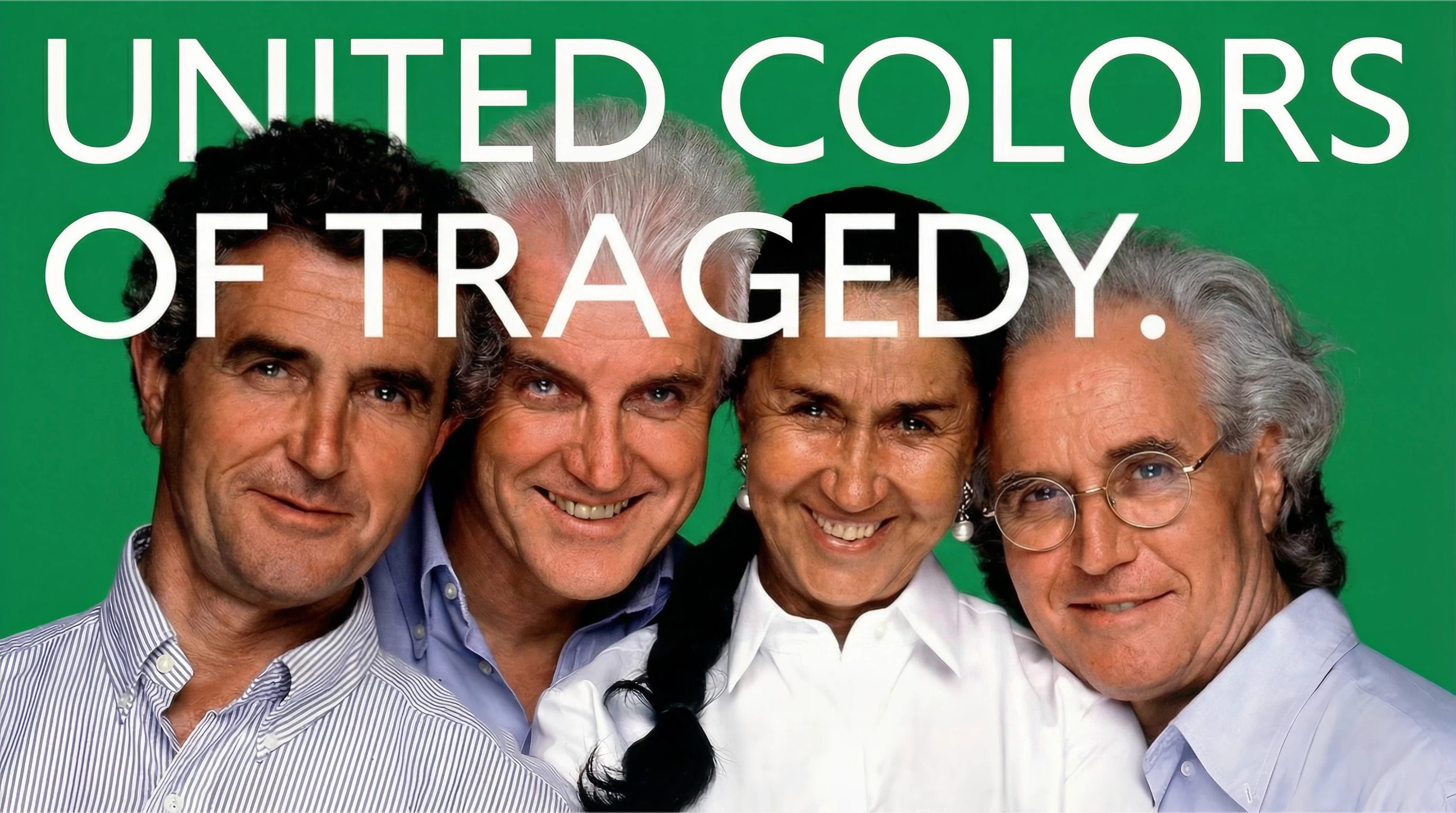
Chapter One: The Rainbow at Its Peak
At their zenith in the late nineteen nineties, the four Benetton siblings—Luciano, Giuliana, Gilberto, and Carlo—commanded a fashion empire without equal.
Seven thousand stores worldwide by nineteen ninety-nine.
Over two billion dollars in annual revenue.
One hundred twenty million garments produced annually at their Castrette facility in Treviso, Italy.
Forbes would later estimate each sibling’s net worth at two billion nine hundred million dollars.
The psychology driving such empire-building—and the family devastation it produces—receives extended treatment in our free Substack newsletter, where dynasties too complex for documentary format reveal what inherited ambition actually costs across generations.
The Benetton story belongs in that company.
Through Edizione S.p.A., their holding company, the four siblings maintained one hundred percent ownership of Benetton Group.
Each held an equal twenty-five percent stake.
The arrangement was clean: Luciano served as chairman and visionary marketer, Giuliana designed the collections, Gilberto handled financial and real estate investing, and Carlo managed production and liaison between headquarters and factories.
The fashion empire was merely one asset in a sprawling portfolio.
Their Benetton Formula racing team competed in two hundred sixty Formula One races, won twenty-seven Grand Prix victories, and captured two consecutive Drivers’ Championships with Michael Schumacher in nineteen ninety-four and nineteen ninety-five, plus one Constructors’ Championship.
Through a thirty point two five percent stake in Atlantia S.p.A., the family controlled the operator of nearly two-thirds of Italy’s four thousand miles of toll highways.
They held a sixty percent stake in Autogrill, the world’s leading chain of roadside restaurants and travel food service.
They owned stakes in Cellnex telecom, Assicurazioni Generali insurance, and Mediobanca.
The automated logistics hub at Castrette, designed by architects Tobia and Afra Scarpa and inaugurated in nineteen eighty-four, handled more than one hundred twenty thousand packages daily—sixty thousand incoming and sixty thousand outgoing—shipping to over five thousand outlets around the globe.
By two thousand twenty-four, Edizione would achieve consolidated revenues of ten billion one hundred million euros and a net asset value of thirteen billion two hundred million euros.
The family employed over one hundred thousand people across their various holdings.
The bet on infrastructure paid off brilliantly—everywhere except in the sweater business that made them famous.
The siblings who commanded this empire had started with nothing more than a yellow sweater and a desperate sacrifice.


