
In February 2020, the Madison Avenue flagship of Barneys New York displayed bright orange and yellow discount signs advertising ninety percent off.
Racks stood nearly empty.
Remaining merchandise sold from bins.
Even the chairs and display tables carried price tags.
One last buy, one last goodbye.
And yet, this was the store that introduced Giorgio Armani to America.
It was the store that brought Comme des Garçons, Christian Louboutin, and Azzedine Alaïa to American consumers before anyone else knew their names.
Indeed, it was the store where fashion editors, celebrities, and style-conscious New Yorkers made pilgrimages to discover what was next.
But then… they filed for bankruptcy, twice—first in 1996, then catastrophically in 2019.
And the family that remained sued each other over tax fraud and disinheritance.
Today on Old Money Luxury, we examine how a man who pawned his wife’s engagement ring for five hundred dollars built one of fashion’s great tastemakers—and how his grandsons destroyed it through debt, hubris, and a feud that outlasted the business itself.
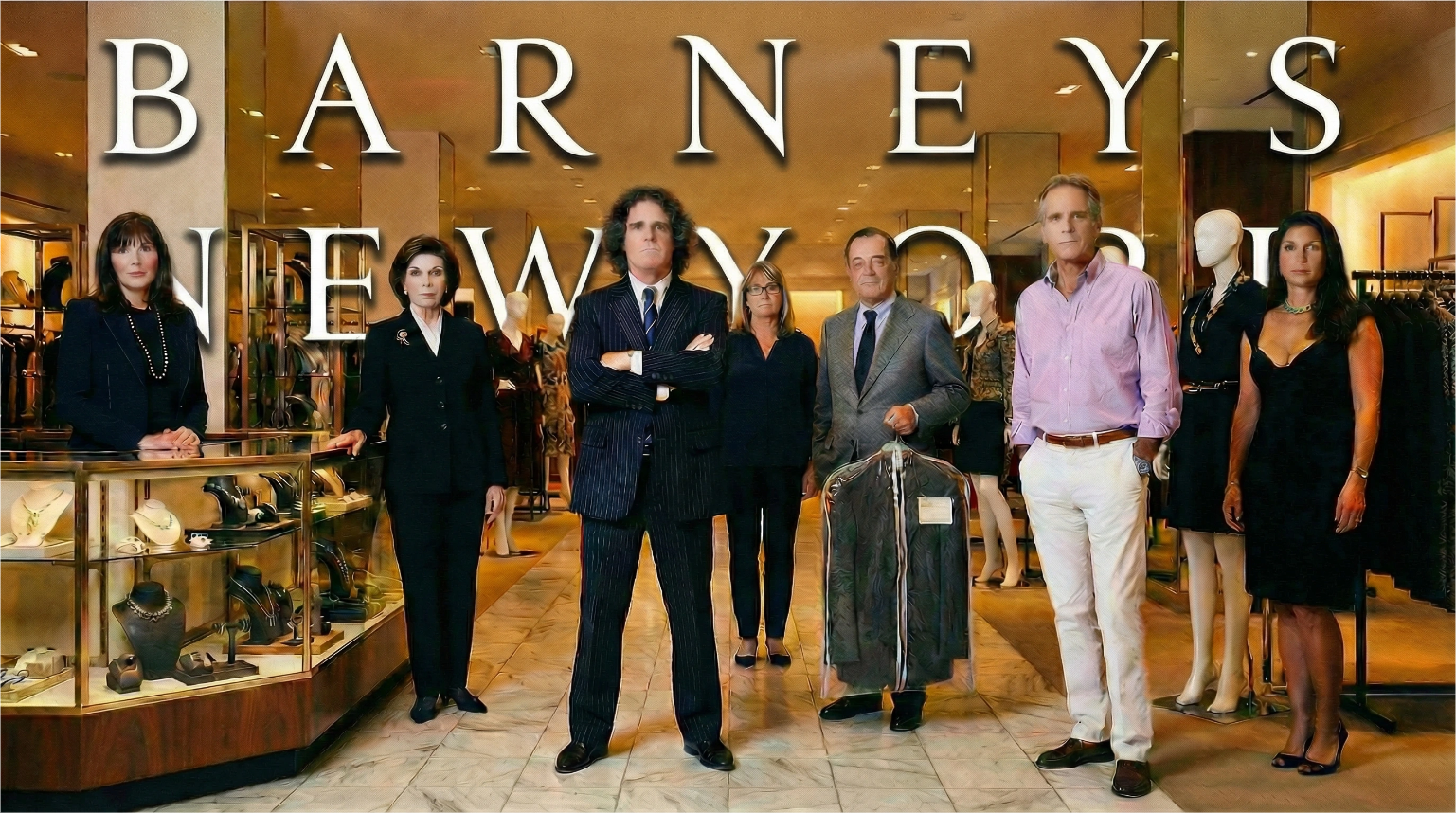
Chapter 1: The Madison Avenue Monument
The Pressman family - through their mammoth Barney’s fashion empire - sold the idea that Americans could dress like Europeans—if Americans were willing to pay European prices and accept European condescension about their taste.
At the height of this enterprise, the Madison Avenue flagship sprawled across two hundred thirty thousand square feet designed by Kohn Pedersen Fox and finished in goatskin and Carrara marble.
The store generated approximately one-third of total company revenue.
It was, as New York Times fashion critic Vanessa Friedman observed, unabashedly elitist, proudly exclusionary—you either got it or you didn’t.
The Pressmans got it so thoroughly that by 2004, Jones Apparel Group paid four hundred million dollars to acquire the company.
Three years later, Dubai’s Istithmar World paid eight hundred twenty-five million more.
Most proceeds flowed to Phyllis Pressman, the widow who had created Chelsea Passage and transformed the store’s visual identity with antiques she personally sourced from European markets.
When Phyllis died in April 2024 at ninety-five, her estate included a 2.3-acre Southampton oceanfront compound listed at thirty-eight million, an Upper East Side apartment valued at nearly four million, and a jewelry collection featuring Harry Winston diamonds, Van Cleef & Arpels pieces, a ten-carat pear-shaped diamond ring, and a rivière necklace holding approximately forty carats that Freeman’s auction house sold in September 2025.
Her husband Fred, who died of pancreatic cancer in 1996 at seventy-three, had been the architect of Barneys’ transformation from discount clothier to luxury destination.
Fred introduced Giorgio Armani to America in 1976, partnered with Givenchy, and turned a store that once sold roast beef sandwiches into a temple where ten thousand dollar jackets hung beside four hundred dollar distressed jeans.
The sons who inherited this temple—Gene and Bob—spent thirty years alternately expanding it and fighting over it.
The full accounting of how retail dynasties implode—the lawsuits, the sibling betrayals, the whistleblower revenge—fills our free Substack newsletter, where family businesses that looked invincible reveal the fractures that brought them down.
The Pressmans wrote the playbook.
In 1996, their Japanese partner Isetan sued the brothers for one hundred sixty-eight million dollars, alleging they had diverted funds into a family holding company called PREEN.
The sisters later sued brother Bob for nearly thirty million, claiming he used family money for a Greenwich estate.
Most recently, Bob—disinherited from his mother’s estate—filed a whistleblower lawsuit alleging the family evaded twenty million in New York taxes.
If proven, the family faces fifty million in penalties.
Bob stands to collect thirty percent.
Blood, it turns out, is not thicker than basis points.
The biannual warehouse sales once drew crowds that wrapped around city blocks.
In 1986, Barneys hosted an AIDS benefit featuring Madonna and Iman.
But debt from the Dubai acquisition—six hundred million loaded onto a company generating eight hundred million annually—proved fatal when the economy collapsed.
The man who started this dynasty had pawned a ring worth five hundred dollars, and his descendants leveraged themselves into oblivion chasing a vision he never would have recognized.
Chapter 2: The Ring and the Rag Trade
The Pressman surname tells the story before the story begins.
In Yiddish, “pres” means flat iron—the Pressmans were the people who pressed clothes.
Sixty-four percent of people carrying this name today have Ashkenazi Jewish ancestry.
Barney Pressman’s father owned a small clothing store, and Barney started working there as a boy, pressing pants for three cents each.
He was born December 14, 1894, on Elizabeth Street in the Lower East Side of Manhattan—the epicenter of Jewish immigrant life at the turn of the twentieth century.
He was one of seven children in a neighborhood that was dense, ambitious, and hungry.
It was also the center of the American garment industry, the “shmatte business” that provided the primary path to economic advancement for Eastern European Jewish immigrants.
The tenements on Elizabeth Street produced an extraordinary number of future retail pioneers.
Something about growing up surrounded by fabric and the constant hum of sewing machines created a generation who understood both product and customer.
Barney understood both.
By his late twenties, he had married Bertha—a woman whose faith in him would prove more valuable than any inventory.
In 1923, he saw an opportunity: a five-hundred-square-foot retail space at Seventh Avenue and 17th Street in Manhattan.
The lease cost five hundred dollars.
Barney did not have five hundred dollars.
Bertha did have an engagement ring.
The calculation was simple even if the sacrifice was not.
She handed it to him.
He pawned it.
He opened the store.
The business operated under a motto that defined its first four decades: No Bunk, No Junk, No Imitations.
The value proposition was straightforward—quality menswear at discounted prices, achieved by purchasing showroom samples, overstocks, and closeouts at auction and bankruptcy sales.
Barney proved an innovator in marketing, with “Calling All Men to Barney’s” radio spots that parodied the Dick Tracy radio show.
He sponsored Irish tenors to promote woolens.
He once chartered boats to transport two thousand customers from Manhattan to Coney Island.
By 1950, Barneys sold more suits than any single store in the world.
By 1973, the inventory included sixty thousand suits, and the store on Seventh Avenue had become a fixture for middle-class New York men seeking quality without premium pricing.
Barney ran the business until his son Fred took over in the 1960s.
He lived long enough to see the transformation he never would have attempted—the shift from discount house to luxury destination, from roast beef sandwiches to Perrier and light salads.
He died August 24, 1991, at ninety-six years old, his funeral held at Central Synagogue in Manhattan.
The store that started with a pawned engagement ring was by then generating hundreds of millions in revenue annually.
What replaced that ring—ambition, debt, expansion, and eventually litigation—would have confused the man who pressed pants for pennies on Elizabeth Street.
But that confusion came later, after his son decided Americans didn’t want discount suits anymore, and that the real money was in teaching them how to pronounce Givenchy.
Chapter Three: The Isetan Disaster
In nineteen eighty-nine, Gene and Bob Pressman formed a holding company with Isetan, one of Japan’s premier department stores, to operate stores in both countries.
The partnership called for approximately two hundred fifty million dollars in investment to acquire locations and open thirty new stores.
Isetan held majority interest in Japanese ventures while the Pressman family maintained majority control of U.S. operations.
The first Tokyo store opened in November nineteen ninety, spanning thirty thousand square feet—the largest standalone outlet affiliated with an American retailer in Japan at the time—projected to generate forty million dollars in first-year sales.
This expansion accelerated U.S. growth as well.
The nineteen ninety-three opening of the Madison Avenue flagship marked the pinnacle: two hundred thirty thousand square feet of Kohn Pedersen Fox-designed luxury retail that would become the company’s most important asset and, ultimately, its executioner.
Additional flagships opened in Chicago in nineteen ninety-three and Beverly Hills in nineteen ninety-four.
By the mid-nineteen nineties, Barneys had expanded from two stores to fifteen, creating significant fixed costs and operational complexity.
The aggressive expansion, financed heavily through the Isetan relationship, proved unsustainable.
Tensions emerged as rental payments and debt obligations mounted.
According to court filings, Barneys and Isetan disputed their agreement terms: Barneys claimed Isetan reneged on commitments to take an equity stake in exchange for cutting rental payments, while Isetan accused Barneys management of withholding critical financial information.
In late November nineteen ninety-five, Bob Pressman reportedly told Isetan officials that Barneys had been incurring significant losses on an operational basis for some time—contradicting years of quarterly reports showing profitability.
The disclosure shattered the relationship.
On January eleventh, nineteen ninety-six, Barneys filed for Chapter 11 bankruptcy protection, listing assets of three hundred eighty-one million dollars and liabilities of three hundred sixty-one million.
Isetan filed suit against Gene and Bob personally, seeking to recover approximately one hundred sixty-eight million dollars in short-term loans that Isetan claimed were personally guaranteed and now in default.
Isetan’s statement was brutal: The behavior exhibited by Barneys management up to this point is utterly unacceptable.
Gene and Bob blamed each other for the failure.
Bob’s sisters sued him for thirty million dollars after the bankruptcy, claiming he had stolen from the company.
Gene later accused Bob of running the business into the ground and failing in his responsibility for the company’s financial health.
Barneys emerged from bankruptcy in nineteen ninety-eight, but the family had fractured in ways that would never heal—and the debt that nearly killed them the first time was nothing compared to what was coming.
Chapter Four: The Dubai Catastrophe
Jones Apparel Group purchased Barneys in two thousand four for four hundred million dollars, ending eighty-one years of Pressman family ownership.
Barneys never aligned comfortably with Jones Apparel’s mainstream brand portfolio; the flagship locations catered to celebrities and executives seeking ten thousand dollar tailored suits while Jones focused on accessible fashion.
But Jones recognized Barneys’ value in the booming luxury market.
Sales at established locations increased ten percent in two thousand six, significantly exceeding industry averages.
Three years later, Jones sold to Istithmar World for eight hundred twenty-five million—more than doubling their investment.
The Dubai acquisition represented the apex of Barneys’ value.
It also loaded the company with between five hundred and six hundred sixty million dollars in debt—a structure designed to enable Dubai World to acquire Barneys without significant equity investment.
Retail analysts and credit rating agencies called the debt structure impossible and unsustainable.
The timing proved catastrophic.
Within eighteen months, the two thousand eight financial crisis struck, decimating demand for luxury goods as affluent consumers pulled back on discretionary spending.
Sales declined sharply precisely when Barneys needed revenue to service its massive debt load.
Then Dubai World itself imploded.
In November two thousand nine, Dubai World shocked global markets by announcing a standstill request on fifty-nine billion dollars in liabilities as the emirate’s property values collapsed.
The Dubai housing market fell forty percent in the first three months of two thousand nine—the steepest decline anywhere in the world.
The crisis left Istithmar unable to provide additional capital to support Barneys during the recession.
Standard and Poor’s downgraded Barneys’ credit rating from CCC to CC in February two thousand twelve, stating that its debt levels were unsustainable.
By this point, Barneys carried five hundred ninety million dollars in long-term debt against annual revenue approaching nine hundred million—a burden that strangled profitability and prevented investment in e-commerce.
In May two thousand twelve, Perry Capital—the hedge fund led by billionaire Richard Perry—orchestrated a debt-for-equity swap that reduced long-term debt from five hundred ninety million to fifty million dollars.
Perry took majority control.
Richard Perry once equated owning Barneys to owning the New York Yankees, signaling his emotional and financial commitment.
The restructuring gave Barneys breathing room, and the company returned to profitability with record sales—but critical years had been lost while competitors built digital empires, and the landlord of their most profitable location was already preparing demands that would prove fatal.
Chapter Five: The Rent That Killed an Empire
The existential threat emerged from the landlord of Barneys’ most profitable location.
Ashkenazy Acquisition Corporation owned the retail portion of 660 Madison Avenue, where the flagship generated approximately one-third of total company revenue.
The lease, originally signed in nineteen eighty-nine when department stores wielded pricing power, was set to expire in January two thousand nineteen.
When rent renegotiations reached arbitration, Barneys argued that rent should remain flat given deteriorating retail conditions and the contracting department store sector.
Ashkenazy initially demanded rent increase from sixteen million dollars annually to sixty million.
On August tenth, two thousand eighteen, an arbitrator ruled that Ashkenazy could raise the rent to thirty million annually—nearly double the previous rate.
With property taxes and other expenses, Barneys’ total annual obligation at Madison Avenue escalated to over forty-four million dollars.
One real estate analyst told the New York Post: Could they afford twenty-five million? Maybe. Could they afford thirty million? Probably not.
The rent crisis illuminated a structural disadvantage.
Unlike Saks Fifth Avenue, which owned its flagship location, Barneys owned no properties.
Every location was leased, leaving the company vulnerable to landlord demands with minimal negotiating leverage.
But deeper market forces had been eroding Barneys’ position for years.
The value proposition that made Barneys indispensable—exclusive access to curated European designers—had evaporated in the digital age.
Multi-brand luxury platforms like Farfetch, Net-a-Porter, and MatchesFashion offered comparable selection without requiring customers to travel to physical stores.
A shopper could find Dries van Noten or The Row with a Google search, eliminating the need for Barneys’ curation.
As retail consultant Eugene Rabkin explained: Customers now go to a shop not to browse but to buy a specific thing they saw someone else wear on Instagram. And they can buy it from many places online.
Luxury brands had also shifted strategies, opening their own boutiques that directly competed with Barneys.
Where Barneys introduced Armani to Americans in nineteen seventy-six, by two thousand nineteen Armani operated its own flagship stores worldwide, selling directly to consumers and capturing full retail margins rather than wholesale pricing.
As Rabkin observed: It’s A$AP Rocky and Billie Eilish who dictate purchasing decisions, not Barneys.
Instagram influencers and celebrities had replaced department store buyers as arbiters of fashion, and the company that built its reputation on discovering what was next found itself irrelevant to the generation that decided such things on their phones.
Chapter Six: One Last Goodbye
On August sixth, two thousand nineteen, Barneys filed for Chapter 11 bankruptcy for the second time, listing two hundred million dollars in funded debt against eight hundred million in annual revenue.
The company owed more than five thousand creditors.
The filing revealed how deeply the luxury fashion world had invested in Barneys.
The Row was owed three million seven hundred thousand dollars.
Celine was owed two million seven hundred thousand.
Saint Laurent, two million two hundred thousand.
Balenciaga, two million one hundred thousand.
Gucci, Prada, Givenchy, Christian Louboutin, Manolo Blahnik—all owed millions they would likely never recover.
Vendors had become increasingly anxious in the months preceding bankruptcy, with some withholding shipments or demanding cash on delivery as Barneys fell behind on payments.
Maintenance contractors suspended work at the Madison Avenue flagship due to more than five hundred thousand dollars in unpaid bills, resulting in uncleaned bathrooms and unremoved trash in the weeks before filing.
On October twenty-fourth, two thousand nineteen, a bankruptcy court approved the sale of Barneys to Authentic Brands Group for two hundred seventy-one million dollars.
No competing bids materialized.
The purchase price was insufficient to cover even a fraction of what was owed to vendors.
Distressed debt expert Adam Stein-Sapir explained that vendors would likely receive nothing for merchandise present in stores at the time of filing.
On February twenty-third, two thousand twenty, all remaining Barneys stores permanently closed.
In New York alone, seven hundred nineteen employees lost their jobs at the Madison Avenue flagship, Chelsea store, Woodbury Common outlet, and corporate headquarters.
The final weeks displayed bright orange and yellow signs: Nothing held back. One last buy, one last goodbye: ninety percent off lowest ticketed price.
The Pressman family’s story did not conclude cleanly.
In July two thousand twenty-five, Bob Pressman filed a lawsuit alleging that his late mother Phyllis and siblings Gene, Elizabeth, and Nancy orchestrated a scheme to evade more than twenty million dollars in New York state income and estate taxes.
Bob claimed Phyllis falsely declared Florida residency while actually living in her thirty-eight million dollar oceanfront mansion in Southampton for the last six years of her life.
According to the lawsuit, Phyllis openly expressed her dislike for Florida and had no intention of making it her permanent home.
Phyllis died in two thousand twenty-four at age ninety-five, leaving an estate valued at more than one hundred million dollars, including a three million nine hundred fifty thousand dollar Upper East Side apartment and jewelry from Bulgari and Harry Winston.
Bob was completely disinherited.
The will stated: Bob doesn’t get anything for reasons he well knows.
As a whistleblower, Bob could potentially receive up to thirty percent of any recovery—estimated at more than fifty million dollars including penalties.
Bob was reportedly writing a tell-all manuscript exposing family affairs that caused Barneys’ demise, though the book has not been released.
Gene characterized the family dynamic: Bob conveniently overlooks that he was the co-CEO responsible for the company’s financial health, a position in which he failed miserably.
The dynasty that began with a pawned engagement ring ended in litigation over tax fraud and a will that erased one son entirely.
The Barneys brand now exists as licensed shops within Saks stores and luxury condominiums in Tulum, Mexico.
The curated voice that made it matter—the risk-taking, the irreverence, the discoveries—cannot be licensed or manufactured.
A man pawned his wife’s ring in nineteen twenty-three to open a discount suit shop.
His son transformed it into a tastemaker.
His grandsons expanded it into an empire worth nine hundred thirty-seven million dollars.
Then they destroyed it through debt, lost it to Dubai, watched it collapse twice, and sued each other over the remains.
The dynasty collapsed twice.
It will not rise a third time.


