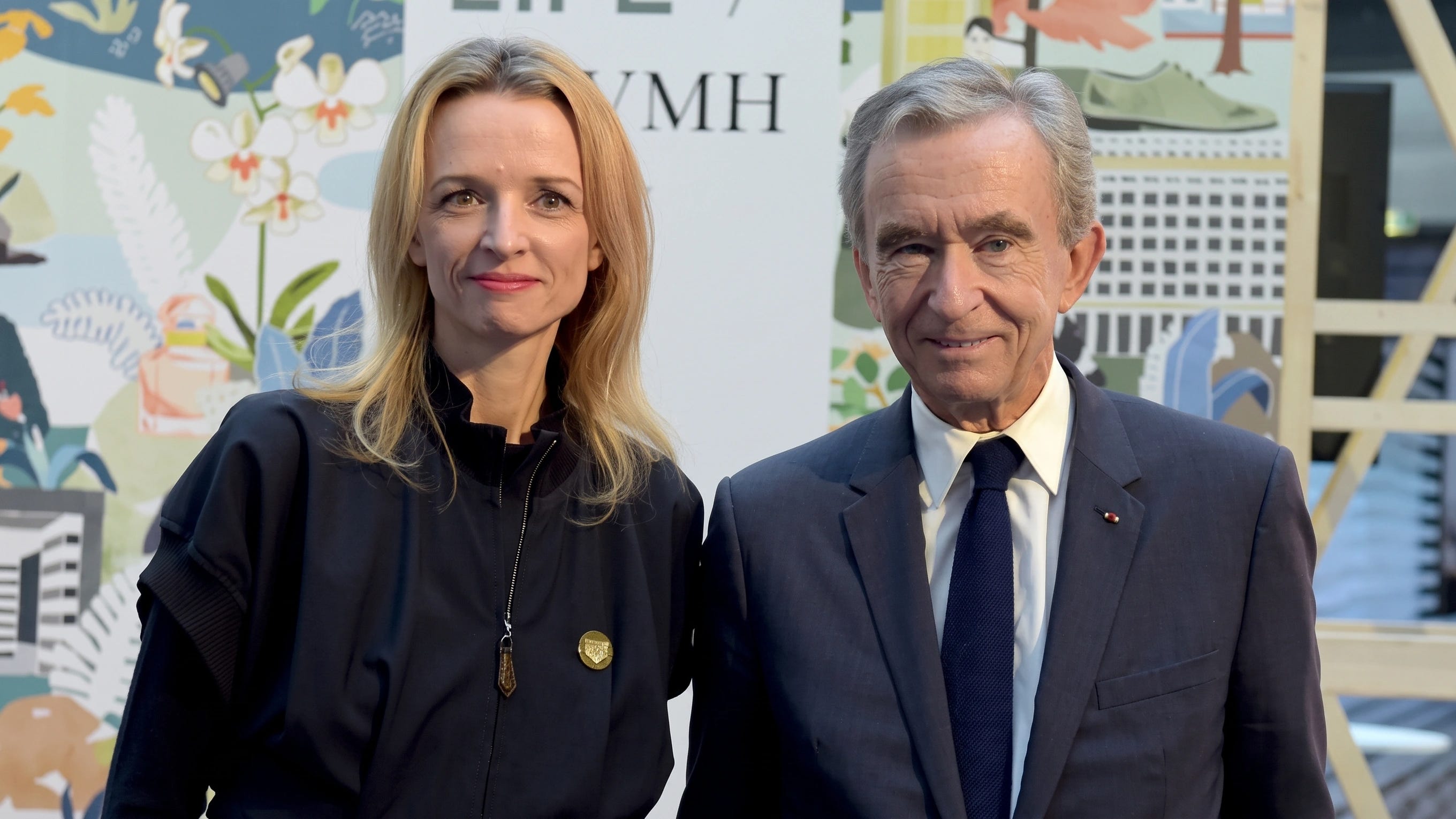
One family with the equivalent of $330 billion in market capitalization.
Indeed - for three decades - Bernard Arnault had methodically built LVMH into luxury’s greatest empire, transforming a modest French textiles company into a conglomerate controlling over 75 prestigious maisons from Louis Vuitton to Tiffany and Co.
And the family’s code was simple - every Arnault child starts from the ground up, learning every facet of luxury from the shop floor to the boardroom, earning their place in fashion’s most powerful dynasty.
But in 2024, a new chapter was being written – as Delphine Arnault, the eldest child and only daughter, ascended to unprecedented heights in the luxury world, setting the stage for what could become the largest wealth transfer in business history.
In today’s episode, we’ll share the full story of luxury’s most powerful heiress, as we explore Delphine Arnault’s rise to become -
The Future Queen of Global Luxury
CHAPTER 1: FROM SILK TO STEEL
The city is Paris, France, and the year is 2024, and while many billionaire heirs chase headlines, one woman was quietly mastering an empire.
In a pristine office overlooking Avenue Montaigne, Delphine Arnault sits at her desk, reviewing the latest collections from Christian Dior, where she’s just been appointed CEO.
At 48, she’s already achieved more than most executives dream of in a lifetime – including transforming Louis Vuitton’s ready-to-wear division and discovering some of fashion’s brightest stars.
But in the Arnault family, excellence is the minimum expectation.
Since 1984, when Bernard Arnault acquired a controlling stake in the troubled textile company Boussac (which owned Christian Dior), the family has lived by one rule: luxury demands perfection.
They measure success not in quarters but in generations – the time it takes to build true luxury brands that stand the test of time.
And the LVMH headquarters at 22 Avenue Montaigne represents far more than just another corporate office - it stands as the nerve center of a luxury empire that has systematically redefined the industry.
From this command post, Bernard Arnault has orchestrated the acquisitions that would transform a modest French textiles business into a global powerhouse controlling over 75 luxury houses.
The portfolio now ranges from historic champagne houses like Moët and Chandon to cutting-edge fashion brands like Fendi, each positioned precisely in its market segment.
But, this empire wasn’t built by chance.
Bernard Arnault’s earliest moves in luxury – acquiring Boussac for a single franc and then methodically restructuring it – established a template for value creation that would be repeated dozens of times.
Each acquisition follows a careful strategy: identify prestigious brands with strong heritage, acquire control through complex financial maneuvers, install world-class management, and relentlessly enhance the brand’s exclusivity.
For Delphine, growing up in this environment meant absorbing lessons in both luxury and power from an early age.
And, while other children visited playgrounds, she accompanied her father to store openings and fashion shows.
Thus, her education wasn’t just in classrooms at École Active Bilingue and EDHEC Business School – it was in watching her father transform troubled heritage brands into global powerhouses.
Thus, the LVMH growth story has become intertwined with her own development.
As she completed her studies at the London School of Economics, the group was acquiring brands like Fendi and Bulgari. While she was learning the business at Louis Vuitton, LVMH was expanding into new luxury categories.
Indeed, each step of her career parallels a new phase in the group’s evolution.
Therefore, by 2024, LVMH has become more than just the world’s largest luxury group – it has become a dynasty in waiting.
The question isn’t just who would succeed Bernard Arnault, but who could possibly match his legendary business acumen.
The answer is perhaps closer than anyone has realized, shaped by the very principles that built the empire - and the next phase of her journey will reveal just how much of the “Wolf in Cashmere’s” instincts she has inherited.
CHAPTER 2: THE QUIET FORCE IN SILK SLIPPERS
Unlike the flashy displays of many luxury heirs, Delphine Arnault’s rise was marked by quiet competence and strategic precision.
Her early career choice to start at McKinsey & Company in the late 1990s raised eyebrows – why would the heiress to luxury’s greatest fortune need outside experience?
But this was exactly what set her apart.
The decision to begin at McKinsey wasn’t just about gaining experience; it was about legitimacy.
For two years, she consulted for global retail and consumer companies, developing an understanding of business transformation that would prove invaluable.
Her projects included analyzing retail strategies for international brands and studying emerging market opportunities – experience that would later shape LVMH’s global expansion.
Her father, Bernard Arnault, known as the “Wolf in Cashmere” for his shrewd business acumen, had designed a succession plan that would test each of his children.
The strategy was methodical: each Arnault heir would prove themselves in different sectors of the luxury business.
Antoine would eventually head up communications and cut his teeth at Berluti. Alexandre would take the reins at Tiffany and Co., bringing fresh energy to the American jeweler.
Frédéric would prove himself in watchmaking at TAG Heuer.
But Delphine’s path was distinct – she was being groomed not just to lead a brand, but to eventually oversee the entire empire.
In 2001, she made her official entry into the family business, joining Christian Dior Couture.
Her appointment to the LVMH board in 2003 marked her as the first of Bernard’s children to take on group-level responsibilities.
Then, from 2008 to 2013, she served as Deputy General Manager at Christian Dior Couture, a position that required both creative vision and commercial acumen.
The year 2013 marked a pivotal moment in her career trajectory, as she was appointed Executive Vice President of Louis Vuitton, overseeing all product-related activities.
In this role, she played a crucial role in the appointment of Nicolas Ghesquière as creative director, a decision that would reinvigorate the brand’s fashion credentials while maintaining its commercial success.
The move demonstrated her inheritance of her father’s key strength: the ability to balance creativity with commerce.
While her brothers focused on specific brands within the portfolio, Delphine’s responsibilities increasingly touched the strategic direction of the entire group.
Her position on the board of Christian Dior SE – the holding company through which the Arnault family controls LVMH – further cemented her position in the power structure.
The carefully orchestrated succession plan revealed Bernard Arnault’s strategic brilliance.
Rather than simply anointing an heir, he created a system where each child would develop specific expertise while competing to prove their capabilities.
This approach ensured that the next generation of leadership would be based not just on birthright, but on demonstrated ability.
But Delphine’s progression suggested something more.
While her brothers excelled in their respective domains, she alone was developing the broad, group-wide perspective that would be necessary to lead the entire organization.
Her understanding of both the creative and commercial aspects of luxury, combined with her experience across multiple brands, created a unique qualification for ultimate leadership.
Throughout her career progression, she demonstrated a keen ability to identify and nurture creative talent while maintaining the commercial discipline that had made LVMH successful.
Under her watch at Louis Vuitton, she oversaw collaborations that would redefine luxury for a new generation, while maintaining the brand’s historic commitment to quality and craftsmanship.
As 2024 approached, the luxury industry watched closely as Bernard Arnault’s master plan continued to unfold.
The next step in the saga would require more than just operational excellence – it would demand the kind of visionary leadership that had transformed LVMH from a troubled textile company into luxury’s greatest empire.
CHAPTER 3: THE KINGMAKER’S DAUGHTER
Under Delphine Arnault’s guidance, LVMH’s approach to creative talent became increasingly systematic and forward-looking.
She developed what industry insiders called “The Arnault Eye” – an ability to spot not just creative genius, but commercially viable creative genius, a crucial distinction in luxury that had been her father’s hallmark in acquiring brands.
Her talent-spotting prowess gained significant industry attention through the LVMH Prize for Young Fashion Designers, which she launched in 2014.
The initiative, offering four hundred thousand euros and a year of mentorship to emerging designers, would become luxury’s most prestigious fashion award.
Winners and finalists included names that would reshape the industry: Simon Porte Jacquemus, Marine Serre, and Grace Wales Bonner.
The prize demonstrated her understanding that luxury’s future depended on nurturing new creative voices while maintaining the group’s exacting standards.
At Louis Vuitton, where she served as Executive Vice President, she worked alongside the management team during a crucial period of creative transition.
The 2013 appointment of Nicholas Ghesquière as creative director following Marc Jacobs’ departure marked a new era for the brand.
Under this new creative direction, Louis Vuitton’s fashion category continued to thrive while maintaining its position as LVMH’s most profitable maison.
Her tenure at Louis Vuitton coincided with several successful initiatives, including the memorable 2023 collaboration with artist Yayoi Kusama, which demonstrated the brand’s ability to create cultural moments that resonated globally.
During her time as Executive Vice President overseeing product-related activities, Louis Vuitton continued to balance its heritage with contemporary relevance, a crucial skill in modern luxury.
The parallel with her father’s business strategy was clear. Just as Bernard Arnault had mastered the art of acquiring and transforming luxury houses, Delphine demonstrated expertise in understanding how creative talent could drive commercial success.
This ability to balance creativity with commerce – the fundamental challenge in luxury – showed she had inherited her father’s most valuable skill.
Through the LVMH Prize and her executive roles, she built a network of relationships with emerging designers and creative leaders that would prove invaluable to the group’s future.
This network became a crucial asset for LVMH, providing early access to emerging talent and trends that would shape luxury’s future.
The management of creative talent at LVMH’s scale presented unique challenges.
With over 75 maisons in the portfolio, each requiring its own creative direction while maintaining group standards, the ability to identify and manage creative talent became increasingly crucial.
Delphine’s success in this arena demonstrated she understood something fundamental about modern luxury: that the creative and commercial sides of the business couldn’t be separated – they had to be integrated at every level.
Under her influence at Louis Vuitton, the brand successfully navigated the digital transformation of luxury, maintaining its exclusivity while embracing new forms of customer engagement.
Her understanding of both traditional luxury values and contemporary consumer behavior proved particularly valuable as the industry faced unprecedented changes in how luxury products were marketed and sold.
By 2023, her contribution to LVMH’s creative direction was clear.
Her work with the LVMH Prize had helped establish the group as a nurturing force for new talent, while her executive experience demonstrated an ability to manage luxury’s delicate balance between innovation and tradition.
The maisons she worked with successfully maintained their heritage while evolving for a new generation of luxury consumers.
But identifying and nurturing creative talent was just one aspect of running a luxury empire.
CHAPTER 4: ASCENDING THE CRYSTAL STAIRS
January 2023 marked a pivotal moment in luxury history.
At age 47, Delphine Arnault’s appointment as CEO of Christian Dior wasn’t just another corporate move – it represented a strategic repositioning at the very heart of luxury’s most powerful empire.
The announcement sent ripples through the industry.
Pietro Beccari, Dior’s CEO since 2018, would move to head Louis Vuitton, while Delphine would take the helm of the maison that had launched her father’s luxury empire.
The choreography of these movements revealed the careful planning behind LVMH’s executive decisions – each step calculated to strengthen the group’s most valuable brands.
The significance of Dior in the Arnault empire cannot be overstated.
When Bernard Arnault acquired Boussac in 1984, Christian Dior was the crown jewel that sparked his luxury ambitions. Since then, Dior had grown to become one of the group’s most prestigious brands, with significant growth under Beccari’s leadership through retail expansion and digital innovation.
But Dior’s importance extends beyond its commercial success. Christian Dior SE serves as the holding company through which the Arnault family maintains control of LVMH.
This complex ownership structure means that leadership at Dior carries particular weight within the group’s power dynamics. By placing his eldest child at its helm, Bernard Arnault was making a clear statement about succession planning.
The timing of the appointment coincided with a period of significant momentum for Dior.
The brand had successfully navigated the challenges of the global pandemic, emerging stronger with expanded digital capabilities and a reinforced connection to younger luxury consumers.
Under Beccari’s leadership, Dior had achieved remarkable growth through strategic retail expansion and successful product launches.
Delphine Arnault’s arrival at Dior came with specific challenges. The brand had achieved strong momentum, with successful launches in both fashion and beauty, and maintaining this trajectory would require both strategic vision and operational excellence.
Her experience overseeing product-related activities at Louis Vuitton provided relevant expertise for this new role.
The appointment also marked a return to Delphine’s professional roots. She had previously served as Deputy General Manager at Christian Dior Couture from 2008 to 2013, giving her deep familiarity with the brand’s operations and culture.
This experience, combined with her decade at Louis Vuitton, positioned her uniquely to understand both Dior’s heritage and its future potential.
In the broader context of luxury industry leadership, Delphine’s appointment as Dior CEO represented a significant milestone.
While women had historically played crucial creative roles in luxury fashion, the business leadership of major luxury houses remained predominantly male.
Her elevation to one of luxury’s most prestigious CEO positions highlighted the industry’s gradual evolution.
The move also demonstrated Bernard Arnault’s continued strategic acumen.
By placing his eldest child at the helm of Dior while moving Beccari to Louis Vuitton, he ensured that LVMH’s two largest fashion brands would be led by executives with proven track records and deep understanding of the group’s culture.
Industry observers noted that the appointment represented more than just a career progression – it was a crucial test of leadership at the highest level of luxury.
Success at Dior would require not just maintaining the brand’s growth trajectory but also navigating the increasingly complex landscape of global luxury, from digital transformation to changing consumer values.
As her tenure at Dior began in February 2023, the luxury industry watched closely.
Delphine Arnault’s performance at Dior would not just determine the future of one of luxury’s most storied brands – it would likely influence the future leadership of the entire LVMH empire.
CHAPTER 5: THE NEXT EMPRESS OF LUXURY
Today, as Delphine Arnault guides Christian Dior into a new era, she stands at a crucial juncture in luxury’s history.
The empire her father built represents the world’s largest luxury conglomerate, with LVMH’s market capitalization exceeding three hundred thirty billion dollars – monetarily demonstrating Bernard Arnault’s vision of luxury as both art and industry.
The challenges facing luxury’s next generation of leadership are fundamentally different from those her father confronted in the 1980s.
While Bernard Arnault mastered the art of acquiring and transforming heritage brands, today’s luxury landscape demands new skills.
Digital transformation, sustainability concerns, and evolving consumer values are reshaping how luxury brands connect with their audiences.
The Arnault succession strategy has become increasingly clear through careful positioning of the next generation.
Each of Bernard’s children has taken on specific responsibilities within the empire: Antoine as CEO of Christian Dior SE and head of image and communications for LVMH; Alexandre at the helm of Tiffany & Co.; Frédéric leading TAG Heuer; and Jean at Louis Vuitton watches.
Yet Delphine’s position at Christian Dior Couture – the brand that started it all – carries particular symbolic and strategic weight.
Bernard Arnault’s approach to succession reflects his broader business philosophy: testing and proving capabilities at every level.
The family maintains control through a complex structure of holding companies, with Christian Dior SE at the center.
This arrangement ensures that family control will persist even as professional managers run individual brands – a balance between family ownership and professional management that has become a hallmark of the LVMH model.
The luxury industry itself stands at a crossroads.
Traditional luxury values of craftsmanship and exclusivity must now coexist with demands for transparency, sustainability, and digital engagement. LVMH’s future leadership will need to navigate these changes while maintaining the group’s reputation for excellence across its portfolio of more than 75 prestigious maisons.
Within this context, Delphine Arnault’s experience bridges crucial worlds, though the question facing LVMH isn’t just about who will eventually succeed Bernard Arnault – it’s about how luxury itself will evolve in the coming decades.
The industry’s transformation requires leaders who can balance heritage with innovation, exclusivity with accessibility, tradition with progress.
Thus, as Delphine Arnault leads Christian Dior, she carries not just the responsibility of managing one of luxury’s most prestigious brands, but also the potential to shape the future of the entire luxury industry.
And the empire her father built now stands at the dawn of a new era.
The challenges ahead – from digital transformation to changing consumer values – will require both preservation and innovation.


